


Madrid is famed worldwide for its wild nightlife — but locals say recession, unemployment and a higher sales tax are changing partying habits in the Spanish capital.
“There’s no denying the crisis. It affects the whole country, and Madrid’s bars and nightclubs are no exception,” said Dani Marin, joint owner of Costello, one of the city center’s hundreds of drinking establishments.
On a Friday night around Christmas, its basement throbs with live rock music, while upstairs drinkers chat leaning on the bar to the mellower rhythms of a DJ.

Warning: Excessive consumption of alcohol can damage your health
Photo: AFP
It is a typical bar scene in a country devoted to partying out on the town — but people in the business say Spaniards are spending less on that pastime.
“Consumption has fallen a lot,” Marin said. “Sometimes the bar still gets as busy and lively as it was six years ago, but overall, our revenues are down by about half.”
After the death of longtime Spanish dictator Francisco Franco in 1975, the Spanish capital responded to the country’s newfound freedom with an explosion in creativity in theater, music and nightlife dubbed La Movida Madrilena, which loosely translates as “the Madrid scene.”
However, times have changed. The economic crisis that erupted in 2008 due to the collapse of a decade-long property bubble altered things.
“Madrid used to be a city like Berlin or London are now, full of opportunities. It used to have more on offer,” said one bar-goer, Juan Canadas, strolling in Madrid’s trendy Malasana district. “It has lost a bit of its magic.”
The crisis drove up unemployment to a current rate of 24 percent and prompted tough economic austerity measures by the conservative government.
These included raising sales tax from eight to 21 percent in 2012, which has cramped consumption.
“I love Madrid. At our age, you find everything you want,” said another festive local, Quiara Lopez, a student of 20, out for a night on the town with a friend. “You have all kinds of places to go and you can do what you want, but you have to watch what you spend.”
With 75,000 people working in them, Madrid’s bars, casinos, theaters, restaurants and nightclubs are crucial for the region.
They generate up to 7.5 billion euros (US$9.1 billion) in revenues a year, about 4.7 percent of the region’s economy, according to some estimates.
The decline in nightlife has erased nearly 1 percentage point from the region’s output, said Vicente Pizcueta, spokesman for a Madrid leisure business association.
The drop in business is striking.
“Thursday used to be like part of the weekend,” with the bars packed, Marin said. “Now it is just another day of the week. That is the most remarkable change we have seen.”
Madrid city hall says it is working to support restaurants and bars, which it says are two of its main tourist draws.
With fewer drinkers coming out to play, bar owners are adapting to survive.
“We have been reinventing ourselves, doing all sorts of things,” German Hughes, manager of the La Palma cafe, which has been open for 20 years. “We used to have three concerts here a week. Now we have five, plus two book launches and a play. We are putting on more activities so that people have more incentives to come.”
After six hard years, figures suggest that consumer spending is slowly taking off again in Spain. As the economy gradually heats back up, bar owners hope this city’s nightlife will do the same.
“Madrid has changed enormously since the Movida, but we who work in nightlife are continuing to fight,” Hughes said. “We continue to believe that like everything in life, this is part of a cycle that soon will turn better.”
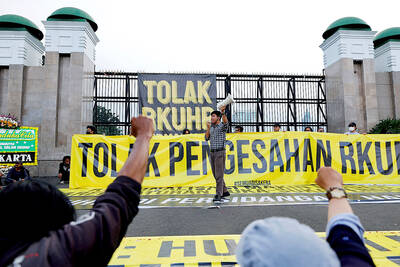
Indonesia yesterday began enforcing its newly ratified penal code, replacing a Dutch-era criminal law that had governed the country for more than 80 years and marking a major shift in its legal landscape. Since proclaiming independence in 1945, the Southeast Asian country had continued to operate under a colonial framework widely criticized as outdated and misaligned with Indonesia’s social values. Efforts to revise the code stalled for decades as lawmakers debated how to balance human rights, religious norms and local traditions in the world’s most populous Muslim-majority nation. The 345-page Indonesian Penal Code, known as the KUHP, was passed in 2022. It
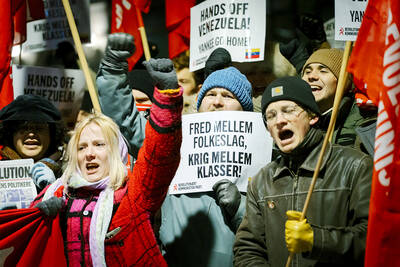
‘DISRESPECTFUL’: Katie Miller, the wife of Trump’s most influential adviser, drew ire by posting an image of Greenland in the colors of the US flag, captioning it ‘SOON’ US President Donald Trump on Sunday doubled down on his claim that Greenland should become part of the US, despite calls by the Danish prime minister to stop “threatening” the territory. Washington’s military intervention in Venezuela has reignited fears for Greenland, which Trump has repeatedly said he wants to annex, given its strategic location in the arctic. While aboard Air Force One en route to Washington, Trump reiterated the goal. “We need Greenland from the standpoint of national security, and Denmark is not going to be able to do it,” he said in response to a reporter’s question. “We’ll worry about Greenland in
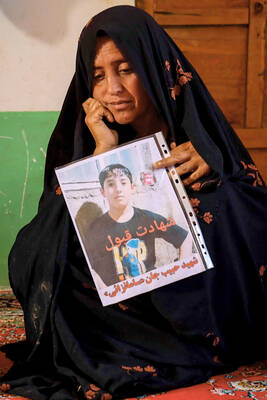
PERILOUS JOURNEY: Over just a matter of days last month, about 1,600 Afghans who were at risk of perishing due to the cold weather were rescued in the mountains Habibullah set off from his home in western Afghanistan determined to find work in Iran, only for the 15-year-old to freeze to death while walking across the mountainous frontier. “He was forced to go, to bring food for the family,” his mother, Mah Jan, said at her mud home in Ghunjan village. “We have no food to eat, we have no clothes to wear. The house in which I live has no electricity, no water. I have no proper window, nothing to burn for heating,” she added, clutching a photograph of her son. Habibullah was one of at least 18 migrants who died
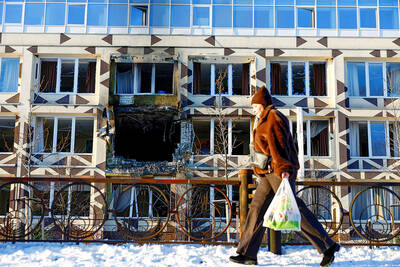
Russia early yesterday bombarded Ukraine, killing two people in the Kyiv region, authorities said on the eve of a diplomatic summit in France. A nationwide siren was issued just after midnight, while Ukraine’s military said air defenses were operating in several places. In the capital, a private medical facility caught fire as a result of the Russian strikes, killing one person and wounding three others, the State Emergency Service of Kyiv said. It released images of rescuers removing people on stretchers from a gutted building. Another pre-dawn attack on the neighboring city of Fastiv killed one man in his 70s, Kyiv Governor Mykola


 RSS
RSS