


HSBC, Europe’s biggest bank, said yesterday that pre-tax profits during the third quarter were “significantly ahead” compared with the equivalent period a year earlier.
In a trading update that did not provide figures, HSBC also said that its expenses linked to loan defaults fell to their lowest quarterly level in more than a year.
“Pre-tax profit for the third quarter of 2009 was significantly ahead of the third quarter 2008,” HSBC said in a statement.
“Driven by stabilized credit performance in the US, loan impairment charges have fallen to their lowest quarterly level for over a year,” chief executive Michael Geoghegan added
Meanwhile, Barclays yesterday reported sharp falls for third-quarter net profits as the British banking group’s bad debts soared.
Barclays said in a statement that profit after tax slumped 54 percent to £1.075 billion (US$1.79 billion) in the three months to Sept. 30 compared with the outcome for the third quarter of last year.
Net profits slumped 29 percent to £2.73 billion in the first nine months of the year.
Shrugging off the falls in profit, Barclays chief executive John Varley said the group had “maintained strong income momentum in the third quarter,” particularly at its investment banking arm Barclays Capital.
In Switzerland, Julius Baer said yesterday that its client assets grew 22 percent to 234 billion Swiss francs (US$232 million) by the end of last month compared with the end of last year amid a recovery in the financial markets.
“The continued recovery of most investment categories until recently resulted in a positive market performance, while the currency impact remained neutral overall,” the Swiss private bank said in a 10-month interim statement.

The nation’s fastest supercomputer, Nano 4 (晶創26), is scheduled to be launched in the third quarter, and would be used to train large language models in finance and national defense sectors, the National Center for High-Performance Computing (NCHC) said. The supercomputer, which would operate at about 86.05 petaflops, is being tested at a new cloud computing center in the Southern Taiwan Science Park in Tainan. The exterior of the server cabinet features chip circuitry patterns overlaid with a map of Taiwan, highlighting the nation’s central position in the semiconductor industry. The center also houses Taiwania 2, Taiwania 3, Forerunner 1 and
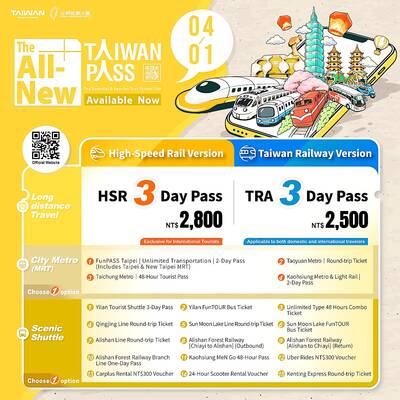
MORE POPULAR: Taiwan Pass sales increased by 59 percent during the first quarter compared with the same period last year, the Tourism Administration said The Tourism Administration yesterday said that it has streamlined the Taiwan Pass, with two versions available for purchase beginning today. The tourism agency has made the pass available to international tourists since 2024, allowing them to access the high-speed rail, Taiwan Railway Corp services, four MRT systems and four Taiwan Tourist Shuttles. Previously, five types of Taiwan Pass were available, but some tourists have said that the offerings were too complicated. The agency said only two types of Taiwan Pass would be available, starting from a three-day pass with the high-speed rail and a three-day pass with Taiwan Railway Corp. The former costs NT$2,800
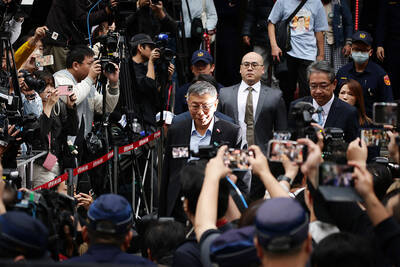
FIRST TRIAL: Ko’s lawyers sought reduced bail and other concessions, as did other defendants, but the bail judge denied their requests, citing the severity of the sentences Former Taipei mayor Ko Wen-je (柯文哲) was yesterday sentenced to 17 years in prison and had his civil rights suspended for six years over corruption, embezzlement and other charges. Taipei prosecutors in December last year asked the Taipei District Court for a combined 28-year, six-month sentence for the four cases against Ko, who founded the Taiwan People’s Party (TPP). The cases were linked to the Core Pacific City (京華城購物中心) redevelopment project and the mismanagement of political donations. Other defendants convicted on separate charges included Chinese Nationalist Party (KMT) Taipei City Councilor Angela Ying (應曉薇), who was handed a 15-year, six-month sentence; Core Pacific
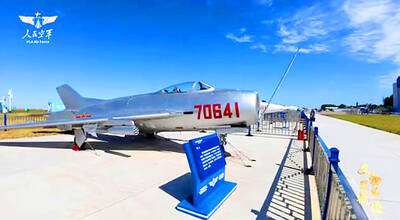
J-6 REMODEL: The converted drones are part of Beijing’s expanding mix of airpower weapons, including bombers with stand-off missiles and UAV swarms, the report said China has stationed obsolete supersonic fighters converted to attack drones at six air bases close to the Taiwan Strait, a report published this month by the Arlington, Virginia-based Mitchell Institute for Aerospace Studies said. Satellite imagery of the airfields from the institute’s “China Airpower Tracker” shows what appear to be lines of stubby, swept-winged aircraft matching the shape of J-6 fighters that first flew with the Chinese People’s Liberation Army (PLA) Air Force in the 1960s. Since their conversion to drones, the aircraft have been identified at five bases in China’s Fujian Province and one in Guangdong Province, the report said. J.


 RSS
RSS