


European stocks fell for the first time in three weeks as the region’s economy shrank at the fastest pace in at least 13 years and Natixis SA and KBC Groep NV posted weaker-than-anticipated earnings.
Natixis and KBC led a retreat by banks, slumping more than 25 percent after posting quarterly losses. Land Securities Group PLC paced a decline among real-estate companies as it reported a record annual loss. HeidelbergCement AG tumbled 24 percent on speculation a debt-refinancing plan for the German cement maker is progressing too slowly.
The Dow Jones STOXX 600 Index lost 3.2 percent to 202.92 this week, the largest decline since the first week of March. Optimism that the global economy is recovering sent the gauge to the highest level since January last week and pushed valuations to a five-year high of 21.4 times the profits of its companies.
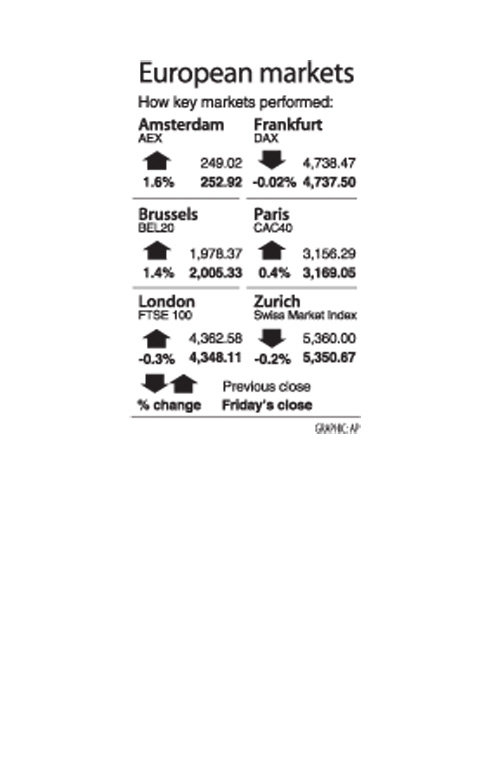
“The rally was on the back of some signs that the economic situation was stabilizing, reasonably cheap valuations and some short covering,” said Chirin Gill, a London-based fund manager at Daiwa SB Investments, which oversees US$60 billion. “We’ve seen some weakness this week on the back of some profit taking and worries that the economic recovery may not be as painless as the market is pricing in.”
National benchmark indexes fell in all of the 18 western European markets except Iceland. The UK’s FTSE 100 dropped 2.6 percent, paced by a slide in Rio Tinto Group and Lonmin PLC. France’s CAC 40 lost 4.3 percent and Germany’s DAX slid 3.6 percent.
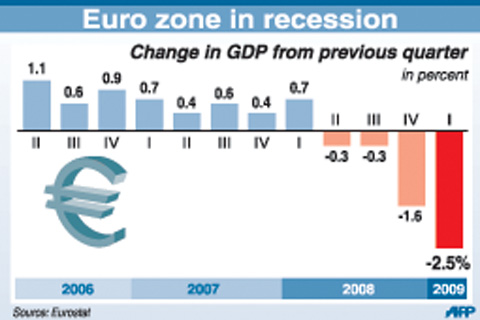
Europe’s economy contracted 2.5 percent in the first quarter from the previous period as companies cut output and jobs to survive the worst global slump in more than six decades, according to the EU’s statistics office in Luxembourg.
The Bank of England this week said the UK economy faced a slow recovery.

The nation’s fastest supercomputer, Nano 4 (晶創26), is scheduled to be launched in the third quarter, and would be used to train large language models in finance and national defense sectors, the National Center for High-Performance Computing (NCHC) said. The supercomputer, which would operate at about 86.05 petaflops, is being tested at a new cloud computing center in the Southern Taiwan Science Park in Tainan. The exterior of the server cabinet features chip circuitry patterns overlaid with a map of Taiwan, highlighting the nation’s central position in the semiconductor industry. The center also houses Taiwania 2, Taiwania 3, Forerunner 1 and

FIRST TRIAL: Ko’s lawyers sought reduced bail and other concessions, as did other defendants, but the bail judge denied their requests, citing the severity of the sentences Former Taipei mayor Ko Wen-je (柯文哲) was yesterday sentenced to 17 years in prison and had his civil rights suspended for six years over corruption, embezzlement and other charges. Taipei prosecutors in December last year asked the Taipei District Court for a combined 28-year, six-month sentence for the four cases against Ko, who founded the Taiwan People’s Party (TPP). The cases were linked to the Core Pacific City (京華城購物中心) redevelopment project and the mismanagement of political donations. Other defendants convicted on separate charges included Chinese Nationalist Party (KMT) Taipei City Councilor Angela Ying (應曉薇), who was handed a 15-year, six-month sentence; Core Pacific

J-6 REMODEL: The converted drones are part of Beijing’s expanding mix of airpower weapons, including bombers with stand-off missiles and UAV swarms, the report said China has stationed obsolete supersonic fighters converted to attack drones at six air bases close to the Taiwan Strait, a report published this month by the Arlington, Virginia-based Mitchell Institute for Aerospace Studies said. Satellite imagery of the airfields from the institute’s “China Airpower Tracker” shows what appear to be lines of stubby, swept-winged aircraft matching the shape of J-6 fighters that first flew with the Chinese People’s Liberation Army (PLA) Air Force in the 1960s. Since their conversion to drones, the aircraft have been identified at five bases in China’s Fujian Province and one in Guangdong Province, the report said. J.

China used fake LinkedIn profiles to harvest sensitive data from NATO and EU institutions by soliciting information from staff, a European security source said on Friday. The operation, allegedly orchestrated by the Chinese Ministry of State Security, targeted dozens of employees at the military alliance or EU organizations through fictitious accounts, the source said, confirming reports in French and Belgian media. Posing as recruiters on the online professional networking platform, Chinese spies would initially request paid reports before later soliciting non-public or even classified information. One particularly active fake profile used the name “Kevin Zhang,” claiming to be the head


 RSS
RSS