


Oil prices fell below US$45 a barrel in Asia yesterday after OPEC decided not to cut production levels at its meeting over the weekend in Vienna.
Benchmark crude for delivery next month fell US$1.88 to US$44.37 a barrel by midmorning in Singapore on the New York Mercantile Exchange. Oil prices dropped US$0.78 on Friday to settle at US$46.25 a barrel.
OPEC members said on Sunday they would strive to adhere more closely to the group’s current output quotas. OPEC is overshooting its daily target level of just under 25 million barrels a day by about 800,000 barrels.
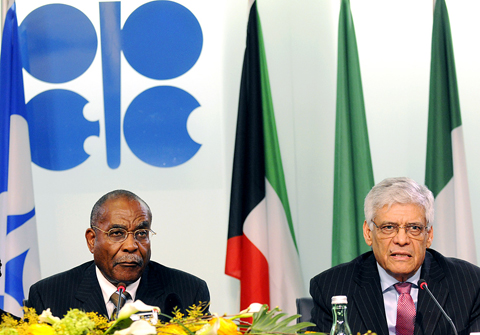
PHOTO: BLOOMBERG
Prices had risen from under US$35 a barrel last month as investors anticipated OPEC would cut production by up to 1 million barrels a day on top of 4.2 million barrels of reductions announced since September.
“The gains we’ve seen in oil over the last two or three weeks were from pricing in a further cutback, which didn’t come through,” said Mark Pervan, senior commodity strategist with ANZ Bank in Melbourne. “So now we’re seeing some profit-taking.”
Russian Deputy Prime Minister Igor Sechin said his country, the world’s second-largest producer, would reduce crude sales. Analysts were skeptical Russia would follow through with production cuts given the country’s reliance on oil income.
“Russia tends to be more talk than action than OPEC,” Pervan said. “I think they’d be pretty hesitant to bring volumes down, but it’s worth watching.”
Oil traders will likely turn their attention to global crude demand and the possibility of a second-half economic recovery.
US Federal Reserve Chairman Ben Bernanke said on Sunday on CBS’ 60 Minutes that the US recession “probably” will end this year if the government succeeds in bolstering the banking system.
However, Bernanke said that even if the recession, which began in December 2007, ends this year, the unemployment rate will keep climbing past the current quarter-century high of 8.1 percent.
“The market now doesn’t have that supply-side issue to support it,” Pervan said. “There’s more downside risk now that the focus is shifting from supply to demand issues.”
“All we need to see is one or two weak numbers out of the US, and we’re right back into the low US$40s and high US$30s,” he said.
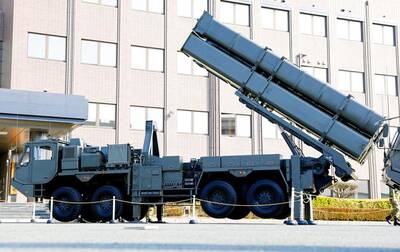
Japan has deployed long-range missiles in a southwestern region near China, the Japanese defense minister said yesterday, at a time when ties with Beijing are at their lowest in recent years. The missiles were installed in Kumamoto in the southern region of Kyushu, as Japan is attempting to shore up its military capacity as China steps up naval activity in the East China Sea. “Standoff defense capabilities enable us to counter the threat of enemy forces attempting to invade our country ... while ensuring the safety of our personnel,” Japanese Minister of Defense Shinjiro Koizumi said. “This is an extremely important initiative for

The nation’s fastest supercomputer, Nano 4 (晶創26), is scheduled to be launched in the third quarter, and would be used to train large language models in finance and national defense sectors, the National Center for High-Performance Computing (NCHC) said. The supercomputer, which would operate at about 86.05 petaflops, is being tested at a new cloud computing center in the Southern Taiwan Science Park in Tainan. The exterior of the server cabinet features chip circuitry patterns overlaid with a map of Taiwan, highlighting the nation’s central position in the semiconductor industry. The center also houses Taiwania 2, Taiwania 3, Forerunner 1 and
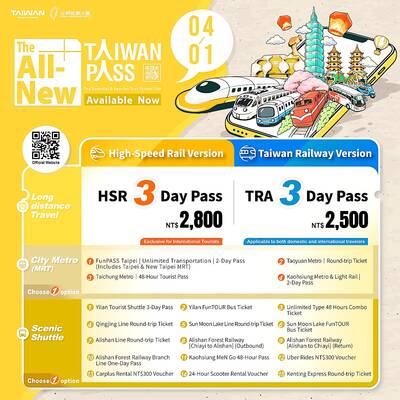
MORE POPULAR: Taiwan Pass sales increased by 59 percent during the first quarter compared with the same period last year, the Tourism Administration said The Tourism Administration yesterday said that it has streamlined the Taiwan Pass, with two versions available for purchase beginning today. The tourism agency has made the pass available to international tourists since 2024, allowing them to access the high-speed rail, Taiwan Railway Corp services, four MRT systems and four Taiwan Tourist Shuttles. Previously, five types of Taiwan Pass were available, but some tourists have said that the offerings were too complicated. The agency said only two types of Taiwan Pass would be available, starting from a three-day pass with the high-speed rail and a three-day pass with Taiwan Railway Corp. The former costs NT$2,800
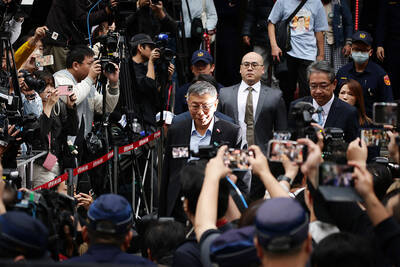
FIRST TRIAL: Ko’s lawyers sought reduced bail and other concessions, as did other defendants, but the bail judge denied their requests, citing the severity of the sentences Former Taipei mayor Ko Wen-je (柯文哲) was yesterday sentenced to 17 years in prison and had his civil rights suspended for six years over corruption, embezzlement and other charges. Taipei prosecutors in December last year asked the Taipei District Court for a combined 28-year, six-month sentence for the four cases against Ko, who founded the Taiwan People’s Party (TPP). The cases were linked to the Core Pacific City (京華城購物中心) redevelopment project and the mismanagement of political donations. Other defendants convicted on separate charges included Chinese Nationalist Party (KMT) Taipei City Councilor Angela Ying (應曉薇), who was handed a 15-year, six-month sentence; Core Pacific


 RSS
RSS