


US President Barack Obama’s administration on Wednesday unveiled the details of a US$75 billion rescue plan to stem rising home foreclosures as grim data suggested a deepening recession.
The Treasury Department said between 7 million and 9 million homeowners could be helped through the program through either home loan modifications or mortgage refinancings.
“It is imperative that we continue to move with speed to help make housing more affordable and help arrest the damaging spiral in our housing markets,” US Treasury Secretary Timothy Geithner said in a statement.
Even with mortgage rates now at historic lows, the US housing market continues to slump as prospective buyers are scared off by falling home prices, a recession firmly in its second year and rising unemployment.
The government’s release of a detailed blueprint for stabilizing the housing sector came amid news of a further deterioration in the job market that signaled a poor reading from the Labor Department expected on Friday.
Data from payrolls firm Automatic Data Processing (ADP) showed the private sector shed 697,000 jobs last month, accelerating the hemorrhaging from January and far exceeding most analysts’ expectations of 630,000 jobs eliminated.
The reading was the worst since ADP began tracking the data in 2000.
Before ADP’s report, most analysts had expected the government to announce the economy shed a seasonally adjusted 650,000 jobs, after 598,000 in January.
The unemployment rate is forecast to jump to 7.9 percent from 7.6 percent in January, the highest level since 1992.
Another report by a private firm highlighted further contraction in the service sector, which, in comparison with manufacturing, had resisted the economic headwinds until recent months.
The Institute for Supply Management (ISM) said that its non-manufacturing index contracted for the fifth consecutive month to 41.6 percent last month from 42.9 percent in January, showing the contraction was accelerating.
An index reading below 50 indicates a decline in activity, while a higher figure indicates growth.
“The pace of contraction of business activity is likely to pick up a little in March as inventory sentiment is still quite negative,” said Brian Bethune, economist at IHS Global Insight.
The US Federal Reserve said in its Beige Book report on Wednesday that US economic activity “deteriorated further” through last month, lowering prospects of a quick recovery.
The report, to be used at the upcoming meeting of Fed policymakers from March 17 to March 18, said the troubles were broad-based, citing weak consumer spending, tight credit and further declines in manufacturing.
“Looking ahead, contacts from various districts rate the prospects for near-term improvement in economic conditions as poor, with a significant pickup not expected before late 2009 or early 2010,” the report said.
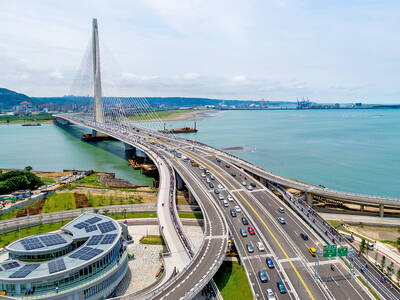
The Ministry of Transportation and Communications yesterday inaugurated the Danjiang Bridge across the Tamsui River in New Taipei City, saying that the structure would be an architectural icon and traffic artery for Taiwan. Feted as a major engineering achievement, the Danjiang Bridge is 920m long, 211m tall at the top of its pylon, and is the longest single-pylon asymmetric cable-stayed bridge in the world, the government’s Web site for the structure said. It was designed by late Iraqi-British architect Zaha Hadid. The structure, with a maximum deck of 70m, accommodates road and light rail traffic, and affords a 200m navigation channel for boats,

Taiwan Semiconductor Manufacturing Co (TSMC, 台積電), the world’s largest foundry service provider, yesterday said that global semiconductor revenue is projected to hit US$1.5 trillion in 2030, after the figure exceeds US$1 trillion this year, as artificial intelligence (AI) demand boosts consumption of token and compute power. “We are still at the beginning of the AI revolution, but we already see a significant impact across the whole semiconductor ecosystem,” TSMC deputy cochief operating officer Kevin Zhang (張曉強) said at the company’s annual technology symposium in Hsinchu City. “It is fair to say that in the past decade, smartphones and other mobile devices were
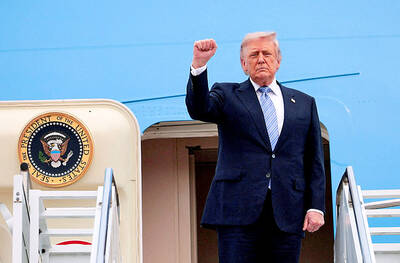
US-CHINA SUMMIT: MOFA welcomed US reassurance of no change in its Taiwan policy; Trump said he did not comment when Xi talked of opposing independence US President Donald Trump yesterday said he has not made a decision on whether to move forward with a major arms package for Taiwan after hearing concerns about it from Chinese President Xi Jinping (習近平). Trump’s comments on Taiwan came as he flew back to Washington after wrapping up critical talks in which both leaders said important progress was made in stabilizing US-China relations even as deep differences persist between the world’s two biggest powers on Iran and Taiwan. “I will make a determination,” Trump said, adding: “I’ll be making decisions. But, you know, I think the last thing we need right

TAIWAN ISSUE: US treasury secretary Scott Bessent said on the first day of meetings that ‘it wouldn’t be a US-China summit without the Taiwan issue coming up’ There were no surprises on the first day of the summit between US President Donald Trump and Chinese President Xi Jinping (習近平), the Mainland Affairs Council (MAC) said yesterday, as the government reiterated that cross-strait stability is crucial to the Asia-Pacific region, as well as the world. As the two presidents met for a highly anticipated summit yesterday, Chinese state media reported that Xi warned Trump that missteps regarding Taiwan could push their two countries into “conflict.” Trump arrived in China with accolades for his host, calling Xi a “great leader” and “friend,” and extending an invitation to visit the White House


 RSS
RSS