


Iran’s oil minister said yesterday there is too much crude on the market, adding that OPEC was reviewing whether supply exceeds demand before deciding whether to cut back production.
Gholam Hossein Nozari spoke on the eve of a meeting of OPEC oil ministers who will decide whether to reduce production or keep it steady. Oil prices have fallen about 30 percent from their highs of almost US$150 a barrel, prompting general concern among OPEC’s 13 members, but Iran, the group’s No. 2 producer, has been the most vocal proponent of tightening the oil spigots.
“We believe the market is oversupplied,” he told reporters, adding the ministers planned to make a decision on what to do about production after their review today.
No one is predicting much of a cutback — if any at all. Still, such a move would not even have been thought of with oil prices setting record after record back in July.
But the bull run appears to have paused, if not ended, which means a new look at options for today’s meeting of the 13 ministers at OPEC’s Vienna headquarters.
Since crude surged to a record US$147.27 a barrel on July 11, it has tumbled by over US$40, or more than 27 percent. Back then, OPEC’s main concern was pushing back against arguments from the US and other key consumers that an output increase was needed to end rocketing prices. Oil ministers insisted there was adequate supply to meet demand, and blamed speculators and a weak US dollar for crude’s stellar rise.
But now, the greenback has strengthened, world demand has decreased because of creaky economies, traders’ appetites for commodities have cooled — and suddenly the market appears to have turned bearish.
Light, sweet crude for October delivery fell US$1.66 to settle at US$106.23 a barrel on Friday on the New York Mercantile Exchange — its lowest close since early April.
The downward spiral has led Iran to suggest that it is time to reduce output from the nearly 30.5 million barrels a day being pumped last month by the organization’s members.
Not far behind is Venezuela. While moderating recent demands for immediate output cuts, Venezuelan Oil Minister Rafael Ramirez has drawn the line at US$100 per barrel of oil.
Anything below that should serve as a wake-up call for OPEC to tighten the spigots, he says — sentiment that is shared by other OPEC members.
Still, a major cutback is unlikely without Saudi compliance, and the Saudis — de-facto OPEC policy setters who are now producing nearly a third of total OPEC output — have given no hint they favor that option.
Saudi Oil Minister Ali Naimi has instead talked about a floor of US$80 as the red line for action.
OPEC has reason to be cautious.
Despite their precipitous fall, prices remain 14 percent higher this year than last year and a barrel of benchmark crude still fetches four times what it did five years ago.
Any OPEC move today to pare back output would result in a howl of protest from the US and other major consumers and give a larger platform to Republican presidential candidate Senator John McCain and Senator Barack Obama, his Democratic counterpart, to call for reduced dependence on foreign oil.
Additionally, OPEC understands that high prices drive down demand and will likely try to find a balance between high profits and a price that the market can accept.
In a forecast last month, OPEC predicted that the world’s forecast appetite for oil for this year overall will have fallen by 30,000 barrels a day and noted that world demand growth next year will be “the lowest since 2002.”
And on Wednesday, the US Energy Administration reported a 3.5 percent drop for products including gasoline and other oil-based products compared with last year.
Such factors have led some experts to predict OPEC would opt for no change.
“The ministers will hold the status quo [although] there is going to be the usual jawboning from the usual suspects” for a cutback, said trader analyst Stephen Schork.
Even now, “oil is by no means cheap and that is certainly adding a lot of pressure to the [world’s] economies — the smarter ones, the Saudis, the Qataris the Kuwaitis are aware of this,” he said.
Others think that OPEC, which accounts for about 40 percent of world oil production, will compromise between doing nothing — thereby chancing a further erosion in prices — and slashing boldly — thereby risking skyrocketing prices and an ensuing fallback in demand.
That middle way would mean agreeing to pare away at overproduction without reducing the overall output quota of 27.3 million barrels a day set in November for the 12 OPEC members under production limits.

The nation’s fastest supercomputer, Nano 4 (晶創26), is scheduled to be launched in the third quarter, and would be used to train large language models in finance and national defense sectors, the National Center for High-Performance Computing (NCHC) said. The supercomputer, which would operate at about 86.05 petaflops, is being tested at a new cloud computing center in the Southern Taiwan Science Park in Tainan. The exterior of the server cabinet features chip circuitry patterns overlaid with a map of Taiwan, highlighting the nation’s central position in the semiconductor industry. The center also houses Taiwania 2, Taiwania 3, Forerunner 1 and
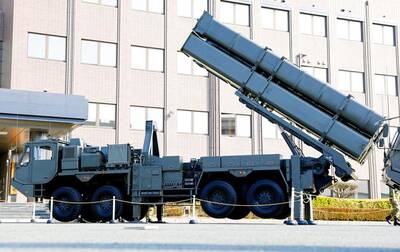
Japan has deployed long-range missiles in a southwestern region near China, the Japanese defense minister said yesterday, at a time when ties with Beijing are at their lowest in recent years. The missiles were installed in Kumamoto in the southern region of Kyushu, as Japan is attempting to shore up its military capacity as China steps up naval activity in the East China Sea. “Standoff defense capabilities enable us to counter the threat of enemy forces attempting to invade our country ... while ensuring the safety of our personnel,” Japanese Minister of Defense Shinjiro Koizumi said. “This is an extremely important initiative for

MORE POPULAR: Taiwan Pass sales increased by 59 percent during the first quarter compared with the same period last year, the Tourism Administration said The Tourism Administration yesterday said that it has streamlined the Taiwan Pass, with two versions available for purchase beginning today. The tourism agency has made the pass available to international tourists since 2024, allowing them to access the high-speed rail, Taiwan Railway Corp services, four MRT systems and four Taiwan Tourist Shuttles. Previously, five types of Taiwan Pass were available, but some tourists have said that the offerings were too complicated. The agency said only two types of Taiwan Pass would be available, starting from a three-day pass with the high-speed rail and a three-day pass with Taiwan Railway Corp. The former costs NT$2,800

FIRST TRIAL: Ko’s lawyers sought reduced bail and other concessions, as did other defendants, but the bail judge denied their requests, citing the severity of the sentences Former Taipei mayor Ko Wen-je (柯文哲) was yesterday sentenced to 17 years in prison and had his civil rights suspended for six years over corruption, embezzlement and other charges. Taipei prosecutors in December last year asked the Taipei District Court for a combined 28-year, six-month sentence for the four cases against Ko, who founded the Taiwan People’s Party (TPP). The cases were linked to the Core Pacific City (京華城購物中心) redevelopment project and the mismanagement of political donations. Other defendants convicted on separate charges included Chinese Nationalist Party (KMT) Taipei City Councilor Angela Ying (應曉薇), who was handed a 15-year, six-month sentence; Core Pacific


 RSS
RSS