


With better-than-expected sales figures, the Renault company's cheap Logan sedan, built in developing countries for developing markets, is proving a hit in developed nations as well.
The 100,000th Logan rolled off the assembly line at Pitesti, Romania, the first production site, this month, and Renault said it was exceeding its most optimistic sales targets both in Romania and abroad. World sales in the first six months of this year exceeded 79,000, the company said.
Customers have to wait at least three months for delivery, and the company said it was struggling to increase production in Romania to meet the unexpected demand -- the question was when and how, according to the company's commercial director, Patrick Blain.
"It's really on the right path," Blain said. "It has started off better than we expected."
By the end of this year, Renault plans to expand production to new sites in Russia, Morocco and Colombia and put the car on sale in about 30 countries, including eight in Western Europe. Further ahead were plans to open plants in Iran next year, India in 2007 and China eventually.
Renault designed the car as a world model with global sales of one million by 2010, but according to Blain that figure may have to be revised upwards if the initial success of the car continues.
The Logan is a mid-sized, family sedan designed to sell in emerging markets for about 5,000 euros (US$6,000). Even with anti-block brakes and other safety equipment required by EU legislation, the car retails in France for about half the price of a similarly sized and equipped automobile built in France.
Since the Logan went on sale in France one month ago -- priced at 7,500 euros for the basic model to 8,500 euros for the high-end version with power steering, onboard computer and air conditioning -- nearly 700 have been delivered and the company has booked 5,000 orders.
Even with zero advertising and minimal promotion, Blain said Renault had been surprised by the success of the car in the French market. One union member said that the company was not promoting the car more aggressively because it feared that it would eat into the sales of other Renault products.
So far the impact on sales other cars has not been noticeable since the Renault Group sold 1.34 million vehicles in the first quarter this year, and said earlier this month that it boosted worldwide sales by 3.6 percent even if markets in Western Europe remained stagnant.
Renault says that the Logan will not compete with the company's higher end autos, but with other low-cost cars being made in Asia, Eastern Europe and developing countries, such as the made-in-Brazil Volkswagen Fox.
Other manufacturers are expanding operations in eastern Europe to take advantage of the low labor costs there and a relatively affluent market in western Europe. They include France's domestic rival, PSA Peugeot Citroen, and the Kia division of Hyundai of South Korea, both of which have established factories in Slovakia.
The Logan appears to appeal to young people and pensioners who might otherwise have bought a second-hand automobile, to families in need of a second car and to rural dwellers more than city inhabitants. Some buyers say they were attracted by the car's relative simplicity and lack of electronic gadgetry.

‘NO SECURITY RISK’: The Railway Bureau reassured the public that the technicians’ activities were limited to technical guidance and did not involve sensitive systems The Railway Bureau yesterday said it had invited eight Chinese technicians to assist with an airport MRT construction project. The bureau issued the confirmation after an Internet user said Chinese nationals had entered the construction zone of Taiwan Taoyuan International Airport’s Terminal 3 project. They asked why “individuals from an enemy state” were allowed access to such a major national infrastructure project, which raised serious concerns over Taiwan’s industrial safety, sensitive systems and information security. The bureau’s Northern Region Engineering Branch Office said subcontractor Taiwan Handle Industrial Co (台灣手把工業) of the Taoyuan airport MRT’s “Contract No. CU05 Project A14 Station Civil, MEP &

A US uncrewed surface vessel (USV) encountered multiple Chinese warships during an autonomous transit of the Taiwan Strait, US defense company Seasats said in a statement on Wednesday. Seasats announced that a Lightfish USV had completed the first autonomous transit of the Taiwan Strait. Over five days, the USV traversed the entire length of the Strait while constantly monitoring surface vessel traffic, the company said. The Lightfish encountered multiple Chinese warships, one of which was a Chinese People’s Liberation Army Navy (PLAN) Type 056 corvette, it said. The Chinese vessels were operating “well within Taiwan’s exclusive economic zone without transmitting their identity via the
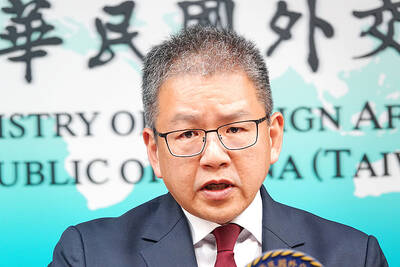
Taiwan is still in the process of assessing the possibility of recruiting workers from Eswatini, the Ministry of Foreign Affairs said yesterday, adding that its goal is to help Eswatini upgrade its vocational training centers. If there are plans to recruit workers from Eswatini, safeguarding national security, protecting public health and ensuring the employment rights of Taiwanese would be prerequisites, Department of West Asian and African Affairs Director-General Yen Chia-liang (顏嘉良) told a news conference. Key considerations would also include filling labor shortages in specific industries, and fostering bilateral professional and technical exchanges, he said. Yen was asked about the progress of labor
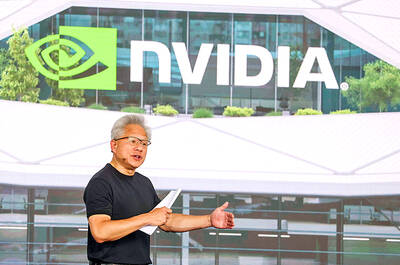
‘BOOMING’: ’ The number of partners we have here is incredible. You can see from their stock prices. They’re doing so well, they’re so happy,’ Jensen Huang said Nvidia Corp’s spending in Taiwan has ballooned to about US$150 billion a year, 10 times the US$10 billion to US$15 billion the company spent five years ago, Nvidia chief executive officer Jensen Huang (黃仁勳) said yesterday, suggesting Taiwan’s strategic importance in the global artificial intelligence (AI) supply chain. “Taiwan is the epicenter of the AI revolution. This is where the chips come, packaging comes. This is where the systems are made. This is where AI supercomputers were created,” Huang said at a meeting for the company’s employees in Beitou-Shilin Technology Park (北投士林科技園區) in Taipei, the planned site of Nvidia’s Taipei headquarters. “Taiwan


 RSS
RSS