


Polaroid's place in history has already been secured by its trademark cameras with their signature instant prints.
But bad investments and the digital imaging revolution buried that business, sending the company spiraling into bankruptcy two years ago as it failed to evolve gracefully in a new instant photo world.
Now Polaroid is back, reconstituted and trying to refocus under new ownership by Chicago-based BankOne. And it's betting its future on digital -- on printing kiosks, that is.
"It has to be their future," thinks Ulysses Yannas, an industry analyst at Buckman, Buckman & Reid. "They don't have a choice."
Relieved of large chunks of the old company's debts (including some pension obligations, to the fury of retirees), and slimmed down from its 1978 peak of 21,000 employees to 3,700, Polaroid is actually making money again on its traditional film and camera business.
But that's clearly a dead end.
The percentage of US households using a digital camera will rise from 20 percent last year to 30 percent by the end of this year, according to Infotrends Research Group. That shift inspired Kodak's recently announced plans to slash its dividend and invest US$3 billion in digital research, while companies with no previous connection to photography are flooding the market with new digital camera models.
Polaroid thinks its best bet for a piece of that action is on the digital processing end, but it will have to play catch-up. A dozen rivals, including Kodak and Fujifilm have already claimed much of the best real estate with nearly 50,000 kiosks installed in the US.
But Polaroid says it can beat them with speed and convenience, and even persuade consumers to print more of their pictures instead of just e-mailing them around to friends and family.
Polaroid's kiosks, fed a credit card and camera memory card, spit out a high-quality print every two seconds. That's three times faster than what Kodak, with the largest installed base, plans to roll out next year and ten times faster than the top speed of most competitors.
The new Polaroid kiosks don't offer bells and whistles, such as cropping and enlargements. Polaroid says 85 percent of the digital print market is first-time printing, with most customers wanting merely to pick their best shots and print on 10cm-by-15cm paper -- all in a transaction as easy as getting cash from an ATM.
Polaroid aims to deploy its kiosks in airports, cruise ships, and restaurants popular for children's birthday parties -- anywhere the urge for instant photographic gratification may strike.
The hope is that the higher speed will open up the market for larger orders, like running off photos to send out with the family Christmas card.
"The difference between 2 seconds and 20 seconds is not too big a deal if you're only printing two or three or four prints," said Bob Barton, the director of marketing at Polaroid for the new product line. "But we're finding that a lot of people are doing transactions of 100 prints or more. If you start doing a hundred-print transaction on a 20 or 23-second printer, you're going to be there for a long time."
Polaroid's strategy has chains or other third parties -- shopping malls, for instance -- buying its kiosks and setting their own prices. A trial version operating in Boston's Prudential Center mall, one of about a dozen now deployed, is charging US$0.59 per print.
The technology, dubbed Opal and Onyx, will eventually appear in home printers, though no timetable has been set.

The nation’s fastest supercomputer, Nano 4 (晶創26), is scheduled to be launched in the third quarter, and would be used to train large language models in finance and national defense sectors, the National Center for High-Performance Computing (NCHC) said. The supercomputer, which would operate at about 86.05 petaflops, is being tested at a new cloud computing center in the Southern Taiwan Science Park in Tainan. The exterior of the server cabinet features chip circuitry patterns overlaid with a map of Taiwan, highlighting the nation’s central position in the semiconductor industry. The center also houses Taiwania 2, Taiwania 3, Forerunner 1 and
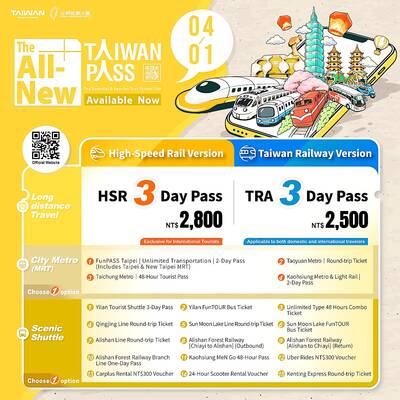
MORE POPULAR: Taiwan Pass sales increased by 59 percent during the first quarter compared with the same period last year, the Tourism Administration said The Tourism Administration yesterday said that it has streamlined the Taiwan Pass, with two versions available for purchase beginning today. The tourism agency has made the pass available to international tourists since 2024, allowing them to access the high-speed rail, Taiwan Railway Corp services, four MRT systems and four Taiwan Tourist Shuttles. Previously, five types of Taiwan Pass were available, but some tourists have said that the offerings were too complicated. The agency said only two types of Taiwan Pass would be available, starting from a three-day pass with the high-speed rail and a three-day pass with Taiwan Railway Corp. The former costs NT$2,800

FIRST TRIAL: Ko’s lawyers sought reduced bail and other concessions, as did other defendants, but the bail judge denied their requests, citing the severity of the sentences Former Taipei mayor Ko Wen-je (柯文哲) was yesterday sentenced to 17 years in prison and had his civil rights suspended for six years over corruption, embezzlement and other charges. Taipei prosecutors in December last year asked the Taipei District Court for a combined 28-year, six-month sentence for the four cases against Ko, who founded the Taiwan People’s Party (TPP). The cases were linked to the Core Pacific City (京華城購物中心) redevelopment project and the mismanagement of political donations. Other defendants convicted on separate charges included Chinese Nationalist Party (KMT) Taipei City Councilor Angela Ying (應曉薇), who was handed a 15-year, six-month sentence; Core Pacific
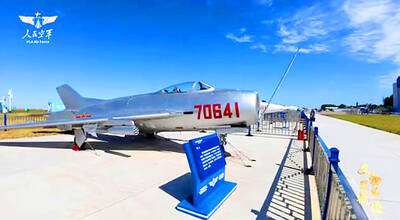
J-6 REMODEL: The converted drones are part of Beijing’s expanding mix of airpower weapons, including bombers with stand-off missiles and UAV swarms, the report said China has stationed obsolete supersonic fighters converted to attack drones at six air bases close to the Taiwan Strait, a report published this month by the Arlington, Virginia-based Mitchell Institute for Aerospace Studies said. Satellite imagery of the airfields from the institute’s “China Airpower Tracker” shows what appear to be lines of stubby, swept-winged aircraft matching the shape of J-6 fighters that first flew with the Chinese People’s Liberation Army (PLA) Air Force in the 1960s. Since their conversion to drones, the aircraft have been identified at five bases in China’s Fujian Province and one in Guangdong Province, the report said. J.


 RSS
RSS