


South Korea's Hyundai Asan Corp will start land tours on Feb. 21 to North Korea, the first time tourists will cross one of the world's most hostile borders.
The one-hour bus trip will give tourists a glimpse into the demilitarized zone, a 4km wide stretch of land that's become a nature preserve, where few people have ventured in the five decades since the end of the Korean War.
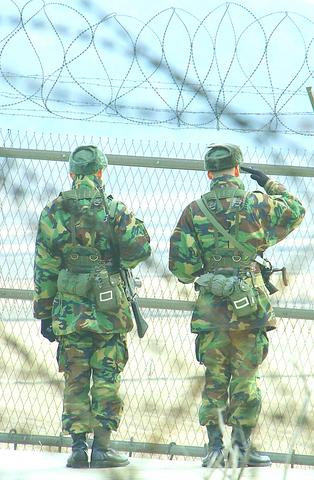
PHOTO: AP
Hyundai is hoping the appeal of the new route and cheaper fee -- about half of what the company now charges for a high-speed ferry ride to the same location -- will help revive a five-year-old North Korean venture that's never made a profit.
"We're trying to add more items to our packages to offer customers value for money," Asan spokeswoman Hong Hyun-joo said.
A 40km bus ride for a three-day visit to North Korea's Mount Geumgang, or Diamond Mountain, on the east coast will cost 350,000 won (US$293) and a two-day visit 230,000 won, it said in a statement. The 113km ferry ride for a three-day tour costs 540,000 won.
Recapturing the interests of tourists is crucial for Hyundai, which agreed to pay North Korea US$942 million by 2005 for the right to develop the region for tourism and industrial use. Asan had only paid two-fifths of the total at the end of last year.
Hyundai began the tourism venture in November 1998 with ferry and cruise ship rides. It scrapped the cruise ship portion after about three years as the number of tourists dwindled. The South Korean government had to intervene in 2001 to bail out the business.
Hyundai will hold a test-run of the land-route tour on Feb.
14 involving key members from the company, government and South Korean media. On Feb. 5, Hyundai Group Chairman Chung Mong-hun and about 100 other company and government officials went on an inspection tour of the road through the demilitarized zone.
North Korea has become an embarrassment for South Korean President Kim Dae-jung, who won the Nobel peace prize in 2000 for his policy of rapprochement with the North, and for the Hyundai companies, which led South Korean business investments in the communist country.
Kim is accused by South Korea's opposition Grand National Party of helping Hyundai Merchant Marine Co and other affiliates send funds to North Korea, which led to North Korean leader Kim Jong Il's agreement to the landmark summit that was held in Pyongyang in June 2000.
Hyundai Merchant Marine, Hyundai Engineering & Construction Co and Hynix Semiconductor Inc, then called Hyundai Electronics Industries Ltd, sent a combined US$500 million to North Korea, Internet news provider OhmyNews said, citing unidentified government officials.

‘NO SECURITY RISK’: The Railway Bureau reassured the public that the technicians’ activities were limited to technical guidance and did not involve sensitive systems The Railway Bureau yesterday said it had invited eight Chinese technicians to assist with an airport MRT construction project. The bureau issued the confirmation after an Internet user said Chinese nationals had entered the construction zone of Taiwan Taoyuan International Airport’s Terminal 3 project. They asked why “individuals from an enemy state” were allowed access to such a major national infrastructure project, which raised serious concerns over Taiwan’s industrial safety, sensitive systems and information security. The bureau’s Northern Region Engineering Branch Office said subcontractor Taiwan Handle Industrial Co (台灣手把工業) of the Taoyuan airport MRT’s “Contract No. CU05 Project A14 Station Civil, MEP &

A signaling system malfunction disrupted high-speed rail (HSR) services beginning at 8am today, with trains temporarily reduced to three northbound and three southbound trains per hour as authorities conduct inspections. The malfunction occurred on a section of track in Miaoli County during pre-operation checks early this morning, forcing northbound and southbound trains to use a single track, the HSR operator said. The regular schedule has been replaced with three hourly trains offering only nonreserved seating in each direction, stopping at every station, it said, adding that business class cars would still have reserved seating. Departures from terminal stations are scheduled at the top

Taiwan is still in the process of assessing the possibility of recruiting workers from Eswatini, the Ministry of Foreign Affairs said yesterday, adding that its goal is to help Eswatini upgrade its vocational training centers. If there are plans to recruit workers from Eswatini, safeguarding national security, protecting public health and ensuring the employment rights of Taiwanese would be prerequisites, Department of West Asian and African Affairs Director-General Yen Chia-liang (顏嘉良) told a news conference. Key considerations would also include filling labor shortages in specific industries, and fostering bilateral professional and technical exchanges, he said. Yen was asked about the progress of labor

A US uncrewed surface vessel (USV) encountered multiple Chinese warships during an autonomous transit of the Taiwan Strait, US defense company Seasats said in a statement on Wednesday. Seasats announced that a Lightfish USV had completed the first autonomous transit of the Taiwan Strait. Over five days, the USV traversed the entire length of the Strait while constantly monitoring surface vessel traffic, the company said. The Lightfish encountered multiple Chinese warships, one of which was a Chinese People’s Liberation Army Navy (PLAN) Type 056 corvette, it said. The Chinese vessels were operating “well within Taiwan’s exclusive economic zone without transmitting their identity via the


 RSS
RSS