


Ken Bradley, a retired United Airlines pilot, may follow his former employer into bankruptcy.
Bradley estimates he's lost US$600,000 in retirement funds tied to company stock. Shares of United's parent, UAL Corp, slid after the company filed for bankruptcy this week, bringing this year's decline to 93 percent. Now Bradley is concerned United will use court protection to cut the pension he spent 35 years building.
"We've had so many sleepless nights over the past three or four days over fears that we'll go under," said 61-year-old Bradley, whose wife, Susan, is a flight attendant for United.
"It's very much an emotional issue because United is so much a part of our lives."
United Airlines workers, the only in the industry to own a majority of their company's shares, have become the most vulnerable as the world's second-largest airline uses court protection to shave costs, analysts said. Employees may lose their jobs as well as their pensions, stock and seats on the company's board.
The 59 million shares United's employees were given in exchange for US$4.9 billion in pay and benefit concessions to help the company in 1994 may become worthless as a result of the bankruptcy proceedings. The shares, worth US$6 billion at a high of US$101.75 in October 1997, closed Tuesday at US$1.07.
United employees' 55-percent ownership of UAL through an employee stock ownership plan, or ESOP, will probably end with the reorganization because the shares are likely to be wiped out, analysts said. Some consultants said worker control contributed to United's downfall by making it difficult to run the company because of conflicting interests.
"The beginning of this slippery slope is when the ESOP was designed the way it was," said Aaron Gellman, a Northwestern University professor following transportation issues, who said employees, especially pilots, got too much control.
Both the pilots and machinists' unions have used their board seats in the past to press for management changes and influence strategy on issues such as acquisitions.
Chief Executive Officer Glenn Tilton, who took over in September, has said he wants to work with the unions to get more than the US$5.2 billion in previously planned concessions. Those cuts were deemed inadequate by a federal board that rejected United's request for a US loan guarantee.
UAL can request court approval to void contracts, defer payments to workers, and contract outside companies for services.
Union leaders know that more concessions are needed and trust that Tilton will negotiate the changes and not try to ram them through court. Talks between United and unions began Tuesday. Tilton will have to tread lightly to avoid upsetting and demoralizing workers, something that may lead to disruptions in service and push the company into liquidation, ana-lysts said.
"With the filing, management has a bigger club, however, implicit in the use of that club is the risk of an implosion of service," said George Ireland, whose Ring Partners LP investment firm owns some airline stocks and has bet others will fall.
"Frequent fliers put up with that in 1999 and 2000 when UAL was healthy, but they might not be so forgiving now."
Everyone's biggest fear
The biggest fear for many workers is the possibility of losing their jobs. Even senior workers who have kept their jobs and may make it past the next cut know they could always be next, said Tom Reardon, the machinists' leader in Chicago.
United planned to trim its work force to 74,000 people by 2004, down from 81,000 today, and now will likely go beyond that, analysts said.
"I tell the members don't buy a car, or a house, because you don't know where we're going to be," said Michael Peat, a machinist union vice president in Chicago. "There's probably going to be massive layoffs as well as pay cuts."
In addition to worries about pensions, flight attendants are nervous about cuts in health care, said Sara Dela Cruz, a United attendant and union worker. And the attendants don't feel that their pay, which is already pegged to industry averages, should be reduced as much as other workers.
"We have no idea what they're going to ask for or what we're going to have to end up giving," she said. "The uncertainty is what's scary."

A signaling system malfunction disrupted high-speed rail (HSR) services beginning at 8am today, with trains temporarily reduced to three northbound and three southbound trains per hour as authorities conduct inspections. The malfunction occurred on a section of track in Miaoli County during pre-operation checks early this morning, forcing northbound and southbound trains to use a single track, the HSR operator said. The regular schedule has been replaced with three hourly trains offering only nonreserved seating in each direction, stopping at every station, it said, adding that business class cars would still have reserved seating. Departures from terminal stations are scheduled at the top

DRONE CENTRAL: Taiwan aims to become Asia’s democratic hub for drones, with most exports focused on high-quality military-grade models, an official said Taiwan’s drone industry is expected to expand significantly by 2030, producing 100,000 units per month and exporting half of them, the Ministry of Economic Affairs said yesterday. Current drone production capacity is about 15,000 units per month, but the industry can quickly scale up as demand increases, Industrial Development Administration Director-General Chiou Chyou-huey (邱求慧) told a news conference in Taipei. Taiwan’s drone output grew 2.5-fold last year to NT$12.9 billion (US$408.3 million) under a government program to develop the uncrewed vehicle sector, he said. The Executive Yuan in October last year approved plans to invest NT$44.2 billion into domestic production of uncrewed aerial
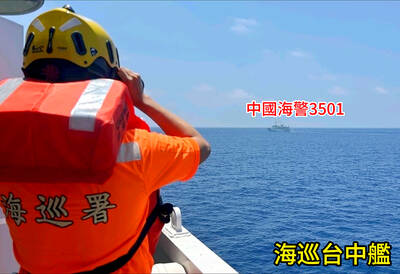
VERBOSE VESSELS: A CGA cutter and a China Coast Guard exchanged verbal barbs for more than a day in Taiwanese-controlled waters before the Chinese vessel left The Taiwanese and Chinese coast guards had a standoff near the strategically located Pratas Islands (Dongsha Islands, 東沙群島) in the north of the South China Sea, the Coast Guard Administration (CGA) said yesterday. The two sides engaged in intense radio exchanges over sovereignty claims during the 33-hour standoff. China Coast Guard vessel 3501 eventually left the restricted waters, 26.6 nautical miles (49.2km) west of the Pratas Islands, at 5pm yesterday, the CGA said. Lying approximately between southern Taiwan and Hong Kong, the Taiwan-controlled Pratas are seen by some security experts as vulnerable to Chinese attack due to their distance — more than
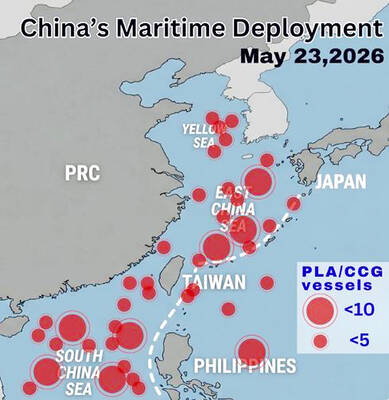
WARNING: China should stop engaging in actions that undermine regional peace and stability, as it would only build resentment among people across the Strait, the CGA said China has deployed more than 100 navy, coast guard and other vessels in waters from the Yellow Sea to the South China Sea and the western Pacific since US President Donald Trump and Chinese President Xi Jinping (習近平) met in Beijing, National Security Council Secretary-General Joseph Wu (吳釗燮) said yesterday. “In this part of the world, #China is the one & only PROBLEM wrecking the #StatusQuo & threatening regional peace & stability,” Wu wrote on X. In a separate post, he said Beijing was coercing Taiwan’s maritime domain, calling it illegal and provocative, after the Coast Guard Administration (CGA) expelled a


 RSS
RSS