


When Togolese President Faure Gnassingbe took to the stage for an election rally in the city of Sokode this month, the crowd chanted the campaign’s popular catchphrase: “Knockout blow.”
It was a potent message in a city that was once at the heart of opposition to the Gnassingbe family, which has dominated the West African state for more than half a century.
The 53-year-old leader himself seemed impressed.
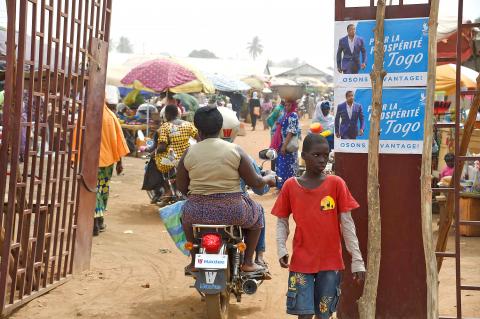
Photo: AFP
“How can I not be surprised by the welcome you’re giving me today?” he asked.
Through 2017 and 2018, huge protests rocked the nation of 8 million people as demonstrators demanded the incumbent, who took power in 2005 after the death of his father, leave office.
Sokode, Togo’s second-largest city, was the hotbed for the unrest.
Spearheaded by little-known local politician Tikpi Atchadam and his Pan-African National Party (PNP), protesters blocked roads, torched police stations and attacked soldiers.
The response from the authorities was fierce — at least 10 people were killed in Sokode alone.
More than a year after the nationwide protests fizzled out, Gnassingbe’s grip appears as solid as ever.
He is almost certain to win a fourth term in Saturday’s election, and has changed the constitution to allow himself potentially to stay in charge until 2030.
People were brought in on buses from surrounding villages for his rally in Sokode, and schools were closed for the day and students pushed to attend.
“Every time we use violence in order to oppose ... it is always Togo that loses out,” the president told the crowd of thousands.
Sokode Mayor Ouro Gbele Tchanile said that “peace has returned” to his city for good.
However, in reality, Sokode is a city still under lockdown.
Trucks filled with armed soldiers continually patrol the main streets, and residents complain of searches in their homes, beatings in the streets and a nightly curfew.
“Whoever wants peace has to prepare for war,” the mayor said in his office. “Tourism stopped, business suffered a lot — development is not possible without security.”
The neighborhood of Kpalo-Kpalo, one of the PNP’s former strongholds, is surrounded by troops.
Supporters of the party — which drew a lot of its support from the mainly Muslim Tem ethnic group — said a crackdown by security forces means that they can only meet in secret.
Their leader Atchadam has fled Togo and is hiding out in Ghana.
“We are not safe anywhere, we live in hiding, we cannot speak out,” a PNP supporter said on condition of anonymity. “I am one of the few who can talk to you, as most of us have been arrested.”
Since November last year, about 50 people have been arrested in a series of publicized operations by the security forces.
Civil groups backed by charity Catholic Relief Services are nonetheless looking to build on the fragile peace in the city.
In an initiative spearheaded by the Catholic Church, they have brought together members of different communities, religious groups and the security forces.
“The elections are the business of the politicians. We are trying to build a climate of peace before and after,” Bishop of Sokode Celestin-Marie Gaoua said. “It is our youth who end up being sacrificed for the sake of politics.”
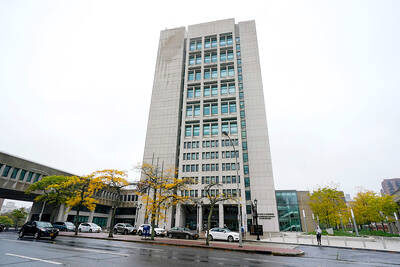
A coalition of civil rights groups on Tuesday asked a New York State judge to order one of its largest suburban counties to stop its deployment of nearly 600 license plate readers, calling it a warrantless and “indiscriminate surveillance system” that violates the state constitution. The class action lawsuit also alleged that Westchester County never got proper authorization to launch the program, which has amassed a database of 1.6 billion plate scans that has been shared with more than 50 outside law enforcement agencies. The complaint said the network “records the long-term travel patterns, daily habits, and intimate information of millions of
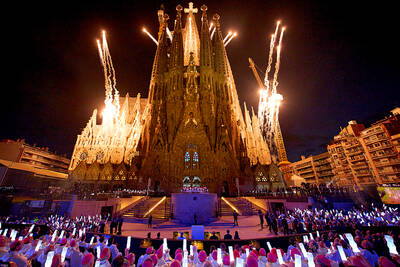
Pope Leo XIV on Wednesday blessed a giant new tower at Barcelona’s famed Sagrada Familia Basilica after celebrating mass inside what is now the world’s tallest church. A fireworks and light show illuminated the exterior of the temple at the end of the ceremony, bathing the unfinished basilica in shifting colours that highlighted its towering spires. A choir of 600 singers performed at the service which lasted around 90 minutes and was attended by Spanish Prime Minister Pedro Sanchez as well as King Felipe VI and Queen Letizia. The stained-glass windows in various colours shone brightly in between the tree-like

Voters in Switzerland yesterday cast their ballots on an initiative championed by the top right-wing party to cap the Alpine country’s population at 10 million. As of press time last night, early results showed that Swiss voters were leaning against it. The populist Swiss People’s Party, which has the most seats in parliament, has stirred up and fostered anti-migration sentiment over the years, notably about an influx of workers from the neighboring EU. Critics called the bid a self-inflicted wound, saying the boom in migration over the past generation has brought foreign labor and skills to sectors such as healthcare, finance, pharmaceuticals

Scientists have discovered communities of marine life — including jellyfish, tubeworms and brittle stars — thriving on a whale graveyard. The graveyards form when whale carcasses fall to the sea floor, becoming a sustaining snack for nearby critters. This one, which is up to 7km below the surface of the southeastern Indian Ocean, spans the largest area, and is so far the deepest found. A whale’s sheer size and the unique chemistry of its bones are the keys to forming these unique underwater neighborhoods, said Song Xikun (宋希坤), a biologist with the Chinese Academy of Sciences’ Institute of Deep-sea Science and Engineering


 RSS
RSS