


As an extraordinary two-week quarantine of a cruise ship was to end yesterday in Japan, many scientists said it was a failed experiment: The ship seemed to become an incubator for COVID-19 instead of an isolation facility meant to prevent the worsening of an outbreak.
The viral illness that emerged last year in central China has sickened tens of thousands of people, but the 542 cases confirmed among the ship’s 3,711 original passengers and crew are the most anywhere outside of China.
The Diamond Princess cruise ship is also the only place where health officials have seen the disease spread easily among people beyond China.
The question is: Why?
The Japanese government has repeatedly defended the effectiveness of the quarantine.
However, some experts have suggested that it might have been less than rigorous.
In a possible sign of lax protocols, three Japanese health officials who helped conduct the quarantine checks on the ship were also infected.
“There are sometimes environments in which disease can spread in a more efficient way,” said Michael Ryan, executive director of the WHO’s health emergencies program.
Ryan said cruise ships in particular were known to occasionally accelerate spread.
“It’s an unfortunate event occurring on the ship, and we trust that the authorities in Japan and the governments who are taking back people will be able to follow up those individuals in the appropriate way,” he said.
Japanese Minister of Health, Labor and Welfare Katsunobu Kato told reporters on Tuesday that all passengers who remained on the cruise ship have had samples taken and that those who tested negative would start getting off the vessel beginning yesterday, when their required 14-day quarantine was scheduled to end.
“They all want to go home as early as possible, and we hope to assist them so that everyone can get home smoothly,” Kato said.
However, it might not be that simple.
US health officials on Tuesday told Americans who declined to return to the US on government-chartered flights that they would not be allowed back into the country for at least 14 days after they had left the Diamond Princess.
“Obviously the quarantine hasn’t worked, and this ship has now become a source of infection,” said Nathalie MacDermott, an outbreak expert at King’s College London.
She said that the exact mechanism of the virus’ spread was unknown.
Although scientists believe the disease is spread mostly by droplets — when people cough or sneeze — it is possible that there are other ways of transmission.
“We need to understand how the quarantine measures on board were implemented, what the air filtration on board is like, how the cabins are connected and how waste products are disposed of,” MacDermott said.
“There could also be another mode of transmission we’re not familiar with,” she said, noting the possibility of environmental spread and the importance of “deep-cleaning” the entire ship to prevent people from touching contaminated surfaces.
During the 2002 and 2003 SARS outbreak, more than 300 people were infected through a defective sewage system in a Hong Kong housing estate.
MacDermott said it was possible there was a similar issue aboard the Diamond Princess.
“There’s no reason this [quarantine] should not have worked if it had been done properly,” she said.
Cruise ships have sometimes been struck by outbreaks of diseases such as norovirus, which can spread quickly in the close quarters of a ship and among elderly passengers with weaker immune systems.
However, MacDermott said it would be highly unusual for an entire ship to be quarantined.
“They might quarantine the people affected in their rooms until they’re 48 hours clear of symptoms, but certainly not all passengers,” she said.
Some passengers on the Diamond Princess described the ship as a “floating prison,” but were allowed to walk on the decks every day while wearing a mask and were told to keep their distance from others.
“I suspect people were not as isolated from other people as we would have thought,” said Paul Hunter, a professor of medicine at the University of East Anglia in England.
He said the continued spread of the virus could be due to compliance problems.
“It’s difficult to enforce a quarantine in a ship environment, and I’m absolutely sure there were some passengers who think they’re not going to let anyone tell them what they can and cannot do,” he said.

A plan by Switzerland’s right-wing People’s Party to cap the population at 10 million has the backing of almost half the country, according to a poll before an expected vote next year. The party, which has long campaigned against immigration, argues that too-fast population growth is overwhelming housing, transport and public services. The level of support comes despite the government urging voters to reject it, warning that strict curbs would damage the economy and prosperity, as Swiss companies depend on foreign workers. The poll by newspaper group Tamedia/20 Minuten and released yesterday showed that 48 percent of the population plan to vote

PARLIAMENT CHAOS: Police forcibly removed Brazilian Deputy Glauber Braga after he called the legislation part of a ‘coup offensive’ and occupied the speaker’s chair Brazil’s lower house of Congress early yesterday approved a bill that could slash former Brazilian president Jair Bolsonaro’s prison sentence for plotting a coup, after efforts by a lawmaker to disrupt the proceedings sparked chaos in parliament. Bolsonaro has been serving a 27-year term since last month after his conviction for a scheme to stop Brazilian President Luiz Inacio Lula da Silva from taking office after the 2022 election. Lawmakers had been discussing a bill that would significantly reduce sentences for several crimes, including attempting a coup d’etat — opening up the prospect that Bolsonaro, 70, could have his sentence cut to

A powerful magnitude 7.6 earthquake shook Japan’s northeast region late on Monday, prompting tsunami warnings and orders for residents to evacuate. A tsunami as high as three metres (10 feet) could hit Japan’s northeastern coast after an earthquake with an estimated magnitude of 7.6 occurred offshore at 11:15 p.m. (1415 GMT), the Japan Meteorological Agency (JMA) said. Tsunami warnings were issued for the prefectures of Hokkaido, Aomori and Iwate, and a tsunami of 40cm had been observed at Aomori’s Mutsu Ogawara and Hokkaido’s Urakawa ports before midnight, JMA said. The epicentre of the quake was 80 km (50 miles) off the coast of
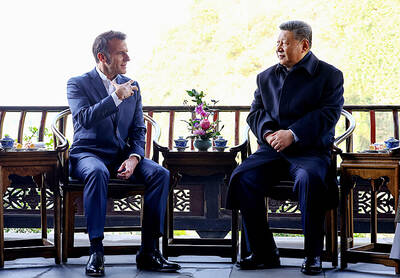
RELAXED: After talks on Ukraine and trade, the French president met with students while his wife visited pandas, after the pair parted ways with their Chinese counterparts French President Emmanuel Macron concluded his fourth state visit to China yesterday in Chengdu, striking a more relaxed note after tough discussions on Ukraine and trade with Chinese President Xi Jinping (習近平) a day earlier. Far from the imposing Great Hall of the People in Beijing where the two leaders held talks, Xi and China’s first lady, Peng Liyuan (彭麗媛), showed Macron and his wife Brigitte around the centuries-old Dujiangyan Dam, a World Heritage Site set against the mountainous landscape of Sichuan Province. Macron was told through an interpreter about the ancient irrigation system, which dates back to the third century


 RSS
RSS