


Abandoned by her sons, shunned by her neighbors and branded a witch. Mosammat Rashida’s crime? Her husband was killed by a Bengal tiger.
Women like her are ostracized in many rural villages in Bangladesh, where they are viewed as the cause of their partner’s misfortune.
“My sons have told me that I am an unlucky witch,” she said in her flimsy plank home, in the honey-hunters’ village of Gabura at the edge of the Sundarbans — a 10,000km2 mangrove forest that straddles Bangladesh and India.
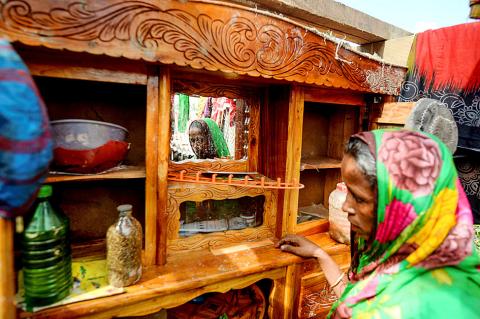
Photo: AFP
Her husband died while out collecting honey in the jungles.
“Honey hunters prefer to collect honey mostly in the southwestern Sundarbans, where most of the man-eaters [tigers] live,” said Monirul Khan, a leading Bengal tiger expert at Jahangirnagar University.
Tigers are an endangered species, but climate change and human development are reducing their wild habitat, often forcing them toward villages in search of food. Wildlife charities estimate there are about 100 tigers in the Bangladesh side of the Sundarbans.
At least 519 men died from tiger attacks in 50 villages in one district — home to half a million people — from 2001 to 2011, according to Ledars Bangladesh, a charity helping widows reintegrate back in the villages.
Their deaths are a double blow for the women left behind. Already grieving the loss of their partner, overnight they become “tiger widows” — pariahs in their homes and villages at a time when they most need support.
They are often left with little means to support themselves or their families.
Rashida is heartbroken, but unsurprised that her adult sons, aged 24 and 27, abandoned her and their young siblings.
“They are part of this society after all,” the 45-year-old said, as she wiped tears from her eyes.
Her tiny shack has no roof — it was blown off by a deadly cyclone — but there have been no offers of help from neighbors or officials, who she said helped others in the village, but shunned her. Instead she uses an old tarpaulin to keep the elements out.
Next door, Mohammad Hossain was fixing his broken tin roof, and confessed he had been instructed by his wife not to talk to Rashida.
“It would mar my family’s well-being and could bring bad luck,” the 31-year-old honey hunter said.
Officials denied omitting Rashida from the help they provided after the cyclone.
However, Ledars Bangladesh head Mohon Kumar Mondal said that the mistreatment of “tiger widows” was widespread in highly conservative communities, which often held “centuries-old” prejudices.
“They [charities] are working to restore the widows’ dignities. The main challenge is to change people’s beliefs,” he said.
Rijia Khatun, who said she has learned to cope with being ostracized by her fellow villagers after her honey-hunter husband’s death 15 years ago, has been secretly supported by her nephew and his family.
“My sons were young, but nobody helped me. I felt bad at first, as they kept blaming me for my husband’s death. I didn’t know what was my fault,” she said. “But now I’ve learned to live with this adversity.”
Her nephew, Yaad Ali, who has witnessed several attacks, including his uncle’s, said that while he wanted to help, he could not do so publicly.
“We had to do it [help Khatun] confidentially or else the village society would have ostracized us as well,” he said.
Honey hunting has traditionally been seen as a more accessible vocation for villagers who cannot afford the equipment or boats needed to undertake the region’s other main profession — fishing.
However, fears of being killed by the predators — and the consequences for the wives they leave behind — has meant more men are opting for a different trade.
Harun ur Rashid, whose father was killed by a tiger, said he is now a fisherman, despite coming from generations of honey hunters.
“My mother doesn’t want me to end up like my father, and I want to stay alive and take care of her, because she has suffered a lot and endured enough abuses after my father’s death,” the 21-year-old said.

A plan by Switzerland’s right-wing People’s Party to cap the population at 10 million has the backing of almost half the country, according to a poll before an expected vote next year. The party, which has long campaigned against immigration, argues that too-fast population growth is overwhelming housing, transport and public services. The level of support comes despite the government urging voters to reject it, warning that strict curbs would damage the economy and prosperity, as Swiss companies depend on foreign workers. The poll by newspaper group Tamedia/20 Minuten and released yesterday showed that 48 percent of the population plan to vote

PARLIAMENT CHAOS: Police forcibly removed Brazilian Deputy Glauber Braga after he called the legislation part of a ‘coup offensive’ and occupied the speaker’s chair Brazil’s lower house of Congress early yesterday approved a bill that could slash former Brazilian president Jair Bolsonaro’s prison sentence for plotting a coup, after efforts by a lawmaker to disrupt the proceedings sparked chaos in parliament. Bolsonaro has been serving a 27-year term since last month after his conviction for a scheme to stop Brazilian President Luiz Inacio Lula da Silva from taking office after the 2022 election. Lawmakers had been discussing a bill that would significantly reduce sentences for several crimes, including attempting a coup d’etat — opening up the prospect that Bolsonaro, 70, could have his sentence cut to

A powerful magnitude 7.6 earthquake shook Japan’s northeast region late on Monday, prompting tsunami warnings and orders for residents to evacuate. A tsunami as high as three metres (10 feet) could hit Japan’s northeastern coast after an earthquake with an estimated magnitude of 7.6 occurred offshore at 11:15 p.m. (1415 GMT), the Japan Meteorological Agency (JMA) said. Tsunami warnings were issued for the prefectures of Hokkaido, Aomori and Iwate, and a tsunami of 40cm had been observed at Aomori’s Mutsu Ogawara and Hokkaido’s Urakawa ports before midnight, JMA said. The epicentre of the quake was 80 km (50 miles) off the coast of

RELAXED: After talks on Ukraine and trade, the French president met with students while his wife visited pandas, after the pair parted ways with their Chinese counterparts French President Emmanuel Macron concluded his fourth state visit to China yesterday in Chengdu, striking a more relaxed note after tough discussions on Ukraine and trade with Chinese President Xi Jinping (習近平) a day earlier. Far from the imposing Great Hall of the People in Beijing where the two leaders held talks, Xi and China’s first lady, Peng Liyuan (彭麗媛), showed Macron and his wife Brigitte around the centuries-old Dujiangyan Dam, a World Heritage Site set against the mountainous landscape of Sichuan Province. Macron was told through an interpreter about the ancient irrigation system, which dates back to the third century


 RSS
RSS