


In the heart of picturesque old Ryton village in northeast England, pub regulars banded together to save their favorite watering hole in a cutthroat sector where competition is fierce.
Ye Olde Cross has a history dating back to the 1800s, when Ryton grew into a small town as the wealthy escaped the grime of industry and urban sprawl of Newcastle and Gateshead, 10km to the east down the River Tyne.
The pub, which takes its name from the monument erected on the nearby village green where the founder of Methodism, John Wesley, once preached, quickly became a fixture of local life.
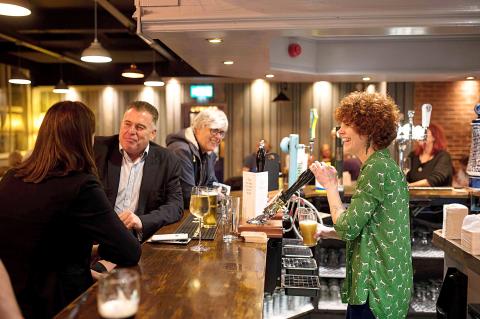
Photo: AFP
However, it was forced to call time two years ago due to competition from supermarkets and online retail giants.
That caused “heartbreak” for the 7,500 locals, one regular said.
Hundreds of punters then dug deep and took it into community ownership.
“We raised enough money to buy the building, but not much more than that,” said Ted Euers, who is one of 12 directors on the pub’s management committee.
“So we decided that we would try and do as much of the work ourselves as we could,” he told reporters.
Now a handful of the most dedicated customers are helping build a new upstairs bar and create space to install an elevator.
Ye Olde Cross is one of a select group of about 100 pubs that are owned by individual investors, after laws passed in 2010 that sought to protect iconic British pubs and help stop their disappearance with community-led takeovers.
Like French cafes, pubs have been a feature of British life for centuries.
However, over the past 13 years, about 12,000 have closed across the UK — about one-quarter of the nation’s drinking establishments, the UK Office for National Statistics has said.
“Last year, we were seeing a pub closing every 12 hours,” said Nik Antona, chairman of pressure group Campaign for Real Ale, which seeks to promote real ale and safeguard pubs as part of the UK’s cultural and social heritage.
The collapse in pub numbers has been attributed to changes in social habits, from falling alcohol consumption, increased social opportunities for the young, high taxation on commercial property and the continued hangover from the bitter 2008 global recession.
However, there are signs of recovery: The office last month said that the number of small pubs and bars — those with fewer than 10 employees — increased last year for the first time in 15 years.
The sector also showed the highest levels of turnover since the end of the financial crisis, it added.
The example of Ye Olde Cross shows what can be done, with people power and lateral thinking, making pubs not just a place to eat and drink, but also as a focus of the community.
After months of campaigning, pub regulars raised about £150,000 (US$195,707 at the current exchange rate) from more than 300 local people who became shareholders.
The pub has also been boosted by a total of £100,000 in a mixture of grants and bank loans.
While the value of the shares would not fluctuate or increase in value, it does offer local investors a symbolic stake in the future of their community hub.
Volunteer Richard held aloft a pint of lager after tidying the pub floor, which doubles as a yoga venue.
“We don’t get paid in beers,” he joked.
As well as yoga, the pub has also become a venue for local knitting groups, film shows and other activities, all aimed at raising cash donations to keep the place running.
“It’s a win-win situation,” the yoga teacher added.
Abigail Bennett, who runs the pub with her partner, Billy, said their job was not without its demands.
Most pubs in the UK are managed by pub companies or individual breweries, with premises leased out to landlords.
Bennett said that running a community-owned pub was “much more stressful than the standard model, but much more rewarding as well. Emotionally rewarding.”

A plan by Switzerland’s right-wing People’s Party to cap the population at 10 million has the backing of almost half the country, according to a poll before an expected vote next year. The party, which has long campaigned against immigration, argues that too-fast population growth is overwhelming housing, transport and public services. The level of support comes despite the government urging voters to reject it, warning that strict curbs would damage the economy and prosperity, as Swiss companies depend on foreign workers. The poll by newspaper group Tamedia/20 Minuten and released yesterday showed that 48 percent of the population plan to vote

PARLIAMENT CHAOS: Police forcibly removed Brazilian Deputy Glauber Braga after he called the legislation part of a ‘coup offensive’ and occupied the speaker’s chair Brazil’s lower house of Congress early yesterday approved a bill that could slash former Brazilian president Jair Bolsonaro’s prison sentence for plotting a coup, after efforts by a lawmaker to disrupt the proceedings sparked chaos in parliament. Bolsonaro has been serving a 27-year term since last month after his conviction for a scheme to stop Brazilian President Luiz Inacio Lula da Silva from taking office after the 2022 election. Lawmakers had been discussing a bill that would significantly reduce sentences for several crimes, including attempting a coup d’etat — opening up the prospect that Bolsonaro, 70, could have his sentence cut to

A powerful magnitude 7.6 earthquake shook Japan’s northeast region late on Monday, prompting tsunami warnings and orders for residents to evacuate. A tsunami as high as three metres (10 feet) could hit Japan’s northeastern coast after an earthquake with an estimated magnitude of 7.6 occurred offshore at 11:15 p.m. (1415 GMT), the Japan Meteorological Agency (JMA) said. Tsunami warnings were issued for the prefectures of Hokkaido, Aomori and Iwate, and a tsunami of 40cm had been observed at Aomori’s Mutsu Ogawara and Hokkaido’s Urakawa ports before midnight, JMA said. The epicentre of the quake was 80 km (50 miles) off the coast of

RELAXED: After talks on Ukraine and trade, the French president met with students while his wife visited pandas, after the pair parted ways with their Chinese counterparts French President Emmanuel Macron concluded his fourth state visit to China yesterday in Chengdu, striking a more relaxed note after tough discussions on Ukraine and trade with Chinese President Xi Jinping (習近平) a day earlier. Far from the imposing Great Hall of the People in Beijing where the two leaders held talks, Xi and China’s first lady, Peng Liyuan (彭麗媛), showed Macron and his wife Brigitte around the centuries-old Dujiangyan Dam, a World Heritage Site set against the mountainous landscape of Sichuan Province. Macron was told through an interpreter about the ancient irrigation system, which dates back to the third century


 RSS
RSS