


The tiny village of Brunsmark, an hour outside Hamburg in the lush north German countryside, might seem an unlikely spot to suffer a sudden Brexit shock, but Britain’s departure from the EU means that Iain Macnab, a Scotsman comfortably settled in the area for decades, must give up the mayor’s seat he has held for 12 years.
“I don’t have a vote in Germany anymore, and if you have no vote ... you cannot be mayor,” he told reporters in his office squeezed under the rafters.
His political participation dropped from “100 to zero at midnight” on Friday last week, Britain’s final day of EU membership, the 70-year-old said.
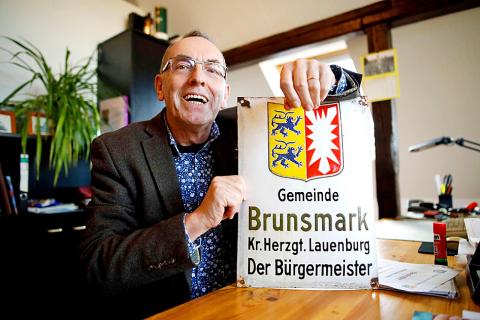
Photo: AFP
What is more, Macnab has lived outside the UK for more than 15 years — the cutoff point for voting from abroad in elections to the London parliament.
“It’s struck me as very strange to suddenly know you have no vote anymore... You’re completely impotent as far as democracy is concerned,” he said.
Married to a German woman, with whom he has two children, Macnab has lived in Brunsmark — which has a population of just 150 — for 28 years.
Originally from Achiltibuie in Scotland’s far northwest, he did not rush — as many other Britons in Germany did — to secure citizenship following the 2016 referendum vote to quit the EU.
“I have considered it a couple of times,” he said, but never acted on the idea.
Macnab is no fan of Brexit, saying that “the EU definitely has its negative points ... but if you are in it, you can change it.”
He said that his job as mayor has been “to mediate between reality and stupid laws” — including those issuing from the “huge bureaucracy” in Brussels.
The day before Brexit, Macnab sealed the end of his term in the voluntary post, handing over to his deputy with little ceremony at a meeting of the village council.
“You went to the door and thought, God, after 12 years, this is the last committee meeting. That was the time I really felt something, it’s a bit sad,” he said.
On the day itself, Macnab spent the evening rehearsing with his rock group, the Lucky Devils, before sharing a few glasses of whiskey with his bandmates.
As he sniffs the bottle to savor the aroma, the low level visible in the bottle of 2008 Glenfarclas — commemorating the year Macnab was first elected — hints at a somewhat drawn-out evening.
Looking ahead, Macnab fears that Britain could break apart in the future, even feeling the first stirrings of Scottish nationalism in his own chest.
“I’m tending to look more and more at Scottish nationalism. I think I would have never done before,” he said.
A present from his constituents just before he stepped down, the Scottish flag now waves in the wind outside Macnab’s house.
“The antics of — I would call it — the elite in Britain” have fueled support for Scotland to go it alone, he said, pointing also to the possibility that Northern Ireland could similarly break away.
Recent polls suggest that support for independence among Scots is as high as 52 percent, its highest level since 2016, when most north of the border voted to remain in the EU.
For his part, Macnab will retain from his time as mayor the positive “feeling that you are able to do something,” even if “you’ll never get any thanks.”
A poster pinned to his door with a familiar British motto sums up the Scotsman’s attitude to his altered circumstances: “Keep calm and carry on.”

A plan by Switzerland’s right-wing People’s Party to cap the population at 10 million has the backing of almost half the country, according to a poll before an expected vote next year. The party, which has long campaigned against immigration, argues that too-fast population growth is overwhelming housing, transport and public services. The level of support comes despite the government urging voters to reject it, warning that strict curbs would damage the economy and prosperity, as Swiss companies depend on foreign workers. The poll by newspaper group Tamedia/20 Minuten and released yesterday showed that 48 percent of the population plan to vote

PARLIAMENT CHAOS: Police forcibly removed Brazilian Deputy Glauber Braga after he called the legislation part of a ‘coup offensive’ and occupied the speaker’s chair Brazil’s lower house of Congress early yesterday approved a bill that could slash former Brazilian president Jair Bolsonaro’s prison sentence for plotting a coup, after efforts by a lawmaker to disrupt the proceedings sparked chaos in parliament. Bolsonaro has been serving a 27-year term since last month after his conviction for a scheme to stop Brazilian President Luiz Inacio Lula da Silva from taking office after the 2022 election. Lawmakers had been discussing a bill that would significantly reduce sentences for several crimes, including attempting a coup d’etat — opening up the prospect that Bolsonaro, 70, could have his sentence cut to

A powerful magnitude 7.6 earthquake shook Japan’s northeast region late on Monday, prompting tsunami warnings and orders for residents to evacuate. A tsunami as high as three metres (10 feet) could hit Japan’s northeastern coast after an earthquake with an estimated magnitude of 7.6 occurred offshore at 11:15 p.m. (1415 GMT), the Japan Meteorological Agency (JMA) said. Tsunami warnings were issued for the prefectures of Hokkaido, Aomori and Iwate, and a tsunami of 40cm had been observed at Aomori’s Mutsu Ogawara and Hokkaido’s Urakawa ports before midnight, JMA said. The epicentre of the quake was 80 km (50 miles) off the coast of
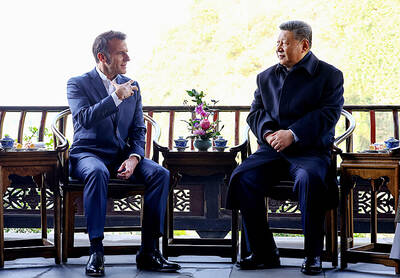
RELAXED: After talks on Ukraine and trade, the French president met with students while his wife visited pandas, after the pair parted ways with their Chinese counterparts French President Emmanuel Macron concluded his fourth state visit to China yesterday in Chengdu, striking a more relaxed note after tough discussions on Ukraine and trade with Chinese President Xi Jinping (習近平) a day earlier. Far from the imposing Great Hall of the People in Beijing where the two leaders held talks, Xi and China’s first lady, Peng Liyuan (彭麗媛), showed Macron and his wife Brigitte around the centuries-old Dujiangyan Dam, a World Heritage Site set against the mountainous landscape of Sichuan Province. Macron was told through an interpreter about the ancient irrigation system, which dates back to the third century


 RSS
RSS