


Sinking into steamy hot springs, the giant rodents of Izu Shaboten Zoo flicked their ears and closed their eyes against the camera clicks of fascinated onlookers, drifting into a hazy midday nap.
They might not know it, but the five capybaras are the star attraction at the zoo about two hours by train south of Tokyo, the host of this year’s Summer Olympics.
Zookeepers are banking on the tourism appeal of the world’s largest rodents to cash in on the fortuitous coincidence of Japan hosting the Olympics in the Lunar zodiac’s Year of the Rat.
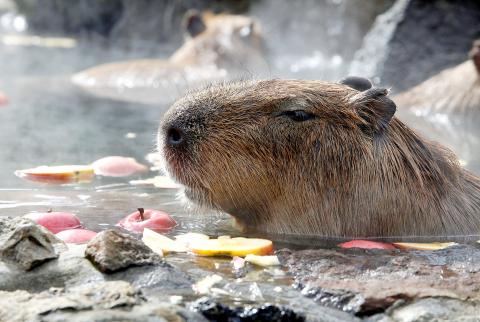
Photo: Reuters
“The capybaras are the highlight of our zoo, so we’re taking the Year of the Rat as an opportunity to push their popularity up even more,” deputy zookeeper Masahiro Takeda said. “We’re really hoping that this will catch on with people from all over the world visiting Japan too.”
Ironically, the capybaras, which are native to the tropical jungles of South America, have been credited with improving the zoo’s popularity in the quieter winter months.
The winter tradition of giving the capybaras daily baths started almost 40 years ago, when a zoo attendant cleaning their pen with hot water turned around to find that they were huddled together trying to sit in one of the warm puddles.
In a country with nearly 3,000 hot spring resorts, the baths quickly became a fixture at Izu Shaboten and other zoos across Japan, where the number of capybaras jumped from 126 in 2006 to 422 in 2016.
The rodents have inspired a popular plush toy and associated merchandise called Kapibarasan, and online video clips of bathing capybaras have been viewed hundreds of thousands of times.
At Izu Shaboten, the capybaras, which weigh between 35kg and 65kg, eat apples and leaves dumped by their keeper into their hot bath before drifting off to sleep. When awake, visitors can don special mittens to pet and hand-feed the giant hamster-like animals.
Daytrippers who stop for a bite to eat at the zoo’s restaurant can indulge in a capybara-themed beef burger, which features a bun in the shape of the animal, with chocolate eyes and mouth drawn on.
Takeda said that he did not have exact data, but estimated that the zoo received 20 to 30 percent more visitors during the winter since it started showcasing the bathing capybaras.
“I’d only ever seen the capybaras sit in hot springs on TV, so I really wanted to see it in person,” 23-year-old visitor Kayo Kogai said on Saturday.
“They look so relaxed… I would really like to join them in their bath,” Kogai’s friend, 23-year-old Mizuki Aoki, added with a laugh.

When a hiker fell from a 55m waterfall in wild New Zealand bush, rescuers were forced to evacuate the badly hurt woman without her dog, which could not be found. After strangers raised thousands of dollars for a search, border collie Molly was flown to safety by a helicopter pilot who was determined to reunite the pet and the owner. A week earlier, an emergency rescue helicopter found the woman with bruises and lacerations after a fall at a rocky spot at the waterfall on the South Island’s West Coast. She was airlifted on March 24, but they were forced to

HIGH HOPES: The power source is expected to have a future, as it is not dependent on the weather or light, and could be useful for places with large desalination facilities A Japanese water plant is harnessing the natural process of osmosis to generate renewable energy that could one day become a common power source. The possibility of generating power from osmosis — when water molecules pass from a less salty solution to a more salty one — has long been known. However, actually generating energy from that has proved more complicated, in part due the difficulty of designing the membrane through which the molecules pass. Engineers in Fukuoka, Japan, and their private partners think they might have cracked it, and have opened what is only the world’s second osmotic power plant. It generates

Hundreds of Filipinos and tourists flocked to a sun-bleached field north of Manila yesterday, on Good Friday, to witness one of the country’s most blood-soaked displays of religious fervor, undeterred by rising fuel prices. Scores of bare-chested flagellants with covered faces walked barefoot through the dusty streets of Pampanga Province’s San Fernando as they flogged their backs with bamboo whips in the scorching heat. Agence France-Presse (AFP) journalists said they saw devotees deliberately puncturing their skin with glass shards attached to a small wooden paddle to ensure their bleeding during the ritual, a way to atone for sins and seek miracles from

Chinese dissident artist Gao Zhen (高兟), famous for making provocative satirical sculptures of former Chinese leader Mao Zedong (毛澤東), was tried on Monday over accusations of “defaming national heroes and martyrs,” his wife and a rights group said. Gao, 69, who was detained in 2024 during a visit from the US, faces a maximum three-year prison sentence, said his wife, Zhao Yaliang (趙雅良), and Shane Yi, a researcher at the Chinese Human Rights Defenders group which operates outside the nation. The closed-door, one-day trial took place at Sanhe City People’s Court in Hebei Province neighboring the capital, Beijing, and ended without a


 RSS
RSS