


The sparky young performers on stage thanked us for coming out that night. There were so many other things we could have been doing, they told us, before launching into their show: Too Much Sexual Freedom Will Turn You Into Terrorists.
“Burning subways” got the biggest laugh. The play was, after all, in Santiago, where only three months ago people took to the streets and did exactly that.
Even now, in spite of soaring summer temperatures, Chileans continue to protest every weekend. Their list of complaints ranges from inadequate private pensions to an out-of-touch president.
The graffiti creeping across every surface called for an end to police violence, for the renationalization of water and for the indigenous Mapuche people to fight back.
Sprayed everywhere was the figure 6 percent — Chilean President Sebastian Pinera’s popularity rating.
While all that was going on outdoors, things were just as polemical in the theaters.
POLITICAL
“We are in a special situation here, but Chilean theater is always political,” said Carmen Romero, director of the Santiago a Mil festival, sitting in the sun outside Centro GAM, once the political headquarters of the administration of former Chilean president Augusto Pinochet, now a city-center arts complex.
“Theater is always thinking and writing about the social process,” she said.
Nearly all of the dozen shows in the festival bear her out.
Sometimes comic, sometimes earnest, always indignant, Chilean theater repeatedly gives voice to the abused, the angry and the dispossessed.
In Too Much Sexual Freedom, directed by Ernesto Orellana Gomes, four performers turn a panel discussion into a confrontational cabaret about fat shaming, HIV prejudice, discrimination against sex workers and trans rights.
Upfront and ribald, they perform with intelligence, humor and an impassioned sense of injustice.
“Let’s decolonize gender,” they said as they picked apart forces of oppression lying deep in Latin America’s history.
GENDER AND POWER
Gender and power were also on the mind of director Stephie Bastias in The Tower, an all-female adaptation of Alejandra Pizarnik’s The Bloody Countess.
It is inspired by the myth of 16th-century Transylvanian countess Elizabeth Bathory; her insatiable taste for blood threatens the lives of her servants, who plan a pre-emptive strike.
High on gothic melodrama and hand-wringing excess, it was an uneven piece, but its call for unity in the face of tyranny echoed what was going on in the streets.
A sharper show was Dragon by Guillermo Calderon. It was written before the October last year emergency, but the playwright, a frequent visitor to the UK, is amazed to see how topical it has become.
Like a polemical take on Yasmina Reza’s Art, it is about a collective of conceptual artists whose every attempt to create Augusto Boal-inspired “invisible theater” on the streets throws them into ethical dilemmas about class, race and representation.
Is it right they should re-enact the assassination in 1980 of Walter Rodney, a Guyanese political advocate, or are they merely reinforcing cliches about Africa and violence?
If they play the roles of Brazilians, will they be making assumptions about the immigrant experience?
Funny, slippery and energetically acted, the three-hander satirized artistic vanity even as it recognized the value of political engagement.
“I’m making a show, while out there on the street is a war,” one said.
All this was consistent with a festival that has its roots in the underground resistance to the Pinochet dictatorship.
Fiercely independent, Santiago a Mil sees itself on the side of the people and has accessibility in its DNA: The three-week festival attracts audiences of 200,000, of whom 150,000 pay nothing.
“Theater and people are together here,” Romero said.
This can mean there are times when political import and giving voice to the voiceless outweigh other considerations.
Love to Death, created by Samoan choreographer Lemi Ponifasio, fused the mournful Mapuche song of Elisa Avendano Curaqueo and the controlled flamenco moves of Natalia Garcia-Huidobro in a lament for Camilo Catrillanca, a young indigenous man killed by the police’s “jungle commandos” in 2018.
For all its butoh-influenced restraint, it was a slow wallow in grief that lacked dramatic momentum.
You sense it got a standing ovation less because of its insight than for the import of what it stands for.
“This is a very special edition of the festival because of the emergency,” said Romero, who had to cancel street theater performances and schedule daytime shows to keep the festival going.
“We are living in a crisis and we need the opportunity to talk about what is happening,” she said.

A plan by Switzerland’s right-wing People’s Party to cap the population at 10 million has the backing of almost half the country, according to a poll before an expected vote next year. The party, which has long campaigned against immigration, argues that too-fast population growth is overwhelming housing, transport and public services. The level of support comes despite the government urging voters to reject it, warning that strict curbs would damage the economy and prosperity, as Swiss companies depend on foreign workers. The poll by newspaper group Tamedia/20 Minuten and released yesterday showed that 48 percent of the population plan to vote

PARLIAMENT CHAOS: Police forcibly removed Brazilian Deputy Glauber Braga after he called the legislation part of a ‘coup offensive’ and occupied the speaker’s chair Brazil’s lower house of Congress early yesterday approved a bill that could slash former Brazilian president Jair Bolsonaro’s prison sentence for plotting a coup, after efforts by a lawmaker to disrupt the proceedings sparked chaos in parliament. Bolsonaro has been serving a 27-year term since last month after his conviction for a scheme to stop Brazilian President Luiz Inacio Lula da Silva from taking office after the 2022 election. Lawmakers had been discussing a bill that would significantly reduce sentences for several crimes, including attempting a coup d’etat — opening up the prospect that Bolsonaro, 70, could have his sentence cut to

A powerful magnitude 7.6 earthquake shook Japan’s northeast region late on Monday, prompting tsunami warnings and orders for residents to evacuate. A tsunami as high as three metres (10 feet) could hit Japan’s northeastern coast after an earthquake with an estimated magnitude of 7.6 occurred offshore at 11:15 p.m. (1415 GMT), the Japan Meteorological Agency (JMA) said. Tsunami warnings were issued for the prefectures of Hokkaido, Aomori and Iwate, and a tsunami of 40cm had been observed at Aomori’s Mutsu Ogawara and Hokkaido’s Urakawa ports before midnight, JMA said. The epicentre of the quake was 80 km (50 miles) off the coast of
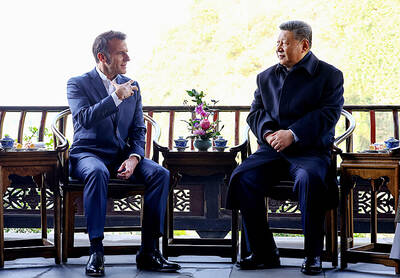
RELAXED: After talks on Ukraine and trade, the French president met with students while his wife visited pandas, after the pair parted ways with their Chinese counterparts French President Emmanuel Macron concluded his fourth state visit to China yesterday in Chengdu, striking a more relaxed note after tough discussions on Ukraine and trade with Chinese President Xi Jinping (習近平) a day earlier. Far from the imposing Great Hall of the People in Beijing where the two leaders held talks, Xi and China’s first lady, Peng Liyuan (彭麗媛), showed Macron and his wife Brigitte around the centuries-old Dujiangyan Dam, a World Heritage Site set against the mountainous landscape of Sichuan Province. Macron was told through an interpreter about the ancient irrigation system, which dates back to the third century


 RSS
RSS