


British Prime Minister Boris Johnson yesterday set out a tough opening gambit in negotiations with the EU, saying the UK would walk away without a free-trade deal rather than agree to follow rules set by the 27-nation bloc.
Just 60 hours after Britain left the EU, the first country ever to do so, Johnson was digging in his heels about future relations.
In a speech to business leaders and international diplomats in London, Johnson planned to say: “We want a free-trade agreement,” but not at any cost.
“The choice is emphatically not ‘deal or no-deal,’” he was to say, according to extracts released by his office. “The question is whether we agree a trading relationship with the EU comparable to Canada’s — or more like Australia’s.”
Australian-style trade would mean a panoply of new tariffs and other barriers between the UK and the EU.
In their divorce agreement, Britain and the EU agreed to strike an “ambitious, broad, deep and flexible partnership,” including a free-trade deal and agreements for security and other areas. They gave themselves 11 months to do it.
A post-Brexit “transition period,” in which relations stay essentially unchanged, runs until the end of this year.
For the rest of this year the UK is to continue to follow EU rules, although it will no longer have a say in EU decisionmaking.
Britain says it wants a “Canada-style” free-trade agreement with the EU covering both goods and services, but it is adamant it would not agree to follow the EU’s entire rule book in return for unfettered trade, because it wants to be free to diverge in order to strike other new deals around the world.
The bloc insists there can be no trade deal unless Britain agrees to a “level playing field” and does not undercut EU regulations, especially in areas of environmental protections, workers’ rights, and health and safety standards.
Johnson intends to double down on Britain’s tough stance.
“There is no need for a free-trade agreement to involve accepting EU rules on competition policy, subsidies, social protection, the environment, or anything similar, any more than the EU should be obliged to accept UK rules,” he was to say.
“The UK will maintain the highest standards in these areas — better, in many respects, than those of the EU — without the compulsion of a treaty. And it is vital to stress this now,” he added.
It is a message aimed as much at a domestic audience as it is a t the bloc, but EU leaders are unlikely to be impressed by what they see as British intransigence and wishful thinking.
EU Chief Negotiator for Brexit Michel Barnier was yesterday due to publish the bloc’s draft negotiating guidelines. Formal talks are to start next month, once they have been approved by the remaining 27 EU nations.
EU leaders have repeatedly warned that the timetable is tight to strike any kind of deal.
Free-trade agreements typically take years. The EU-Canada deal that the British government cites as a model took seven years to negotiate.
If there is no deal by the end of this year, and the UK refuses to extend the negotiating period, Britain faces an abrupt, disruptive economic break from the bloc — with tariffs and other obstacles to trade imposed immediately between the UK and the EU.
That prospect alarms many businesses, especially in sectors such as the auto industry, which depend on the easy flow of parts across borders.

A plan by Switzerland’s right-wing People’s Party to cap the population at 10 million has the backing of almost half the country, according to a poll before an expected vote next year. The party, which has long campaigned against immigration, argues that too-fast population growth is overwhelming housing, transport and public services. The level of support comes despite the government urging voters to reject it, warning that strict curbs would damage the economy and prosperity, as Swiss companies depend on foreign workers. The poll by newspaper group Tamedia/20 Minuten and released yesterday showed that 48 percent of the population plan to vote
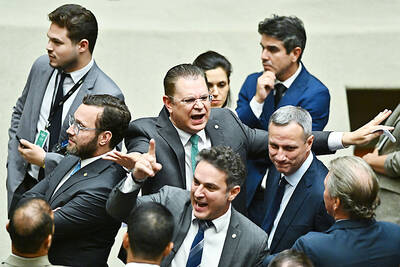
PARLIAMENT CHAOS: Police forcibly removed Brazilian Deputy Glauber Braga after he called the legislation part of a ‘coup offensive’ and occupied the speaker’s chair Brazil’s lower house of Congress early yesterday approved a bill that could slash former Brazilian president Jair Bolsonaro’s prison sentence for plotting a coup, after efforts by a lawmaker to disrupt the proceedings sparked chaos in parliament. Bolsonaro has been serving a 27-year term since last month after his conviction for a scheme to stop Brazilian President Luiz Inacio Lula da Silva from taking office after the 2022 election. Lawmakers had been discussing a bill that would significantly reduce sentences for several crimes, including attempting a coup d’etat — opening up the prospect that Bolsonaro, 70, could have his sentence cut to
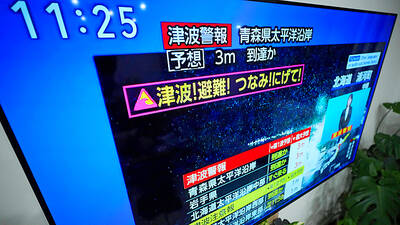
A powerful magnitude 7.6 earthquake shook Japan’s northeast region late on Monday, prompting tsunami warnings and orders for residents to evacuate. A tsunami as high as three metres (10 feet) could hit Japan’s northeastern coast after an earthquake with an estimated magnitude of 7.6 occurred offshore at 11:15 p.m. (1415 GMT), the Japan Meteorological Agency (JMA) said. Tsunami warnings were issued for the prefectures of Hokkaido, Aomori and Iwate, and a tsunami of 40cm had been observed at Aomori’s Mutsu Ogawara and Hokkaido’s Urakawa ports before midnight, JMA said. The epicentre of the quake was 80 km (50 miles) off the coast of
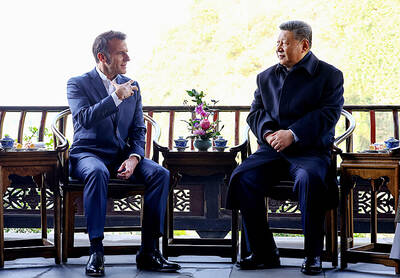
RELAXED: After talks on Ukraine and trade, the French president met with students while his wife visited pandas, after the pair parted ways with their Chinese counterparts French President Emmanuel Macron concluded his fourth state visit to China yesterday in Chengdu, striking a more relaxed note after tough discussions on Ukraine and trade with Chinese President Xi Jinping (習近平) a day earlier. Far from the imposing Great Hall of the People in Beijing where the two leaders held talks, Xi and China’s first lady, Peng Liyuan (彭麗媛), showed Macron and his wife Brigitte around the centuries-old Dujiangyan Dam, a World Heritage Site set against the mountainous landscape of Sichuan Province. Macron was told through an interpreter about the ancient irrigation system, which dates back to the third century


 RSS
RSS