


Smokers can effectively turn back time in their lungs by kicking the habit, with healthy cells emerging to replace some of their tobacco-damaged and cancer-prone ones, a study shows.
Smokers have long been told their risk of developing diseases such as lung cancer would fall if they could quit and that stopping smoking prevents new damage to the body, but a study published yesterday in the journal Nature found that the benefits might go further, with the body appearing to draw on a reservoir of healthy cells to replace smoke-damaged ones in the lungs of smokers when they quit.
The study’s joint senior author, Peter Campbell of the Wellcome Sanger Institute, said the results should give new hope to smokers who want to quit.
“People who have smoked heavily for 30, 40 or more years often say to me that it’s too late to stop smoking — the damage is already done,” he said in a statement issued by the institute. “What is so exciting about our study is that it shows that it’s never too late to quit.”
Some of the people in the study had smoked more than 15,000 packs of cigarettes in their life, he said.
“But within a few years of quitting, many of the cells lining their airways showed no evidence of damage from tobacco,” he said.
The study analyzed lung biopsies from 16 people, including current smokers, former smokers, adults who had never smoked and children, looking for the mutations that can lead to cancer.
Genetic changes that appear in the body’s cells are a normal part of aging and many of these mutations are harmless so-called “passenger mutations,” but a mutation in the wrong gene in the wrong cell can dramatically change the behavior of the cells “and instruct them to behave more like a cancer,” Campbell said.
“If enough of these ‘driver mutations’ accumulate, then the cell will become a full-blown cancer,” he said.
The study found nine out of every 10 lung cells in current smokers had mutations, including those that can cause cancer, but in former smokers, many of those damaged cells had been replaced by healthy ones akin to those seen in people who had never smoked.
Up to 40 percent of the total lung cells in former smokers were healthy, four times more than in their still-smoking counterparts.
Campbell said the damaged cells had not been able to “magically repair themselves.”
“Rather, they are replaced by healthy cells that have escaped the damage from cigarette smoke,” he said.
The precise mechanism by which that replacement occurs is not yet clear, but the study’s authors believe there might be a sort of reservoir of cells, waiting for a chance to emerge.
“Once the person quits smoking, the cells gradually proliferate from this safe harbor to replace the damaged cells,” Campbell said.
Gerd Pfeifer, a professor at the Grand Rapids, Michigan-based Van Andel Institute’s Center for Epigenetics praised the study in a review published by Nature.
“It has shed light on how the protective effect of smoking cessation plays out at the molecular level in human lung tissue,” wrote Pfeifer, who was not involved in the study.
Obtaining lung biopsies raises ethical concerns, meaning the researchers could only study 16 samples obtained from patients who had to undergo biopsies for separate medical reasons.
The small sample size could provide a caveat to the study’s findings, Pfeifer wrote.
However, it “raises many interesting questions worthy of further investigation,” he wrote.
Campbell said the key now would be to locate the reservoir of healthy cells and work out how they are able to replace damaged ones.
“If we can work out where they normally live and what makes them expand when someone stops smoking, perhaps we have opportunities to make them even more effective at repair,” he said.

A plan by Switzerland’s right-wing People’s Party to cap the population at 10 million has the backing of almost half the country, according to a poll before an expected vote next year. The party, which has long campaigned against immigration, argues that too-fast population growth is overwhelming housing, transport and public services. The level of support comes despite the government urging voters to reject it, warning that strict curbs would damage the economy and prosperity, as Swiss companies depend on foreign workers. The poll by newspaper group Tamedia/20 Minuten and released yesterday showed that 48 percent of the population plan to vote

PARLIAMENT CHAOS: Police forcibly removed Brazilian Deputy Glauber Braga after he called the legislation part of a ‘coup offensive’ and occupied the speaker’s chair Brazil’s lower house of Congress early yesterday approved a bill that could slash former Brazilian president Jair Bolsonaro’s prison sentence for plotting a coup, after efforts by a lawmaker to disrupt the proceedings sparked chaos in parliament. Bolsonaro has been serving a 27-year term since last month after his conviction for a scheme to stop Brazilian President Luiz Inacio Lula da Silva from taking office after the 2022 election. Lawmakers had been discussing a bill that would significantly reduce sentences for several crimes, including attempting a coup d’etat — opening up the prospect that Bolsonaro, 70, could have his sentence cut to

A powerful magnitude 7.6 earthquake shook Japan’s northeast region late on Monday, prompting tsunami warnings and orders for residents to evacuate. A tsunami as high as three metres (10 feet) could hit Japan’s northeastern coast after an earthquake with an estimated magnitude of 7.6 occurred offshore at 11:15 p.m. (1415 GMT), the Japan Meteorological Agency (JMA) said. Tsunami warnings were issued for the prefectures of Hokkaido, Aomori and Iwate, and a tsunami of 40cm had been observed at Aomori’s Mutsu Ogawara and Hokkaido’s Urakawa ports before midnight, JMA said. The epicentre of the quake was 80 km (50 miles) off the coast of
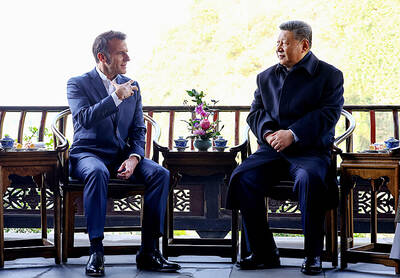
RELAXED: After talks on Ukraine and trade, the French president met with students while his wife visited pandas, after the pair parted ways with their Chinese counterparts French President Emmanuel Macron concluded his fourth state visit to China yesterday in Chengdu, striking a more relaxed note after tough discussions on Ukraine and trade with Chinese President Xi Jinping (習近平) a day earlier. Far from the imposing Great Hall of the People in Beijing where the two leaders held talks, Xi and China’s first lady, Peng Liyuan (彭麗媛), showed Macron and his wife Brigitte around the centuries-old Dujiangyan Dam, a World Heritage Site set against the mountainous landscape of Sichuan Province. Macron was told through an interpreter about the ancient irrigation system, which dates back to the third century


 RSS
RSS