


US President Donald Trump on Monday hosted Israel’s prime minister and his chief rival at the White House on the eve of unveiling a long-awaited Middle East peace plan, expressing confidence that despite adamant Palestinian rejection they would ultimately go along with a blueprint he said was “very good for them.”
The Trump proposal is widely expected to be favorable to Israel, with Israeli Prime Minister Benjamin Netanyahu and challenger Benny Gantz speaking in glowing terms about the president and his initiative.
Yet with the Palestinians steadfastly refusing to even speak to Trump, and urging other Arab nations to boycott yesterday’s unveiling, there is great skepticism over the plan’s chances of success.

Photo: AP
The meetings come just a month before Netanyahu and Gantz are set to face off in national elections for the third time in less than a year, and both were looking to project leadership in their separate meetings with the president.
Trump called his proposal a great “opportunity,” but would not discuss further details, saying that its release has long been delayed because of the uncertain political situation in Israel.
He refused to answer questions about whether it would include Israeli annexation of parts of the West Bank, signaling that it was premature for Palestinians to rule it out.
“I think in the end they’re going to want it. It’s very good for them,” he said alongside Netanyahu.
“We’re going to show a plan. It’s been worked on by everybody, and we’ll see whether or not it catches hold,” Trump said. “If it does, that would be great, and if it doesn’t, we can live with it, too, but I think it might have a chance.”
Netanyahu has hailed it as a chance to “make history” and define Israel’s final borders.
At the White House, Netanyahu pointed out Trump’s various gestures to Israel as well as his strong stance against Iran.
Netanyahu’s office said most of the meeting actually focused on Iran, although the peace plan was also discussed.
“You have made our alliance stronger than ever,” Netanyahu said to Trump.
Shortly after Netanyahu left, Gantz was invited into the White House for his first meeting with Trump.
Speaking to reporters later, he did not disclose details of their conversation, but he did shower Trump with praise.
He called his peace plan “a significant and historic milestone” that he looked forward to implementing once he became prime minister, in tandem with other countries in the region, specifically mentioning Jordan.
In the run-up to the March 2 vote, Netanyahu has called for annexing parts of the West Bank and imposing Israeli sovereignty on all its settlements there.
Israel captured the West Bank in the 1967 Mideast war, and the Jordan Valley in particular is considered a vital security asset.
Reports in Israeli media have speculated that Trump’s plan could include the possible annexation of large pieces of territory that the Palestinians seek for a future independent state.
US approval could give Netanyahu the type of cover to go ahead with a move that he has resisted taking for more than a decade.
Annexing Israel’s settlements in the occupied West Bank would appeal to Netanyahu’s hardline nationalist supporters, but would almost certainly torpedo the viability of an independent Palestinian state and likely infuriate neighboring Jordan.
In 1994, Israel and Jordan signed a peace treaty, the second between Israel and its Arab neighbors after Egypt.
Palestinian Prime Minister Mohammad Shtayyeh denounced the still-unpublished proposal, saying that it “doesn’t constitute a basis for resolving the conflict.”
He said that the plan contravenes international law and “comes from a party that has lost its credibility to be an honest broker in a serious and genuine political process.”

A plan by Switzerland’s right-wing People’s Party to cap the population at 10 million has the backing of almost half the country, according to a poll before an expected vote next year. The party, which has long campaigned against immigration, argues that too-fast population growth is overwhelming housing, transport and public services. The level of support comes despite the government urging voters to reject it, warning that strict curbs would damage the economy and prosperity, as Swiss companies depend on foreign workers. The poll by newspaper group Tamedia/20 Minuten and released yesterday showed that 48 percent of the population plan to vote

PARLIAMENT CHAOS: Police forcibly removed Brazilian Deputy Glauber Braga after he called the legislation part of a ‘coup offensive’ and occupied the speaker’s chair Brazil’s lower house of Congress early yesterday approved a bill that could slash former Brazilian president Jair Bolsonaro’s prison sentence for plotting a coup, after efforts by a lawmaker to disrupt the proceedings sparked chaos in parliament. Bolsonaro has been serving a 27-year term since last month after his conviction for a scheme to stop Brazilian President Luiz Inacio Lula da Silva from taking office after the 2022 election. Lawmakers had been discussing a bill that would significantly reduce sentences for several crimes, including attempting a coup d’etat — opening up the prospect that Bolsonaro, 70, could have his sentence cut to

A powerful magnitude 7.6 earthquake shook Japan’s northeast region late on Monday, prompting tsunami warnings and orders for residents to evacuate. A tsunami as high as three metres (10 feet) could hit Japan’s northeastern coast after an earthquake with an estimated magnitude of 7.6 occurred offshore at 11:15 p.m. (1415 GMT), the Japan Meteorological Agency (JMA) said. Tsunami warnings were issued for the prefectures of Hokkaido, Aomori and Iwate, and a tsunami of 40cm had been observed at Aomori’s Mutsu Ogawara and Hokkaido’s Urakawa ports before midnight, JMA said. The epicentre of the quake was 80 km (50 miles) off the coast of
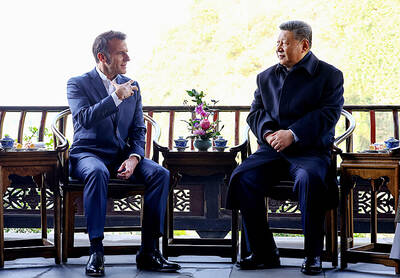
RELAXED: After talks on Ukraine and trade, the French president met with students while his wife visited pandas, after the pair parted ways with their Chinese counterparts French President Emmanuel Macron concluded his fourth state visit to China yesterday in Chengdu, striking a more relaxed note after tough discussions on Ukraine and trade with Chinese President Xi Jinping (習近平) a day earlier. Far from the imposing Great Hall of the People in Beijing where the two leaders held talks, Xi and China’s first lady, Peng Liyuan (彭麗媛), showed Macron and his wife Brigitte around the centuries-old Dujiangyan Dam, a World Heritage Site set against the mountainous landscape of Sichuan Province. Macron was told through an interpreter about the ancient irrigation system, which dates back to the third century


 RSS
RSS