


The sudden surge in violence in Yemen could scupper fragile moves toward a peace settlement, UN special envoy to Yemen Martin Griffiths said.
“We have to get the genie back in the bottle,” Griffiths said. “Whoever started this renewed violence, it is unequivocally the case that there has been a huge rupture of confidence and a huge loss of life for the sake of uncertain territorial gains.”
Griffiths, who is calling for an emergency meeting of the UN Security Council, said he had “a very real fear of the wheels coming off” in a region already made less safe by the fallout from the killing of Iranian top general Qassem Suleimani in a US raid in Baghdad earlier this month.

Photo: EPA-EFE
On Jan. 18, more than 130 Yemeni soldiers were killed at a training camp in Marib, 113km east of the capital, Sana’a, in one of the bloodiest single incidents since the civil war erupted five years ago.
Related battles in the district of Nihm, to the northeast of Sana’a, and al-Jawf appear to have led to an extraordinary loss of life. Houthi rebel forces appear to have cut off and routed the government forces, even overcoming close air support from Saudi Arabia.
Before the violence there had been a period of de-escalation that Griffiths had hailed in a briefing to the UN Security Council given only two days before the Marib massacre.
Saudi airstrikes had fallen 80 percent by one measure.
“The remarkable achievements of de-escalation are at grave risk and we are in danger of going back to a war that is unwinnable. Certain pieces of ground can be captured and recaptured, but none of these are knockout blows, or substantially change the equation,” Griffiths said.
The upswing in violence “told us is that the war is not over,” Griffiths said. “Everyone wants de-escalation and yet it seems difficult to achieve. It is a question of who goes first.”
Griffiths did not directly attribute the Marib attack to the Houthis, saying it was “tragic, egregious and inexplicable.”
His job was to convene, and not condemn, he said.
“My job is to find areas of commonality rather than judging parties, but we need to understand why it happened,” he said.
Yemen’s civil war escalated in 2014 when Saudi Arabia and the United Arab Emirates (UAE) came to the defense of the government of Abdrabbuh Mansour Hadi after he was ejected from the capital by the Houthis, an Islamic political and armed movement that emerged from Sa’dah in northern Yemen in the 1990s.
As many as 100,000 people have been killed subsequently, and millions afflicted by severe food shortages.
The UAE has pulled out of the war, and the Saudis appear to favor a peace in which the Houthis form part of a unified government.
Griffiths acknowledged that the previous strategy of localized agreements before national talks, such as an agreement over the strategic port city of Hodeidah, was no longer appropriate.
He said the crucial trigger for national talks over a transitional national coalition government was the implementation of an agreement negotiated by the Saudi Arabians in November between the Hadi government and the Southern Transitional Council, a separatist movement.
The council had seized the port city of Aden from Hadi in August last year, exposing a further fissure in Yemen’s anti-Houthi alliance.
“Progress on the agreement is vital if we are to launch political talks,” Griffiths said.

A plan by Switzerland’s right-wing People’s Party to cap the population at 10 million has the backing of almost half the country, according to a poll before an expected vote next year. The party, which has long campaigned against immigration, argues that too-fast population growth is overwhelming housing, transport and public services. The level of support comes despite the government urging voters to reject it, warning that strict curbs would damage the economy and prosperity, as Swiss companies depend on foreign workers. The poll by newspaper group Tamedia/20 Minuten and released yesterday showed that 48 percent of the population plan to vote

PARLIAMENT CHAOS: Police forcibly removed Brazilian Deputy Glauber Braga after he called the legislation part of a ‘coup offensive’ and occupied the speaker’s chair Brazil’s lower house of Congress early yesterday approved a bill that could slash former Brazilian president Jair Bolsonaro’s prison sentence for plotting a coup, after efforts by a lawmaker to disrupt the proceedings sparked chaos in parliament. Bolsonaro has been serving a 27-year term since last month after his conviction for a scheme to stop Brazilian President Luiz Inacio Lula da Silva from taking office after the 2022 election. Lawmakers had been discussing a bill that would significantly reduce sentences for several crimes, including attempting a coup d’etat — opening up the prospect that Bolsonaro, 70, could have his sentence cut to

A powerful magnitude 7.6 earthquake shook Japan’s northeast region late on Monday, prompting tsunami warnings and orders for residents to evacuate. A tsunami as high as three metres (10 feet) could hit Japan’s northeastern coast after an earthquake with an estimated magnitude of 7.6 occurred offshore at 11:15 p.m. (1415 GMT), the Japan Meteorological Agency (JMA) said. Tsunami warnings were issued for the prefectures of Hokkaido, Aomori and Iwate, and a tsunami of 40cm had been observed at Aomori’s Mutsu Ogawara and Hokkaido’s Urakawa ports before midnight, JMA said. The epicentre of the quake was 80 km (50 miles) off the coast of
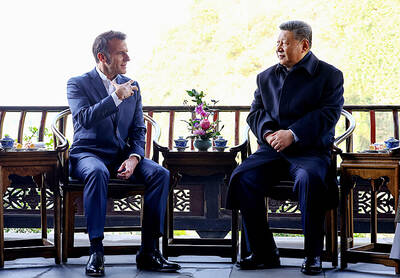
RELAXED: After talks on Ukraine and trade, the French president met with students while his wife visited pandas, after the pair parted ways with their Chinese counterparts French President Emmanuel Macron concluded his fourth state visit to China yesterday in Chengdu, striking a more relaxed note after tough discussions on Ukraine and trade with Chinese President Xi Jinping (習近平) a day earlier. Far from the imposing Great Hall of the People in Beijing where the two leaders held talks, Xi and China’s first lady, Peng Liyuan (彭麗媛), showed Macron and his wife Brigitte around the centuries-old Dujiangyan Dam, a World Heritage Site set against the mountainous landscape of Sichuan Province. Macron was told through an interpreter about the ancient irrigation system, which dates back to the third century


 RSS
RSS