


The risk of civil collapse from nuclear weapons and the climate crisis is at a record high, US scientists and former officials said, calling the current environment “profoundly unstable.”
They said the rise of “cyber-enabled disinformation campaigns” compounds both threats by keeping the public from insisting on progress.
The Bulletin of the Atomic Scientists announced its symbolic “doomsday clock” has moved forward to 100 seconds to midnight, the closest to catastrophe that the scientists have judged the world to be at any point since its creation in 1947, at the outset of the Cold War.
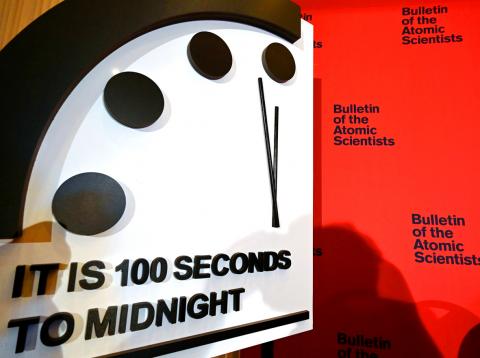
Photo: AFP
“The world needs to wake up. Our planet faces two simultaneous existential threats,” said Mary Robinson, chair of an independent group of global leaders called The Elders, and the former president of Ireland and former UN high commissioner of human rights.
Robinson said that countries that do not aim to eliminate greenhouse gas emissions heating the planet and instead exploit fossil fuels are issuing “a death sentence for humanity.”
She said while public pressure presents a “sliver of hope” for the climate, there is no such pressure on leaders to avert nuclear threats.
As long as nuclear weapons are available, it is inevitable they will one day be used, “by accident, miscalculation or design,” she said.
Robert Rosner, chair of the Bulletin’s science and security board, said society has normalized a very dangerous world, and that “information warfare” is undermining “the public’s ability to sort out what’s true and what’s patently false.”
Sharon Squassoni, a board member and research professor at George Washington University, noted the US’ withdrawal from the Iran nuclear agreement, which has resulted in Tehran reducing compliance.
Although some thought US President Donald Trump’s unique approach might bring North Korea to the negotiating table, no real progress has ensued, she said.
The warning comes as nuclear arms control is in danger of dying out altogether. The Intermediate-range Nuclear Forces (INF) treaty lapsed in August after the US accused Russia of cheating and Trump said he would leave the 1987 treaty altogether.

A plan by Switzerland’s right-wing People’s Party to cap the population at 10 million has the backing of almost half the country, according to a poll before an expected vote next year. The party, which has long campaigned against immigration, argues that too-fast population growth is overwhelming housing, transport and public services. The level of support comes despite the government urging voters to reject it, warning that strict curbs would damage the economy and prosperity, as Swiss companies depend on foreign workers. The poll by newspaper group Tamedia/20 Minuten and released yesterday showed that 48 percent of the population plan to vote

PARLIAMENT CHAOS: Police forcibly removed Brazilian Deputy Glauber Braga after he called the legislation part of a ‘coup offensive’ and occupied the speaker’s chair Brazil’s lower house of Congress early yesterday approved a bill that could slash former Brazilian president Jair Bolsonaro’s prison sentence for plotting a coup, after efforts by a lawmaker to disrupt the proceedings sparked chaos in parliament. Bolsonaro has been serving a 27-year term since last month after his conviction for a scheme to stop Brazilian President Luiz Inacio Lula da Silva from taking office after the 2022 election. Lawmakers had been discussing a bill that would significantly reduce sentences for several crimes, including attempting a coup d’etat — opening up the prospect that Bolsonaro, 70, could have his sentence cut to

A powerful magnitude 7.6 earthquake shook Japan’s northeast region late on Monday, prompting tsunami warnings and orders for residents to evacuate. A tsunami as high as three metres (10 feet) could hit Japan’s northeastern coast after an earthquake with an estimated magnitude of 7.6 occurred offshore at 11:15 p.m. (1415 GMT), the Japan Meteorological Agency (JMA) said. Tsunami warnings were issued for the prefectures of Hokkaido, Aomori and Iwate, and a tsunami of 40cm had been observed at Aomori’s Mutsu Ogawara and Hokkaido’s Urakawa ports before midnight, JMA said. The epicentre of the quake was 80 km (50 miles) off the coast of
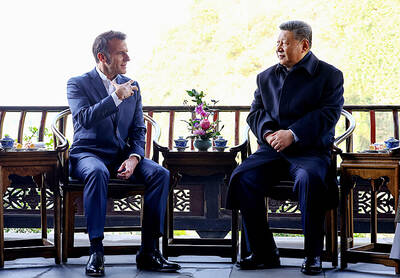
RELAXED: After talks on Ukraine and trade, the French president met with students while his wife visited pandas, after the pair parted ways with their Chinese counterparts French President Emmanuel Macron concluded his fourth state visit to China yesterday in Chengdu, striking a more relaxed note after tough discussions on Ukraine and trade with Chinese President Xi Jinping (習近平) a day earlier. Far from the imposing Great Hall of the People in Beijing where the two leaders held talks, Xi and China’s first lady, Peng Liyuan (彭麗媛), showed Macron and his wife Brigitte around the centuries-old Dujiangyan Dam, a World Heritage Site set against the mountainous landscape of Sichuan Province. Macron was told through an interpreter about the ancient irrigation system, which dates back to the third century


 RSS
RSS