


Thousands of Iraqis yesterday rallied at two central Baghdad intersections after a prominent cleric called for a “million strong” protest against the US military presence, following the US killing of an Iranian general and an Iraqi militia chief.
The march called by Moqtada al-Sadr aims to pressure Washington to pull out its troops, but many anti-government protesters fear it could overshadow their separate, months-long demonstrations that have challenged Iran-backed Shiite groups’ grip on power.
Al-Sadr opposes all foreign interference in Iraq, but has recently aligned himself more closely with Iran, whose allies have dominated state institutions since the US-led invasion of Iraq in 2003.

Photo: Reuters
Throngs of marchers started gathering early yesterday at al-Hurriya Square in central Baghdad and near around the city’s main university, witnesses said.
Marchers avoided Tahrir Square, symbol of mass protests against Iraq’ ruling elites.
“We want them all out — America, Israel, and the corrupt politicians in government,” said Raed Abu Zahra, a health ministry worker from southern city of Samawa, who arrived by bus at night and stayed in Sadr City, a sprawling district of Baghdad controlled by the cleric’s followers.
“We support the protests in Tahrir as well, but understand why Sadr held this protest here so it doesn’t take attention from theirs,” he added.
Men and women marched waving the red, white and black national colors, and chanted slogans against the US, which leads a military coalition against the Islamic State militants in Iraq and Syria.
Some were wearing symbolic white robes indicating they are willing to die for their country, while others sat looking out over the square from half-finished buildings, holding signs reading “No, no, America, no, no, Israel, no, no, colonialists.”
Marchers were protected by al-Sadr’s Saraya al-Salam brigades and Iraq’s Popular Mobilization Forces, an umbrella grouping of Iran-backed Shiite militias, witnesses said.
Main roads in Baghdad were barricaded by security forces and the city’s Green Zone, which houses foreign missions, was blocked off with concrete barriers.
Outside the US embassy, a sign reads “Warning. Do not cross this barrier, we will use pre-emptive measures against any attempt to cross.”
The US killing of Iranian military mastermind General Qassem Soleimani in Baghdad this month has raised the specter of more civil strife in a country torn by years of sectarian conflict.
Long opposed to the US troop presence, al-Sadr seized on the public anger over the drone strike to call “a million-strong, peaceful, unified demonstration to condemn the American presence and its violations.”
The cleric controls parliament’s largest bloc and his followers hold top ministerial positions. The 46-year-old is a notoriously fickle politician, known for switching alliances quickly.
Harith Hasan of the Carnegie Middle East Center in Beirut said al-Sadr was trying to sustain his “multiple identities” by backing various protests.
“On the one hand, [he seeks to] position himself as the leader of a reform movement, as a populist, as anti-establishment,” Hasan told Agence France-Presse. “On the other hand, he also wants to sustain his image as the leader of the resistance to the ‘American occupation,’” partly to win favor with Iran.”
“This protest will show [al-]Sadr is still the one able to mobilize large groups of people in the streets — but it’s also possible he wants other groups to respond by giving him more space to choose the prime minister,” Hasan said.
Additional reporting by AFP

A plan by Switzerland’s right-wing People’s Party to cap the population at 10 million has the backing of almost half the country, according to a poll before an expected vote next year. The party, which has long campaigned against immigration, argues that too-fast population growth is overwhelming housing, transport and public services. The level of support comes despite the government urging voters to reject it, warning that strict curbs would damage the economy and prosperity, as Swiss companies depend on foreign workers. The poll by newspaper group Tamedia/20 Minuten and released yesterday showed that 48 percent of the population plan to vote

PARLIAMENT CHAOS: Police forcibly removed Brazilian Deputy Glauber Braga after he called the legislation part of a ‘coup offensive’ and occupied the speaker’s chair Brazil’s lower house of Congress early yesterday approved a bill that could slash former Brazilian president Jair Bolsonaro’s prison sentence for plotting a coup, after efforts by a lawmaker to disrupt the proceedings sparked chaos in parliament. Bolsonaro has been serving a 27-year term since last month after his conviction for a scheme to stop Brazilian President Luiz Inacio Lula da Silva from taking office after the 2022 election. Lawmakers had been discussing a bill that would significantly reduce sentences for several crimes, including attempting a coup d’etat — opening up the prospect that Bolsonaro, 70, could have his sentence cut to

A powerful magnitude 7.6 earthquake shook Japan’s northeast region late on Monday, prompting tsunami warnings and orders for residents to evacuate. A tsunami as high as three metres (10 feet) could hit Japan’s northeastern coast after an earthquake with an estimated magnitude of 7.6 occurred offshore at 11:15 p.m. (1415 GMT), the Japan Meteorological Agency (JMA) said. Tsunami warnings were issued for the prefectures of Hokkaido, Aomori and Iwate, and a tsunami of 40cm had been observed at Aomori’s Mutsu Ogawara and Hokkaido’s Urakawa ports before midnight, JMA said. The epicentre of the quake was 80 km (50 miles) off the coast of
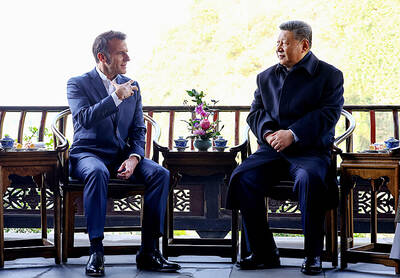
RELAXED: After talks on Ukraine and trade, the French president met with students while his wife visited pandas, after the pair parted ways with their Chinese counterparts French President Emmanuel Macron concluded his fourth state visit to China yesterday in Chengdu, striking a more relaxed note after tough discussions on Ukraine and trade with Chinese President Xi Jinping (習近平) a day earlier. Far from the imposing Great Hall of the People in Beijing where the two leaders held talks, Xi and China’s first lady, Peng Liyuan (彭麗媛), showed Macron and his wife Brigitte around the centuries-old Dujiangyan Dam, a World Heritage Site set against the mountainous landscape of Sichuan Province. Macron was told through an interpreter about the ancient irrigation system, which dates back to the third century


 RSS
RSS