


A CIA contract psychologist who helped draft the US program of “enhanced interrogation” of suspected terrorists has told a military tribunal that he was unable to stop cases of “abusive drift” by an unnamed senior agency official.
Giving evidence at a military commission on Guantanamo Bay, James Mitchell gave a detailed account of the 2002 decision to interrogate suspected al-Qaeda leaders using waterboarding and other techniques, which the US later admitted constituted torture.
At the 40th pre-trial hearing of the Sept. 11, 2001, case in a specially built courtroom at the US naval base, Mitchell was watched with close attention by the five defendants.
On the front row closest to the witness box was Khalid Sheikh Mohammed, the self-proclaimed mastermind of the 2001 attacks on New York and Washington, who was waterboarded 183 times.
In testimony that veered from the gruff to jokey to tearful, Mitchell said the methods he had recommended were based on a course given to US armed services to help them withstand enemy interrogation, known as survival, evasion, resistance and escape (SERE).
The measures, which included slamming detainees repeatedly against a wooden wall, cramming them in a small box sometimes with insects and waterboarding — simulated drowning — had been approved by the US Department of Justice in July 2002 under the administration of then-US president George W. Bush administration.
Mitchell said the measures were within the limits of what was legal and were designed to force detainees to give up information rapidly that could help prevent a further attack, possibly involving a nuclear weapon.
“The CIA was never interested in prosecution,” he told the court. “They were going to go right up to the line of what was legal, put their toes on it and lean forward.”
Mitchell, who was recruited by the CIA in 2002 to first observe and then apply coercive measures, said that the agency was determined to “get tough” and he wanted to make sure it was done within limits.
“What I was told was: ‘The gloves were off,’” said Mitchell, now 68, a tall, thin man with a trimmed white beard, dressed in a charcoal suit and red tie. “They were going to use some form of physical coercion... My concern was that they were going to make it up on the fly.”
Mitchell has accused other CIA interrogators of using waterboarding far in excess of guidelines as well as other unauthorized interrogation techniques.
In court on Tuesday he described these excesses as “abusive drift.”
“When people are left to make up coercive measures, it tends to escalate over time,” Mitchell said. “They dehumanize the detainees. They think they are justified in using a higher level of pressure. They think: ‘If a little is good, a lot is better.’”
He said he had tried to stop several interrogations that had got out of hand, in particular by the head of CIA interrogations of the CIA’s newly formed rendition, detention and interrogation group, an unnamed officer he referred to by the nickname the “New Sheriff.”
“The agency had not approved the techniques he was using,” Mitchell said.
He described the approach underlying the abuses as: “Hurt the person until they tell you what you want to know and then you hurt them some more, to find out if they are lying to you.”
Mitchell said he had voluntarily flown to Guantanamo Bay to give evidence.
“I didn’t do it for you,” he told James Connell, the defense lawyer questioning him. “I did it for the victims and families” of the 9/11 attacks.
On entering the courtroom, Mitchell appeared to make eye contact with Mohammed, who he had subjected to multiple waterboarding sessions and with whom he claimed to have long discussions about Islam.
Choking his words and tearing up as he defended his actions, Mitchell told the court: “I felt my moral obligation to protect American lives outweighed the temporary discomfort of terrorists who had taken up arms against America.”

A plan by Switzerland’s right-wing People’s Party to cap the population at 10 million has the backing of almost half the country, according to a poll before an expected vote next year. The party, which has long campaigned against immigration, argues that too-fast population growth is overwhelming housing, transport and public services. The level of support comes despite the government urging voters to reject it, warning that strict curbs would damage the economy and prosperity, as Swiss companies depend on foreign workers. The poll by newspaper group Tamedia/20 Minuten and released yesterday showed that 48 percent of the population plan to vote
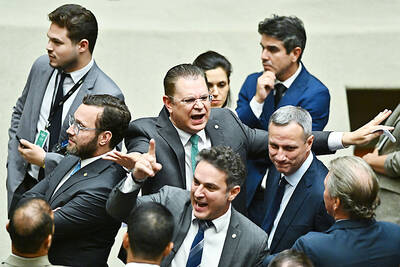
PARLIAMENT CHAOS: Police forcibly removed Brazilian Deputy Glauber Braga after he called the legislation part of a ‘coup offensive’ and occupied the speaker’s chair Brazil’s lower house of Congress early yesterday approved a bill that could slash former Brazilian president Jair Bolsonaro’s prison sentence for plotting a coup, after efforts by a lawmaker to disrupt the proceedings sparked chaos in parliament. Bolsonaro has been serving a 27-year term since last month after his conviction for a scheme to stop Brazilian President Luiz Inacio Lula da Silva from taking office after the 2022 election. Lawmakers had been discussing a bill that would significantly reduce sentences for several crimes, including attempting a coup d’etat — opening up the prospect that Bolsonaro, 70, could have his sentence cut to

A powerful magnitude 7.6 earthquake shook Japan’s northeast region late on Monday, prompting tsunami warnings and orders for residents to evacuate. A tsunami as high as three metres (10 feet) could hit Japan’s northeastern coast after an earthquake with an estimated magnitude of 7.6 occurred offshore at 11:15 p.m. (1415 GMT), the Japan Meteorological Agency (JMA) said. Tsunami warnings were issued for the prefectures of Hokkaido, Aomori and Iwate, and a tsunami of 40cm had been observed at Aomori’s Mutsu Ogawara and Hokkaido’s Urakawa ports before midnight, JMA said. The epicentre of the quake was 80 km (50 miles) off the coast of
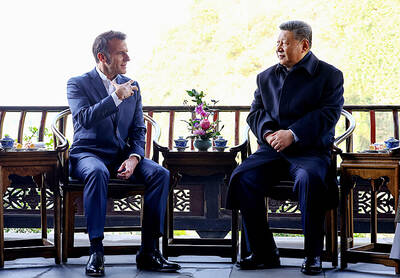
RELAXED: After talks on Ukraine and trade, the French president met with students while his wife visited pandas, after the pair parted ways with their Chinese counterparts French President Emmanuel Macron concluded his fourth state visit to China yesterday in Chengdu, striking a more relaxed note after tough discussions on Ukraine and trade with Chinese President Xi Jinping (習近平) a day earlier. Far from the imposing Great Hall of the People in Beijing where the two leaders held talks, Xi and China’s first lady, Peng Liyuan (彭麗媛), showed Macron and his wife Brigitte around the centuries-old Dujiangyan Dam, a World Heritage Site set against the mountainous landscape of Sichuan Province. Macron was told through an interpreter about the ancient irrigation system, which dates back to the third century


 RSS
RSS