


The first stage of an extradition hearing for a senior executive of Chinese tech giant Huawei started on Monday in a Vancouver courtroom, a case that has infuriated Beijing, caused a diplomatic uproar between China and Canada, and complicated high-stakes trade talks between Beijing and Washington.
Canada’s arrest of chief financial officer Meng Wanzhou (孟晚舟), the daughter of Huawei founder Ren Zhengfei (任正非), in late 2018 at the US’ request, enraged Beijing to the point it detained two Canadians in apparent retaliation.
Huawei represents China’s progress in becoming a technological power and has been a subject of US security concerns for years. Beijing views Meng’s case as an attempt to contain China’s rise.
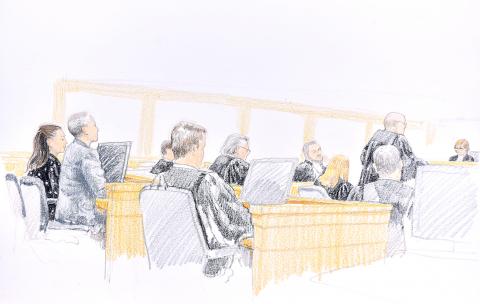
Photo: AFP
“Our government has been clear. We are a rule of law country and we honor our extradition treaty commitments,” Canadian Deputy Prime Minister Chrystia Freeland said at a Cabinet retreat in Manitoba. “It is what we need to do and what we will do.”
The Chinese Ministry of Foreign Affairs on Monday accused the US and Canada of violating Meng’s rights and called for her release.
“It is completely a serious political incident,” ministry spokesman Geng Shuang (耿爽) said, urging Canada to “correct mistakes with concrete actions, release Ms Meng Wanzhou and let her return safely as soon as possible.”
Washington accuses Huawei of using a Hong Kong shell company to sell equipment to Iran in a breach of US sanctions. It says Meng, 47, committed fraud by misleading HSBC about the company’s business dealings in Tehran.
Meng, who is free on bail and living in one of the two Vancouver mansions she owns, sat next to her lawyers. She earlier waved at reporters as she arrived at court.
Meng denies the US allegations. Her defense team says comments by US President Donald Trump suggest the case against her is politically motivated.
“We trust in Canada’s judicial system, which will prove Ms Meng’s innocence,” Huawei said in a statement as the proceedings began.
Meng was detained in December 2018 in Vancouver as she was changing flights — on the same day that Trump and Chinese President Xi Jinping (習近平) met for trade talks.
Huawei is the biggest global supplier of network gear for cellphone and Internet companies.
Washington is pressuring other countries to limit use of its technology, warning they could be opening themselves up to surveillance and theft.
The initial stage of Meng’s extradition hearing this week is focusing on whether Meng’s alleged crimes are crimes both in the US and Canada. Her lawyers on Friday filed a motion arguing that Meng’s case is really about US sanctions against Iran, not a fraud case. Canada does not have similar sanctions on Iran.
Richard Peck, Meng’s lawyer, said in court that the fraud allegations are a “facade” and the charges are really about the US attempting to enforce its sanctions on Iran.
“Would we be here in the absence of US sanctions law? My response is no,” Peck said.
The second phase, scheduled for June, would consider defense allegations that Canada Border Services, the Royal Canadian Mounted Police and the FBI violated Meng’s rights while collecting evidence before she was actually arrested.
The extradition case could take years to resolve if there are appeals. From 2008 to 2018, nearly 90 percent of those arrested in Canada on extradition requests from the US were surrendered to US authorities.

A plan by Switzerland’s right-wing People’s Party to cap the population at 10 million has the backing of almost half the country, according to a poll before an expected vote next year. The party, which has long campaigned against immigration, argues that too-fast population growth is overwhelming housing, transport and public services. The level of support comes despite the government urging voters to reject it, warning that strict curbs would damage the economy and prosperity, as Swiss companies depend on foreign workers. The poll by newspaper group Tamedia/20 Minuten and released yesterday showed that 48 percent of the population plan to vote
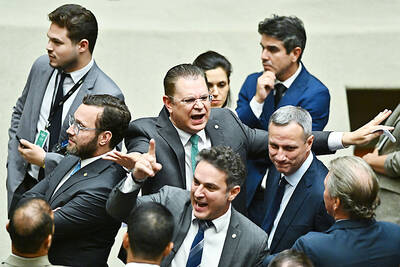
PARLIAMENT CHAOS: Police forcibly removed Brazilian Deputy Glauber Braga after he called the legislation part of a ‘coup offensive’ and occupied the speaker’s chair Brazil’s lower house of Congress early yesterday approved a bill that could slash former Brazilian president Jair Bolsonaro’s prison sentence for plotting a coup, after efforts by a lawmaker to disrupt the proceedings sparked chaos in parliament. Bolsonaro has been serving a 27-year term since last month after his conviction for a scheme to stop Brazilian President Luiz Inacio Lula da Silva from taking office after the 2022 election. Lawmakers had been discussing a bill that would significantly reduce sentences for several crimes, including attempting a coup d’etat — opening up the prospect that Bolsonaro, 70, could have his sentence cut to

A powerful magnitude 7.6 earthquake shook Japan’s northeast region late on Monday, prompting tsunami warnings and orders for residents to evacuate. A tsunami as high as three metres (10 feet) could hit Japan’s northeastern coast after an earthquake with an estimated magnitude of 7.6 occurred offshore at 11:15 p.m. (1415 GMT), the Japan Meteorological Agency (JMA) said. Tsunami warnings were issued for the prefectures of Hokkaido, Aomori and Iwate, and a tsunami of 40cm had been observed at Aomori’s Mutsu Ogawara and Hokkaido’s Urakawa ports before midnight, JMA said. The epicentre of the quake was 80 km (50 miles) off the coast of
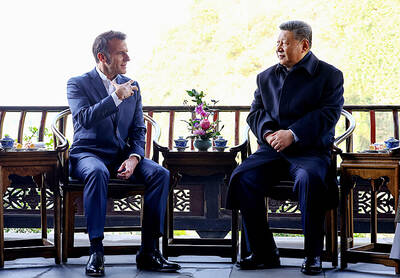
RELAXED: After talks on Ukraine and trade, the French president met with students while his wife visited pandas, after the pair parted ways with their Chinese counterparts French President Emmanuel Macron concluded his fourth state visit to China yesterday in Chengdu, striking a more relaxed note after tough discussions on Ukraine and trade with Chinese President Xi Jinping (習近平) a day earlier. Far from the imposing Great Hall of the People in Beijing where the two leaders held talks, Xi and China’s first lady, Peng Liyuan (彭麗媛), showed Macron and his wife Brigitte around the centuries-old Dujiangyan Dam, a World Heritage Site set against the mountainous landscape of Sichuan Province. Macron was told through an interpreter about the ancient irrigation system, which dates back to the third century


 RSS
RSS