


Ander Mendez and his friends were hoping they had struck it rich with the idea of selling alcohol-infused gummy bears — until they found themselves in the sights of sweet giant Haribo. Now, the three Spaniards say they are afraid of being shut down by the German confectionery king, which is famed for its vast array of jelly sweets and was founded 100 years ago in the western city of Bonn.
In a not-so-sweetly worded legal letter, Haribo has accused their start-up of infringing its trademarked little bear.
However, the graduates from the northern Spanish port city of Bilbao say that they will carry on producing their “drunken gummy bears” — “because people like them.”
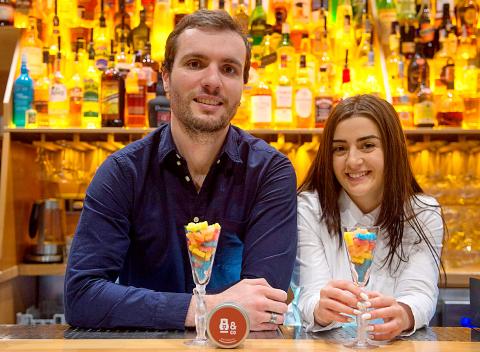
Photo: AFP
The conflict arose from the apparent similarities between the fruit gums created a year ago by the start-up, Osito & Co, and the miniature jelly bear that has become Haribo’s best-known product. With a manufacturing facility in Spain’s northern Basque Country, the trio created a premium product in five different flavors in stylish metal tins that hold 30 sweets and retail at 9 euros (US$10). Each is color-coded to denote different flavors: blue for rum and pineapple, pink for gin and strawberry, orange for vodka and orange, brown for whisky and coke, and yellow for tequila and lemon.
Haribo’s chewy confections are alcohol-free and sold at thousands of shops around the world, from Europe to China, Australia, Brazil and the US.
“As normal in such cases, Haribo has started judicial proceedings to protect its registered trademarks,” a spokesperson for the company told reporters.
For Mendez, who heads Osito, it was a huge shock when he received a “cease and desist” letter from a law firm working on behalf of Haribo.
“It like was a bolt from the blue,” the 24-year-old engineering graduate said.
The six-page letter “explained in very threatening English that we were copying their trademarked product, that what we were doing was unfair competition,” he said. “At the end, they said they wanted to resolve the matter amicably.”
The letter demands that Osito halt all manufacturing, sales and advertising of their product, destroy all promotional material, both online and off, cancel its Spanish trademark application and transfer ownership of the domain name, ositosconalcohol.com, to Haribo.
“We’re not doing any harm to their brand and the bears don’t even look similar,” said Mendez, accusing the sweetmaker of trying “to take over” the start-up’s creation.
In 2012, Haribo took legal action against Swiss chocolate maker Lindt, saying its hollow chocolate teddy bears wrapped in gold foil were an imitation of its products.
Following a long-running legal battle, a German court ruled in Lindt’s favor, saying the chocolate bears could not be mistaken for Haribo’s jelly sweets.
Osito, which sells its products online and at entertainment venues in Spain — mostly in the Basque Country — was set up by Mendez and two of his university friends, fellow engineer Julen Justa, 25, and Tamar Gigolashvili, a 24-year-old law and management graduate. It began operating a year ago and quickly won an innovative enterprise grant awarded by the local authorities in Getxo, an upmarket coastal town near Bilbao.
At the time, the award generated some controversy, with opposition figures saying the product would encourage the consumption of alcohol among youngsters.
Each of the tiny treats contain 15 percent alcohol, with seven to nine of them equating to a 150ml glass of wine, while 15 to 17 would be the equivalent of a gin and tonic, Mendez said.
He said they are mulling the letter “very carefully” with the help of a lawyer, without knowing yet what they will do, and in any case, acknowledging that they “don’t have enough resources to take on a legal case.”
For now, though, they will keep on marketing their products “as we have done until now,” Mendez said.
“We will try and ensure that this festive spirit that runs through our veins will make it into bars, clubs and cocktail lounges,” he said.

A plan by Switzerland’s right-wing People’s Party to cap the population at 10 million has the backing of almost half the country, according to a poll before an expected vote next year. The party, which has long campaigned against immigration, argues that too-fast population growth is overwhelming housing, transport and public services. The level of support comes despite the government urging voters to reject it, warning that strict curbs would damage the economy and prosperity, as Swiss companies depend on foreign workers. The poll by newspaper group Tamedia/20 Minuten and released yesterday showed that 48 percent of the population plan to vote

PARLIAMENT CHAOS: Police forcibly removed Brazilian Deputy Glauber Braga after he called the legislation part of a ‘coup offensive’ and occupied the speaker’s chair Brazil’s lower house of Congress early yesterday approved a bill that could slash former Brazilian president Jair Bolsonaro’s prison sentence for plotting a coup, after efforts by a lawmaker to disrupt the proceedings sparked chaos in parliament. Bolsonaro has been serving a 27-year term since last month after his conviction for a scheme to stop Brazilian President Luiz Inacio Lula da Silva from taking office after the 2022 election. Lawmakers had been discussing a bill that would significantly reduce sentences for several crimes, including attempting a coup d’etat — opening up the prospect that Bolsonaro, 70, could have his sentence cut to

A powerful magnitude 7.6 earthquake shook Japan’s northeast region late on Monday, prompting tsunami warnings and orders for residents to evacuate. A tsunami as high as three metres (10 feet) could hit Japan’s northeastern coast after an earthquake with an estimated magnitude of 7.6 occurred offshore at 11:15 p.m. (1415 GMT), the Japan Meteorological Agency (JMA) said. Tsunami warnings were issued for the prefectures of Hokkaido, Aomori and Iwate, and a tsunami of 40cm had been observed at Aomori’s Mutsu Ogawara and Hokkaido’s Urakawa ports before midnight, JMA said. The epicentre of the quake was 80 km (50 miles) off the coast of

RELAXED: After talks on Ukraine and trade, the French president met with students while his wife visited pandas, after the pair parted ways with their Chinese counterparts French President Emmanuel Macron concluded his fourth state visit to China yesterday in Chengdu, striking a more relaxed note after tough discussions on Ukraine and trade with Chinese President Xi Jinping (習近平) a day earlier. Far from the imposing Great Hall of the People in Beijing where the two leaders held talks, Xi and China’s first lady, Peng Liyuan (彭麗媛), showed Macron and his wife Brigitte around the centuries-old Dujiangyan Dam, a World Heritage Site set against the mountainous landscape of Sichuan Province. Macron was told through an interpreter about the ancient irrigation system, which dates back to the third century


 RSS
RSS