


In the old Jewish quarter of the coastal city of Essaouira in Morocco, a newly opened “House of Memory” has been dedicated to the historic coexistence of its Jewish and Muslim communities.
Nestled in a narrow alleyway among labyrinthine lanes, Bayt Dakira (House of Memory) is situated in a former family home of wealthy traders, who added a small synagogue decorated with woodwork and carved furnishings.
The restored building “testifies to a period when Islam and Judaism had an exceptional closeness, complicity and intimacy,” said Andre Azoulay, an adviser to Moroccan King Mohammed VI.
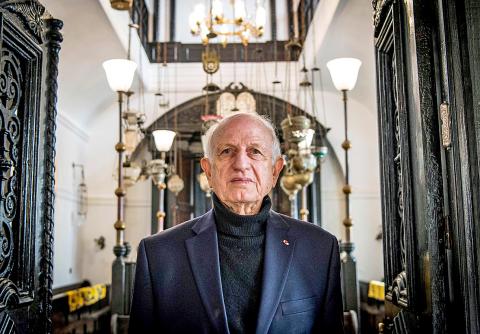
Photo: AFP
Azoulay, himself a member of Essaouira’s Jewish community, launched the project in partnership with the Moroccan Ministry of Culture.
“We said to ourselves: We’re going to let our patrimony speak, and protect what was the art of living together in mutual respect,” he said.
His daughter, Audrey Azoulay, who is director-general of the UN cultural agency UNESCO, was also present on Wednesday last week when the king made an official visit to the center.
Bayt Dakira showcases objects donated by local families alongside stories of members of the Jewish community from the southwestern city on the Atlantic Ocean.
They include former British minister of finance, transport and war Leslie Belisha (1893-1957), and David Yulee Levy (1810-1986), the “first Jew elected in US history.”
A panel lists Jewish royal advisers from Essaouira, including Azoulay who was called to the palace in 1991 by then-Moroccan king Hassan II, the late father of Mohammed.
Bayt Dakira also houses old photographs, archive footage, musical recordings, traditional dress and religious objects.
Upstairs will house a research center.
At the time of Moroccan sultan Mohammed III, who in the 18th century transformed the small port into a diplomatic and commercial hub, Essaouira was “the only city in the Islamic world with a majority Jewish population,” the 78-year-old royal adviser says.
Azoulay’s goal is to turn his city’s history into a symbol of “the art of the possible” and push back against what he calls “amnesia, regression and archaism.”
At one point, Essaouira had 37 synagogues, but most have fallen into ruin.
The Jewish community has been in Morocco since antiquity and grew over the centuries, particularly with the arrival of Jews expelled from Spain by the Catholic kings after 1492.
At the end of the 1940s, Jewish Moroccans numbered about 250,000 — about 10 percent of the population.
Many left after the creation of Israel in 1948 and the community now numbers about 3,000, still the largest in North Africa.
Essaouira was largely forgotten during the French protectorate (1912-1956), but has experienced a gradual rebirth since the early 1990s, turning into a tourist destination and cultural beacon.
It is not the only city to house a memorial to the country’s Judeo-Moroccan heritage, something that the king often highlights. Cemeteries, synagogues and historic Jewish quarters are also being restored.
Since 1997, Casablanca has housed a Moroccan Jewish Museum, the only one of its kind in the Arab world. And in Fez, the country’s spiritual capital, a museum dedicated to the Jewish memory is under construction. While the kingdom does not have official ties with Israel, thousands of Jews of Moroccan descent visit every year — including from the Jewish state.
They come to rediscover the land of their ancestors, celebrate religious events or make pilgrimages.
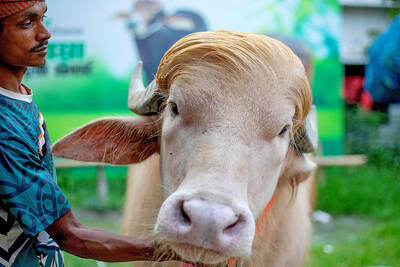
Crowds in Bangladesh are flocking to snap photographs with an unlikely social media star — an albino buffalo with flowing blond hair nicknamed “Donald Trump” that is due to be sacrificed within days. Owner Zia Uddin Mridha, 38, said his brother named the 700kg bull over its flowing helmet of hair resembling the signature look of the US president. “My younger brother picked this name because of the buffalo’s extraordinary hair,” he said at his farm in Narayanganj, just outside the capital, Dhaka. Mridha said that a constant stream of curious visitors — social media fans, onlookers and children — have come throughout

It began as a satirical online project. Now millions of young people in India are flocking to it as an outlet for their frustration. A parody political party called the Cockroach Janta Party, with the insect as its symbol, has exploded across India’s social media by turning absurdist humor into protest. Memes and short videos mocking corruption, joblessness and political dysfunction have flooded social media sites, where millions of users are embracing the cockroach — known for its ability to survive harsh conditions — as a tongue-in-cheek symbol of endurance. The online movement’s rise has been unusually rapid. The Cockroach Janta Party (CJP)
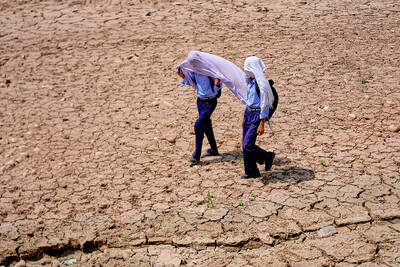
HOTTER: While Indians are accustomed to summer heat, climate change has caused northwestern India to warm faster than other parts of the country, an academic said Roads and markets have emptied during afternoons and some farmers have switched to nighttime work to avoid scorching temperatures as a heat wave grips large parts of India. The India Meteorological Department forecast maximum temperatures for yesterday of about 45°C in the capital, New Delhi, where authorities have opened temporary “cooling zones” to help people cope. The weather department warned that conditions would likely persist across several northern regions in the coming days, with temperatures staying well above seasonal averages. Authorities urged people to stay indoors during the hottest hours and take precautions against heat-related illnesses. India declares a heat wave whenever maximum temperatures
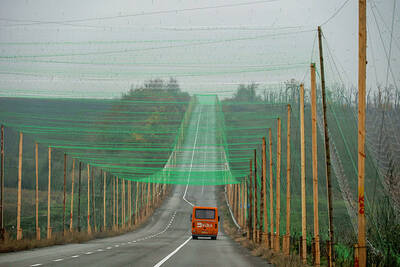
BIGGER ROLE: Beijing has said it maintains an impartial stance on the war in Ukraine, but by training Russian troops, China is far more involved than previously known China’s armed forces secretly trained about 200 Russian military personnel in China late last year, and some have since returned to fight in Ukraine, according to three European intelligence agencies and documents seen by Reuters. While China and Russia have held a number of joint military exercises since Moscow’s full-scale invasion of Ukraine in 2022, Beijing has repeatedly said that it is neutral in the conflict and presents itself as a peace mediator. The covert training sessions, which predominantly focused on the use of drones, were outlined in a dual-language Russian-Chinese agreement signed by senior Russian and Chinese officers in Beijing on


 RSS
RSS