


Three EU countries on Tuesday launched a process charging Iran with failing to observe the terms of the 2015 deal curtailing its nuclear program, a move that sparked anger and threats from Tehran at a time of growing tensions.
Russia also condemned the European move, saying that it risked causing a “new escalation.”
The UK, France and Germany said that they remained committed to the agreement, which has already been severely tested by the US exit from it in 2018.
A US Department of State spokesperson said Washington fully supported the three countries, adding that “further diplomatic and economic pressure is warranted.”
However, British Prime Minister Boris Johnson also indicated he might prefer a new comprehensive accord negotiated with US President Donald Trump instead of the 2015 deal.
The decision to begin the so-called dispute mechanism process came as tensions soar between the West and Iran following the killing of top Iranian commander Qassem Soleimani in a US airstrike, and the admission by Tehran days later that it had accidentally shot down a Ukrainian airliner.
The foreign ministers of the three European nations said Iran had been progressively scaling back its commitments under the deal since May last year.
“We have therefore been left with no choice, given Iran’s actions,” to begin the dispute process, they said in a statement.
The Russian Ministry of Foreign Affairs said it saw “no reason for such a move.”
“We do not rule out that the thoughtless actions of the Europeans could lead to a new escalation around the Iranian nuclear accord,” it said in a statement.
The 2015 nuclear deal signed in Vienna — known as The Joint Comprehensive Plan of Action (JCPOA) — has a provision that allows a party to claim significant noncompliance by another party before a joint commission.
If the issue is not resolved by the commission, it then goes to an advisory board and eventually to the UN Security Council, which could reimpose sanctions.
The first meeting of the process — set to include the European nations, Iran and the other parties to the deal, China and Russia — would take place in Austria by the end of the month, a diplomatic source told reporters in Vienna.
Iran intensified sensitive activities to enrich uranium, which can be used to make a nuclear weapon, in response to Trump’s pulling out of the deal.
Its latest step this month to forgo the limit on the number of centrifuges used in uranium enrichment prompted the Europeans to trigger the mechanism.
However, Tehran lashed out at the European countries and appeared to threaten unspecified retaliation.
“Of course, if the Europeans ... seek to abuse [this process], they must also be prepared to accept the consequences,” the Iranian Ministry of Foreign Affairs said in a statement, without elaborating.
However, the three powers said they “once again express our commitment” to the deal and expressed “determination to work with all participants to preserve it.”
“Our hope is to bring Iran back into full compliance with its commitments under the JCPOA,” they said.
The accord aimed to restrict Iran’s nuclear ambitions, which Western powers feared were aimed at developing weapons, in return for sanctions relief.
The three countries said they would not join “a campaign to implement maximum pressure against Iran” championed by Trump.
However, Johnson said he would be willing to work on a “Trump deal” to replace the JCPOA, which was negotiated by the administration of former US president Barack Obama.
“That’s what we need to see. I think that would be a great way forward,” Johnson said, adding that “from the American perspective it [the 2015 deal] is a flawed agreement.”
British Secretary of State for Foreign and Commonwealth Affairs Dominic Raab denied that Johnson’s remarks represented a shift, saying that London backed the nuclear deal, while also wanting a wider pact that would go beyond Iran’s atomic drive to cover all contentious issues.
EU High Representative for Foreign Affairs and Security Policy Josep Borrell said it was “more important than ever” to save the 2015 Iranian nuclear deal “in light of the ongoing dangerous escalations in the Middle East.”
Borrell told the European Parliament in Strasbourg, France, that “the British prime minister said things in contradiction with the letter signed by the [EU] foreign ministers.”
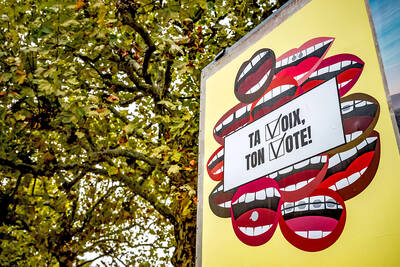
A plan by Switzerland’s right-wing People’s Party to cap the population at 10 million has the backing of almost half the country, according to a poll before an expected vote next year. The party, which has long campaigned against immigration, argues that too-fast population growth is overwhelming housing, transport and public services. The level of support comes despite the government urging voters to reject it, warning that strict curbs would damage the economy and prosperity, as Swiss companies depend on foreign workers. The poll by newspaper group Tamedia/20 Minuten and released yesterday showed that 48 percent of the population plan to vote
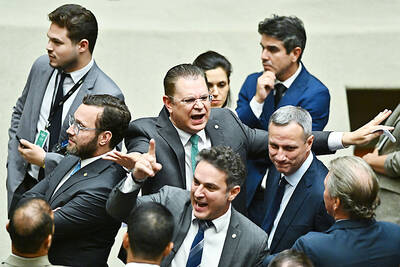
PARLIAMENT CHAOS: Police forcibly removed Brazilian Deputy Glauber Braga after he called the legislation part of a ‘coup offensive’ and occupied the speaker’s chair Brazil’s lower house of Congress early yesterday approved a bill that could slash former Brazilian president Jair Bolsonaro’s prison sentence for plotting a coup, after efforts by a lawmaker to disrupt the proceedings sparked chaos in parliament. Bolsonaro has been serving a 27-year term since last month after his conviction for a scheme to stop Brazilian President Luiz Inacio Lula da Silva from taking office after the 2022 election. Lawmakers had been discussing a bill that would significantly reduce sentences for several crimes, including attempting a coup d’etat — opening up the prospect that Bolsonaro, 70, could have his sentence cut to
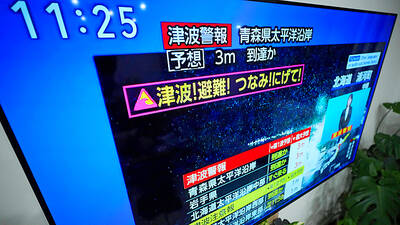
A powerful magnitude 7.6 earthquake shook Japan’s northeast region late on Monday, prompting tsunami warnings and orders for residents to evacuate. A tsunami as high as three metres (10 feet) could hit Japan’s northeastern coast after an earthquake with an estimated magnitude of 7.6 occurred offshore at 11:15 p.m. (1415 GMT), the Japan Meteorological Agency (JMA) said. Tsunami warnings were issued for the prefectures of Hokkaido, Aomori and Iwate, and a tsunami of 40cm had been observed at Aomori’s Mutsu Ogawara and Hokkaido’s Urakawa ports before midnight, JMA said. The epicentre of the quake was 80 km (50 miles) off the coast of
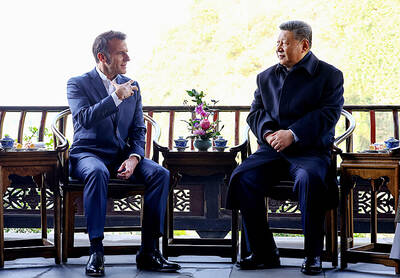
RELAXED: After talks on Ukraine and trade, the French president met with students while his wife visited pandas, after the pair parted ways with their Chinese counterparts French President Emmanuel Macron concluded his fourth state visit to China yesterday in Chengdu, striking a more relaxed note after tough discussions on Ukraine and trade with Chinese President Xi Jinping (習近平) a day earlier. Far from the imposing Great Hall of the People in Beijing where the two leaders held talks, Xi and China’s first lady, Peng Liyuan (彭麗媛), showed Macron and his wife Brigitte around the centuries-old Dujiangyan Dam, a World Heritage Site set against the mountainous landscape of Sichuan Province. Macron was told through an interpreter about the ancient irrigation system, which dates back to the third century


 RSS
RSS