


The White House yesterday proposed regulatory principles to govern the development and use of artificial intelligence (AI) aimed at limiting authorities’ “overreach,” and said that it wants European officials to likewise avoid aggressive approaches.
In a fact sheet, the White House said that federal agencies should “conduct risk assessment and cost-benefit analyses prior to any regulatory action on AI, with a focus on establishing flexible frameworks rather than one-size-fits-all regulation.”
The comments come at a time when companies are racing to integrate AI and deep machine learning into their businesses to remain competitive.
However, the technology raises ethical concerns about control, privacy, cybersecurity and the future of work, companies and experts have said.
US President Donald Trump’s administration said that agencies should “promote trustworthy AI” and “must consider fairness, non-discrimination, openness, transparency, safety and security.”
As an example, the White House cited the US Food and Drug Administration, which is considering how to regulate the use of AI and machine learning technologies by medical device manufacturers.
“Europe and our allies should avoid heavy-handed innovation-killing models,” the White House said. “The best way to counter authoritarian uses of AI is to make sure America and our international partners remain the global hubs of innovation.”
Last year, the European Commission’s High-Level Expert Group on Artificial Intelligence issued a set of ethical guidelines and EU leaders are considering regulatory action.
Some US states have raised concerns about AI applications.
California’s legislature in September last year passed a three-year ban on state and local law enforcement using body cameras with facial-recognition software, the latest curb on technology that some say poses a threat to civil liberties.
Some US cities have also voted to bar facial-recognition technology by law enforcement.
US Chief Technology Officer Michael Kratsios, who will talk about the administration’s AI strategy at the CES trade show in Las Vegas later this week, said in a statement that the “principles set the nation on a path of continued AI innovation and discovery.”
In February last year, Trump signed an executive order for federal government agencies to dedicate more resources and investment to AI-related research, promotion and training.
A 2018 study from consultancy PricewaterhouseCoopers said that 30 percent of jobs around the world are at risk of automation by the mid-2030s, including 44 percent of workers with low education.
The study also found automation could boost global gross domestic product by US$15 trillion by 2030.
The White House held a meeting on AI in 2018 with more than 30 major companies from a variety of industries, including Ford Motor, Boeing, Amazon.com and Microsoft, vowing not to stand in the way of the technology’s development.

A plan by Switzerland’s right-wing People’s Party to cap the population at 10 million has the backing of almost half the country, according to a poll before an expected vote next year. The party, which has long campaigned against immigration, argues that too-fast population growth is overwhelming housing, transport and public services. The level of support comes despite the government urging voters to reject it, warning that strict curbs would damage the economy and prosperity, as Swiss companies depend on foreign workers. The poll by newspaper group Tamedia/20 Minuten and released yesterday showed that 48 percent of the population plan to vote

PARLIAMENT CHAOS: Police forcibly removed Brazilian Deputy Glauber Braga after he called the legislation part of a ‘coup offensive’ and occupied the speaker’s chair Brazil’s lower house of Congress early yesterday approved a bill that could slash former Brazilian president Jair Bolsonaro’s prison sentence for plotting a coup, after efforts by a lawmaker to disrupt the proceedings sparked chaos in parliament. Bolsonaro has been serving a 27-year term since last month after his conviction for a scheme to stop Brazilian President Luiz Inacio Lula da Silva from taking office after the 2022 election. Lawmakers had been discussing a bill that would significantly reduce sentences for several crimes, including attempting a coup d’etat — opening up the prospect that Bolsonaro, 70, could have his sentence cut to

A powerful magnitude 7.6 earthquake shook Japan’s northeast region late on Monday, prompting tsunami warnings and orders for residents to evacuate. A tsunami as high as three metres (10 feet) could hit Japan’s northeastern coast after an earthquake with an estimated magnitude of 7.6 occurred offshore at 11:15 p.m. (1415 GMT), the Japan Meteorological Agency (JMA) said. Tsunami warnings were issued for the prefectures of Hokkaido, Aomori and Iwate, and a tsunami of 40cm had been observed at Aomori’s Mutsu Ogawara and Hokkaido’s Urakawa ports before midnight, JMA said. The epicentre of the quake was 80 km (50 miles) off the coast of
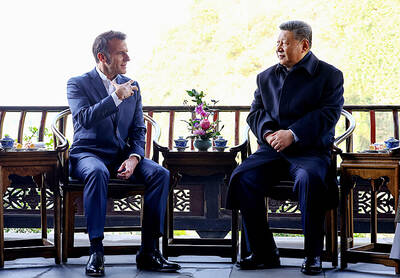
RELAXED: After talks on Ukraine and trade, the French president met with students while his wife visited pandas, after the pair parted ways with their Chinese counterparts French President Emmanuel Macron concluded his fourth state visit to China yesterday in Chengdu, striking a more relaxed note after tough discussions on Ukraine and trade with Chinese President Xi Jinping (習近平) a day earlier. Far from the imposing Great Hall of the People in Beijing where the two leaders held talks, Xi and China’s first lady, Peng Liyuan (彭麗媛), showed Macron and his wife Brigitte around the centuries-old Dujiangyan Dam, a World Heritage Site set against the mountainous landscape of Sichuan Province. Macron was told through an interpreter about the ancient irrigation system, which dates back to the third century


 RSS
RSS