


The Pentagon on Monday distanced itself from US President Donald Trump’s assertions that he would bomb Iranian cultural sites despite international prohibitions on such attacks.
US Secretary of Defense Mark Esper said that the US would “follow the laws of armed conflict.” When asked if that ruled out targeting cultural sites, Esper said: “That’s the laws of armed conflict.”
The split between the president and his Pentagon chief came amid heightened tensions with Tehran following a US drone strike that killed major general Qasem Soleimani, the head of Iran’s elite Quds Force.
Trump has twice warned that he would hit Iranian cultural sites if Tehran retaliates against the US.
Esper’s public comments reflected the private concerns of other defense and military officials, who cited legal prohibitions on attacks on civilian, cultural and religious sites, except under certain, threatening circumstances.
Trump first raised the prospect of targeting cultural sites in a tweet on Saturday and reiterated that view to reporters the next day.
“We have targeted 52 Iranian sites (representing the 52 American hostages taken by Iran many years ago), some at a very high level & important to Iran & Iranian culture, and those targets, and Iran itself, WILL BE HIT VERY FAST AND VERY HARD,” he tweeted.
His message caught administration officials off-guard and prompted an immediate outcry from legal scholars, national security experts and Democratic lawmakers, but the president stood by his threat the following day.
“They’re allowed to kill our people. They’re allowed to torture and maim our people. They’re allowed to use roadside bombs and blow up our people, and we’re not allowed to touch their cultural sites? It doesn’t work that way,” he told reporters traveling with him on Air Force One.
However, by international law, it does.
Specifically, the 1954 Hague Convention says that nations must “take all possible steps” to protect cultural property and shall refrain “from any act of hostility, directed against such property.”
It also says that nations must not use cultural sites for any threatening purposes that would make such locations a military target.
The Pentagon has long had a list of potential targets inside Iran, as well as those associated with Iran throughout the Middle East. Those targets and war plans are routinely updated, including during the recent uptick in hostilities.
Officials would not discuss the list, but it is certain to include an array of Iranian military sites and capabilities, including missile, air defense and command and control locations.
Any targets would go through a lengthy vetting process within the military and the Pentagon to determine that they are legal, appropriate and proportionate to any Iranian action. Only after that process is complete would a list of potential sites go before the president for approval.
Outside of the Pentagon, Trump’s threats were met with condemnation.
“It shows that he is somewhat deranged about this,” US Senator Tim Kaine said. “The pledge to attack cultural sites, likely, is a violation of international law.”
Kaine said that all Trump is doing “is escalating tensions and he seems to believe: ‘I can strike you, but you can’t strike me.’ That’s not the way the world works.”
Trump needs to confer with the US Congress, he added.
The president’s threats drew reaction from the Metropolitan Museum of Art in New York.
“The targeting of sites of global cultural heritage is abhorrent to the collective values of our society,” museum leaders said in a statement. “At this challenging time, we must remind ourselves of the global importance of protecting cultural sites — the objects and places by which individuals, communities, and nations connect to their history and heritage.
Ahead of Esper’s comments, other administration officials made similar efforts to distance themselves from Trump without directly contradicting him.
US Secretary of State Mike Pompeo on Sunday said that any US military strikes inside Iran would be legal.
“We’ll behave inside the system,” Pompeo said. “We always have and we always will.”

A plan by Switzerland’s right-wing People’s Party to cap the population at 10 million has the backing of almost half the country, according to a poll before an expected vote next year. The party, which has long campaigned against immigration, argues that too-fast population growth is overwhelming housing, transport and public services. The level of support comes despite the government urging voters to reject it, warning that strict curbs would damage the economy and prosperity, as Swiss companies depend on foreign workers. The poll by newspaper group Tamedia/20 Minuten and released yesterday showed that 48 percent of the population plan to vote
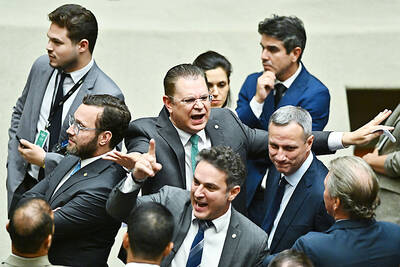
PARLIAMENT CHAOS: Police forcibly removed Brazilian Deputy Glauber Braga after he called the legislation part of a ‘coup offensive’ and occupied the speaker’s chair Brazil’s lower house of Congress early yesterday approved a bill that could slash former Brazilian president Jair Bolsonaro’s prison sentence for plotting a coup, after efforts by a lawmaker to disrupt the proceedings sparked chaos in parliament. Bolsonaro has been serving a 27-year term since last month after his conviction for a scheme to stop Brazilian President Luiz Inacio Lula da Silva from taking office after the 2022 election. Lawmakers had been discussing a bill that would significantly reduce sentences for several crimes, including attempting a coup d’etat — opening up the prospect that Bolsonaro, 70, could have his sentence cut to

A powerful magnitude 7.6 earthquake shook Japan’s northeast region late on Monday, prompting tsunami warnings and orders for residents to evacuate. A tsunami as high as three metres (10 feet) could hit Japan’s northeastern coast after an earthquake with an estimated magnitude of 7.6 occurred offshore at 11:15 p.m. (1415 GMT), the Japan Meteorological Agency (JMA) said. Tsunami warnings were issued for the prefectures of Hokkaido, Aomori and Iwate, and a tsunami of 40cm had been observed at Aomori’s Mutsu Ogawara and Hokkaido’s Urakawa ports before midnight, JMA said. The epicentre of the quake was 80 km (50 miles) off the coast of
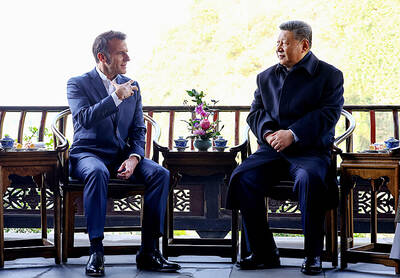
RELAXED: After talks on Ukraine and trade, the French president met with students while his wife visited pandas, after the pair parted ways with their Chinese counterparts French President Emmanuel Macron concluded his fourth state visit to China yesterday in Chengdu, striking a more relaxed note after tough discussions on Ukraine and trade with Chinese President Xi Jinping (習近平) a day earlier. Far from the imposing Great Hall of the People in Beijing where the two leaders held talks, Xi and China’s first lady, Peng Liyuan (彭麗媛), showed Macron and his wife Brigitte around the centuries-old Dujiangyan Dam, a World Heritage Site set against the mountainous landscape of Sichuan Province. Macron was told through an interpreter about the ancient irrigation system, which dates back to the third century


 RSS
RSS