


The Spanish Congress of Deputies was yesterday to vote on whether to confirm Socialist leader Pedro Sanchez as prime minister at the helm of the country’s first-ever coalition government.
Sanchez, who has stayed on as a caretaker prime minister since inconclusive elections last year, is seeking to be reappointed for another term. He wants to form a minority coalition government with hard-left party Podemos.
On Sunday, Sanchez lost a first confidence vote, having failed to win backing from an absolute majority in the 350-seat lower chamber.
He yesterday faced a second vote, in which he needs just a simple majority to remain prime minister.
While the political math works in his favor after the Socialists struck a deal last week with the 13 lawmakers from Catalan separatist party Republican Left of Catalonia (ERC) to abstain, the numbers still look tight.
At the latest count Sanchez, 47, could win by a margin of just two votes after the sole lawmaker from the regional Coalicion Canaria formation broke party ranks over the weekend to say that she would vote against him instead of abstaining.
Spain, the eurozone’s fourth-largest economy, has been in political gridlock without a proper government for most of the past year after two inconclusive elections in April and November.
Sanchez’s Socialists won a repeat Nov. 10 poll, but were weakened, taking 120 seats — three fewer than in April — in an election that saw upstart far-right party Vox surge to third place.
Sanchez quickly struck a deal with Podemos to form what would be the first post-dictatorship coalition government in Spain, despite having previously said that a coalition with the far-left party would keep him up at night.
The two parties have pledged to increase the minimum wage; raise taxes on high earners and large businesses; and repeal elements of Spain’s controversial 2012 labor market reforms that made it easier to fire workers — measures that have alarmed business leaders who warn that they would hurt job creation.
With the two formations’ combined total of 155 seats still falling short of a majority, Sanchez has also secured the support or abstention of several smaller regional parties, including the ERC, which could let him squeak by in yesterday’s second confidence vote.
As part of the deal with the ERC, Sanchez has agreed that the national government should hold talks with Catalonia’s separatist regional government to resolve the “political conflict” over the future of the wealthy northeastern region.
The political situation in Catalonia remains in flux following a 2017 independence referendum that Madrid declared unconstitutional.
“This progressive coalition is the best antidote against this coalition of the apocalypse,” Sanchez said on Sunday, referring to Spain’s conservative parties — the Popular Party, Ciudadanos and Vox — who have accused him of putting national unity at risk with his deal with Catalan separatists.
Popular Party leader Pablo Casado accused Sanchez of forming a “Frankenstein government” made up of “communists” and “separatists” who “want to put an end to Spain,” and warned that the government the Socialist leader is proposing would be unable to govern and not last the full four years.
Sanchez rose to power in June 2018 after ousting his Popular Party predecessor, former Spanish prime minister Mariano Rajoy, in a no-confidence vote, but he was forced to call elections in April last year after Catalan separatists including the ERC refused to back his draft budget.
“The political landscape remains tricky,” ING analyst Steven Trypsteen said. “The new government would be a minority government, the Catalan tensions could flare up again ... and the fiscal situation makes it difficult to increase spending a lot.”

A plan by Switzerland’s right-wing People’s Party to cap the population at 10 million has the backing of almost half the country, according to a poll before an expected vote next year. The party, which has long campaigned against immigration, argues that too-fast population growth is overwhelming housing, transport and public services. The level of support comes despite the government urging voters to reject it, warning that strict curbs would damage the economy and prosperity, as Swiss companies depend on foreign workers. The poll by newspaper group Tamedia/20 Minuten and released yesterday showed that 48 percent of the population plan to vote

PARLIAMENT CHAOS: Police forcibly removed Brazilian Deputy Glauber Braga after he called the legislation part of a ‘coup offensive’ and occupied the speaker’s chair Brazil’s lower house of Congress early yesterday approved a bill that could slash former Brazilian president Jair Bolsonaro’s prison sentence for plotting a coup, after efforts by a lawmaker to disrupt the proceedings sparked chaos in parliament. Bolsonaro has been serving a 27-year term since last month after his conviction for a scheme to stop Brazilian President Luiz Inacio Lula da Silva from taking office after the 2022 election. Lawmakers had been discussing a bill that would significantly reduce sentences for several crimes, including attempting a coup d’etat — opening up the prospect that Bolsonaro, 70, could have his sentence cut to

A powerful magnitude 7.6 earthquake shook Japan’s northeast region late on Monday, prompting tsunami warnings and orders for residents to evacuate. A tsunami as high as three metres (10 feet) could hit Japan’s northeastern coast after an earthquake with an estimated magnitude of 7.6 occurred offshore at 11:15 p.m. (1415 GMT), the Japan Meteorological Agency (JMA) said. Tsunami warnings were issued for the prefectures of Hokkaido, Aomori and Iwate, and a tsunami of 40cm had been observed at Aomori’s Mutsu Ogawara and Hokkaido’s Urakawa ports before midnight, JMA said. The epicentre of the quake was 80 km (50 miles) off the coast of
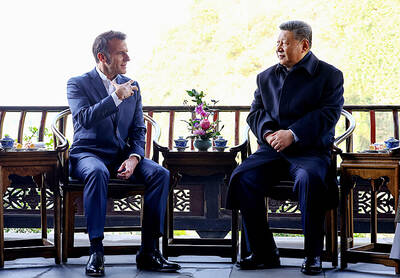
RELAXED: After talks on Ukraine and trade, the French president met with students while his wife visited pandas, after the pair parted ways with their Chinese counterparts French President Emmanuel Macron concluded his fourth state visit to China yesterday in Chengdu, striking a more relaxed note after tough discussions on Ukraine and trade with Chinese President Xi Jinping (習近平) a day earlier. Far from the imposing Great Hall of the People in Beijing where the two leaders held talks, Xi and China’s first lady, Peng Liyuan (彭麗媛), showed Macron and his wife Brigitte around the centuries-old Dujiangyan Dam, a World Heritage Site set against the mountainous landscape of Sichuan Province. Macron was told through an interpreter about the ancient irrigation system, which dates back to the third century


 RSS
RSS