


South Korean President Moon Jae-in yesterday said that he hopes to see North Korean leader Kim Jong-un fulfill a promise to visit the South this year and called for the Koreas to end a prolonged freeze in bilateral relations.
In his New Year’s speech, Moon also reaffirmed his government’s commitment to resume inter-Korean economic activities that have been held back by US-led sanctions imposed on the North over its nuclear weapons and missiles program.
Any resumption in activities would depend on progress in the larger nuclear negotiations between Washington and Pyongyang.
North Korea suspended virtually all cooperation with the South during a deadlock in those larger talks, while also pressuring Seoul to break away from Washington and restart the joint economic projects, which would breathe life into North Korea’s broken economy.
Moon called on Pyongyang to respond to Seoul’s efforts to resume bilateral dialogue, saying an improvement in inter-Korean relations would also help induce progress in the nuclear negotiations.
He urged North Korea to refrain from military demonstrations and threats that would potentially hurt the momentum in nuclear negotiations with Washington.
“The South and North should work together so to create the conditions for Chairman Kim Jong-un’s visit [to South Korea] as soon as possible,” Moon said during a nationally televised speech.
“I have a willingness to meet again and again, and hold ceaseless dialogue. We will continue to invest efforts for the resumption of the Kaesong industrial park and tours to Diamond Mountain,” he said.
South Korean tours to the North’s Diamond Mountain resort were a major symbol of rapprochement between the rivals before they were suspended in 2008 after a North Korean guard fatally shot a South Korean tourist.
Seoul’s previous conservative government shut down a jointly run factory park in the North Korean border town of Kaesong in 2016 following a North Korean nuclear test.
Moon’s comments came days after Kim appeared to sideline inter-Korean issues during a key ruling party conference, where he declared to strengthen his nuclear deterrent in face of “gangster-like” US sanctions and pressure.
The North Korean state media’s account of the meeting did not include any mention of South Korea.
The official Korean Central News Agency yesterday said that Kim visited a fertilizer factory recently and reiterated his call for his people to stay resilient in a struggle for economic “self-reliance” in face of sanctions, saying that the “fiercer the adverse wind raised by the hostile forces gets, the fiercer our red flag will flutter in high spirits.”
North Korea last year dialed up military tensions, conducting 13 rounds of ballistic tests, which potentially expanded its ability to strike targets in South Korea and Japan, including US military bases there.
It in October demanded that South Korea clear out its hotels and other properties at the mountain resort, expressing frustration that Seoul would not defy international sanctions and resume South Korean tours at the site.
The erosion in inter-Korean relations has been a major setback to Moon, a son of North Korean war refugees who met Kim three times in 2018, while expressing ambitions to restart inter-Korean economic engagement.
In their third summit in Pyongyang in September 2018, Kim and Moon had vowed to restart South Korean tours to the resort and normalize operations at the factory park when possible, voicing optimism that sanctions could end to allow such projects.
Kim during the meeting promised Moon that he would visit Seoul “in a short time.”
However, without a breakthrough in the nuclear talks between Washington and Pyongyang, the economic projects remain shelved.
No North Korean leader has visited Seoul since the 1950-1953 Korean War ended in a ceasefire.

A plan by Switzerland’s right-wing People’s Party to cap the population at 10 million has the backing of almost half the country, according to a poll before an expected vote next year. The party, which has long campaigned against immigration, argues that too-fast population growth is overwhelming housing, transport and public services. The level of support comes despite the government urging voters to reject it, warning that strict curbs would damage the economy and prosperity, as Swiss companies depend on foreign workers. The poll by newspaper group Tamedia/20 Minuten and released yesterday showed that 48 percent of the population plan to vote

PARLIAMENT CHAOS: Police forcibly removed Brazilian Deputy Glauber Braga after he called the legislation part of a ‘coup offensive’ and occupied the speaker’s chair Brazil’s lower house of Congress early yesterday approved a bill that could slash former Brazilian president Jair Bolsonaro’s prison sentence for plotting a coup, after efforts by a lawmaker to disrupt the proceedings sparked chaos in parliament. Bolsonaro has been serving a 27-year term since last month after his conviction for a scheme to stop Brazilian President Luiz Inacio Lula da Silva from taking office after the 2022 election. Lawmakers had been discussing a bill that would significantly reduce sentences for several crimes, including attempting a coup d’etat — opening up the prospect that Bolsonaro, 70, could have his sentence cut to

A powerful magnitude 7.6 earthquake shook Japan’s northeast region late on Monday, prompting tsunami warnings and orders for residents to evacuate. A tsunami as high as three metres (10 feet) could hit Japan’s northeastern coast after an earthquake with an estimated magnitude of 7.6 occurred offshore at 11:15 p.m. (1415 GMT), the Japan Meteorological Agency (JMA) said. Tsunami warnings were issued for the prefectures of Hokkaido, Aomori and Iwate, and a tsunami of 40cm had been observed at Aomori’s Mutsu Ogawara and Hokkaido’s Urakawa ports before midnight, JMA said. The epicentre of the quake was 80 km (50 miles) off the coast of
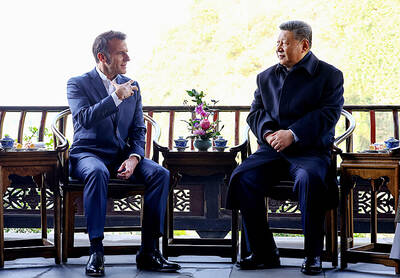
RELAXED: After talks on Ukraine and trade, the French president met with students while his wife visited pandas, after the pair parted ways with their Chinese counterparts French President Emmanuel Macron concluded his fourth state visit to China yesterday in Chengdu, striking a more relaxed note after tough discussions on Ukraine and trade with Chinese President Xi Jinping (習近平) a day earlier. Far from the imposing Great Hall of the People in Beijing where the two leaders held talks, Xi and China’s first lady, Peng Liyuan (彭麗媛), showed Macron and his wife Brigitte around the centuries-old Dujiangyan Dam, a World Heritage Site set against the mountainous landscape of Sichuan Province. Macron was told through an interpreter about the ancient irrigation system, which dates back to the third century


 RSS
RSS