


“Do you want a piece?” beekeeper Ma Gongzuo asked, looking into the camera of a friend’s smartphone before biting into the dripping comb of amber-colored honey.
The clip goes out to his 737,000 followers on Douyin, the Chinese version of popular video sharing app TikTok that has 400 million users and has turned Ma into something of a celebrity.
Creating videos has become a popular sales tactic for Chinese farmers — the clips show increasingly discerning consumers the origins of the product and provide a window into rural life that captures audience imagination.
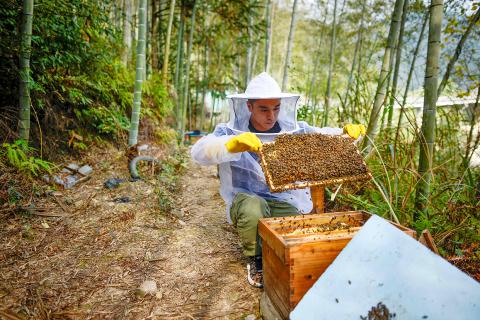
Photo: AFP
For some it has helped them find a way out of poverty, which the Chinese Communist Party hopes to eradicate by this year.
“Everyone said I was good for nothing when they saw I’d come back,” the 31-year-old said of his return to his village after a failed attempt at running an online clothing business. “They tell us that we can only get out of poverty if we study and get a job in a city.”
Today, Ma drives an expensive BMW and has already earned enough to buy property, and help his parents and fellow villagers with their homes and businesses.
Ma in 2015 took on the family honey-producing business in the verdant hills of Zhejiang Province and thanks to e-commerce apps, managed to turn an annual revenue of 1 million yuan (US$144,204).
However, sales stagnated.
So in November 2018, with help from his friends in the village, he began posting videos about his life on the farm. They showed him opening up a hive surrounded by a swarm of bees, swimming bare-chested in a river and chopping wood.
“I never advertise my products. I show my daily life, the landscapes of the countryside. That’s what interests people,” Ma said. “Of course, people suspect that I’m selling honey, but they decide to get in touch with me to say they want to buy some.”
Like most transactions in China, where hard cash is becoming less popular, the orders are paid for through apps such as WeChat and AliPay.
Ma now sells between 2 million and 3 million yuan of honey each year, as well as dried sweet potato and brown sugar.
“When I was young we were poor,” he said. “At school, I used to admire other kids who had pocket money, because I never had any.”
Now he drives a 4x4 BMW that costs about 760,000 yuan and has also invested in building a bed-and-breakfast.
“Using Douyin, that was the turning point,” he said. “Today, I can buy my family what they need. I help the other villagers to sell their products, too. All of the local economy benefits.”
In China, about 847 million people access the Internet via their smartphone, so online apps have played a vital role in Ma’s success.
“It’s progress,” said Ma Gongzuo’s father, Ma Jianchun. “We old people are overwhelmed. With the money, we’ve been able to renovate our house.”
China is home to the world’s largest market for live video broadcasting, according to US audit firm Deloitte.
Getting in on the trend, Douyin’s parent company ByteDance says it has organized training for 26,000 farmers on how to master the art of making videos.
There are other similar platforms such as Kuaishou and Yizhibo.
Taobao, the most popular e-commerce app in the nation owned by technology giant Alibaba, last year launched a project showing farmers how to become livestreaming hosts in a bid to help them earn more.
The number of people living under the poverty line in rural China has reduced dramatically — from 700 million in 1978 to 16.6 million in 2018, government data show.
However, the depopulation of the countryside continues, as many Chinese head to cities in search of better-paid jobs.
“We want to be an example, to show young people that it is entirely possible to set up a business and earn money in rural areas,” university-educated Ma Gongzuo said. “We hope that more will return, so that life and the economy can resume in the villages.”
With his newfound fame, Ma Gongzuo said that he has already received many proposals — and not just from those interested in his honey.

A plan by Switzerland’s right-wing People’s Party to cap the population at 10 million has the backing of almost half the country, according to a poll before an expected vote next year. The party, which has long campaigned against immigration, argues that too-fast population growth is overwhelming housing, transport and public services. The level of support comes despite the government urging voters to reject it, warning that strict curbs would damage the economy and prosperity, as Swiss companies depend on foreign workers. The poll by newspaper group Tamedia/20 Minuten and released yesterday showed that 48 percent of the population plan to vote

PARLIAMENT CHAOS: Police forcibly removed Brazilian Deputy Glauber Braga after he called the legislation part of a ‘coup offensive’ and occupied the speaker’s chair Brazil’s lower house of Congress early yesterday approved a bill that could slash former Brazilian president Jair Bolsonaro’s prison sentence for plotting a coup, after efforts by a lawmaker to disrupt the proceedings sparked chaos in parliament. Bolsonaro has been serving a 27-year term since last month after his conviction for a scheme to stop Brazilian President Luiz Inacio Lula da Silva from taking office after the 2022 election. Lawmakers had been discussing a bill that would significantly reduce sentences for several crimes, including attempting a coup d’etat — opening up the prospect that Bolsonaro, 70, could have his sentence cut to

A powerful magnitude 7.6 earthquake shook Japan’s northeast region late on Monday, prompting tsunami warnings and orders for residents to evacuate. A tsunami as high as three metres (10 feet) could hit Japan’s northeastern coast after an earthquake with an estimated magnitude of 7.6 occurred offshore at 11:15 p.m. (1415 GMT), the Japan Meteorological Agency (JMA) said. Tsunami warnings were issued for the prefectures of Hokkaido, Aomori and Iwate, and a tsunami of 40cm had been observed at Aomori’s Mutsu Ogawara and Hokkaido’s Urakawa ports before midnight, JMA said. The epicentre of the quake was 80 km (50 miles) off the coast of

RELAXED: After talks on Ukraine and trade, the French president met with students while his wife visited pandas, after the pair parted ways with their Chinese counterparts French President Emmanuel Macron concluded his fourth state visit to China yesterday in Chengdu, striking a more relaxed note after tough discussions on Ukraine and trade with Chinese President Xi Jinping (習近平) a day earlier. Far from the imposing Great Hall of the People in Beijing where the two leaders held talks, Xi and China’s first lady, Peng Liyuan (彭麗媛), showed Macron and his wife Brigitte around the centuries-old Dujiangyan Dam, a World Heritage Site set against the mountainous landscape of Sichuan Province. Macron was told through an interpreter about the ancient irrigation system, which dates back to the third century


 RSS
RSS