


Croatia was to elect a new president yesterday in an uncertain vote where the conservative incumbent — trying to unite a fractured right wing — faced a serious challenge from a former leftist prime minister.
About 3.8 million people were eligible to vote in a poll that was being held just days after Croatia took over the EU’s helm for a six-month period that would be dominated by the issues of Brexit and the bloc’s enlargement.
At the same time, the EU’s newest member is struggling with an emigration exodus, corruption and a lackluster economy at home.
Center-right Croatian President Kolinda Grabar-Kitarovic is campaigning on a “real Croatia” ticket, while her rival, former Croatian prime minister Zoran Milanovic, has promised a “normal” liberal democracy of equal citizens.
The outcome of the vote for the largely ceremonial post was uncertain, with the latest survey by Ipsos agency giving Milanovic a 3 percentage point lead over Grabar-Kitarovic.
The latter, backed by the ruling HDZ party, would have to lure back hardliners who voted for a nationalist folk singer in the election’s first round last month.
Dominating in cities, Milanovic led the first round with about one-third of the vote, thanks in part to that split among the right-wingers.
Analysts said the first-round results showed an increase in support for hardliners, a trend seen in other European countries such as Poland or Hungary.
If Grabar-Kitarovic fails to win the presidency, it would deal a heavy blow to the HDZ, whose moderate Croatian Prime Minister Andrej Plenkovic faces parliamentary elections later this year.
“I am a Croatia that unifies,” Grabar-Kitarovic, 51, said during a TV election debate with her rival.
Unity, patriotism and references to the 1990s independence war, which remains an emotive issue, were the key points of her campaign.
“We should come together as in 1990,” before the country declared independence from Yugoslavia, Croatia’s first female president told her supporters in Zagreb.
Meanwhile, Milanovic insisted that the “wars are over” and Croatia should fight for its place in Europe.
“There is no ‘real Croatia’ ... rather a Croatian republic for all, equal citizens,” the 53-year-old told a campaign rally in Zagreb.
Presenting herself as the “woman of the people” with humble farming roots, Grabar-Kitarovic is well-known for stunts such as singing in public which her critics deride as embarrassing.
She has also come under fire for downplaying the crimes committed by Croatia’s World War II pro-Nazi regime.
Meanwhile, Milanovic is trying to make a political comeback and throw off a reputation as elitist.
In office from 2011 to 2016, he was welcomed at the time as a bright, young politician clean of the corruption tainting the rival HDZ.
However, the excitement waned after his government failed to push through much-needed reforms.
Croatia joined the EU in 2013, but its economy, strongly relying on tourism on its Adriatic coast, remains one of the bloc’s weakest.
EU’s open borders also accelerated the emigration exodus for better pay in wealthier member states.
“Our youngsters are leaving,” while politicians are only “insulting each other,” Stjepan Golub, 70, told reporters in Zagreb.

A plan by Switzerland’s right-wing People’s Party to cap the population at 10 million has the backing of almost half the country, according to a poll before an expected vote next year. The party, which has long campaigned against immigration, argues that too-fast population growth is overwhelming housing, transport and public services. The level of support comes despite the government urging voters to reject it, warning that strict curbs would damage the economy and prosperity, as Swiss companies depend on foreign workers. The poll by newspaper group Tamedia/20 Minuten and released yesterday showed that 48 percent of the population plan to vote
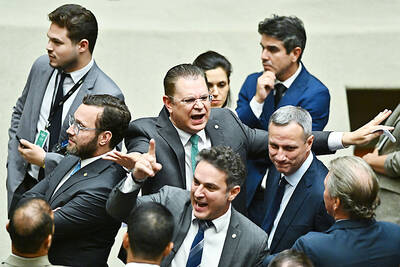
PARLIAMENT CHAOS: Police forcibly removed Brazilian Deputy Glauber Braga after he called the legislation part of a ‘coup offensive’ and occupied the speaker’s chair Brazil’s lower house of Congress early yesterday approved a bill that could slash former Brazilian president Jair Bolsonaro’s prison sentence for plotting a coup, after efforts by a lawmaker to disrupt the proceedings sparked chaos in parliament. Bolsonaro has been serving a 27-year term since last month after his conviction for a scheme to stop Brazilian President Luiz Inacio Lula da Silva from taking office after the 2022 election. Lawmakers had been discussing a bill that would significantly reduce sentences for several crimes, including attempting a coup d’etat — opening up the prospect that Bolsonaro, 70, could have his sentence cut to

A powerful magnitude 7.6 earthquake shook Japan’s northeast region late on Monday, prompting tsunami warnings and orders for residents to evacuate. A tsunami as high as three metres (10 feet) could hit Japan’s northeastern coast after an earthquake with an estimated magnitude of 7.6 occurred offshore at 11:15 p.m. (1415 GMT), the Japan Meteorological Agency (JMA) said. Tsunami warnings were issued for the prefectures of Hokkaido, Aomori and Iwate, and a tsunami of 40cm had been observed at Aomori’s Mutsu Ogawara and Hokkaido’s Urakawa ports before midnight, JMA said. The epicentre of the quake was 80 km (50 miles) off the coast of
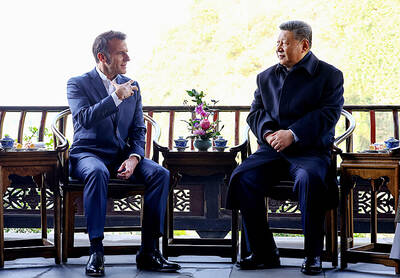
RELAXED: After talks on Ukraine and trade, the French president met with students while his wife visited pandas, after the pair parted ways with their Chinese counterparts French President Emmanuel Macron concluded his fourth state visit to China yesterday in Chengdu, striking a more relaxed note after tough discussions on Ukraine and trade with Chinese President Xi Jinping (習近平) a day earlier. Far from the imposing Great Hall of the People in Beijing where the two leaders held talks, Xi and China’s first lady, Peng Liyuan (彭麗媛), showed Macron and his wife Brigitte around the centuries-old Dujiangyan Dam, a World Heritage Site set against the mountainous landscape of Sichuan Province. Macron was told through an interpreter about the ancient irrigation system, which dates back to the third century


 RSS
RSS