


No one can escape Argentina’s biggest economic crisis in almost two decades — not even the dead.
The cost of buying, renting and maintaining graves and tombs is so high that many people opt to cremate their loved ones instead.
Juan Tapia runs the Cocheria Tacuari undertakers in Buenos Aires, which has been operating for 60 years.
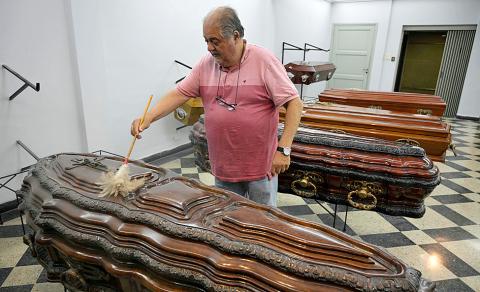
Photo: AFP
“It’s an economic problem. People don’t have enough money to pay for a service. Family members help each other, ask for loans — some come and pay with US dollars that they’ve saved or kept under the mattress,” Tapia said.
Undertakers are constantly forced to drop their prices “because unfortunately people don’t have the same spending power of a few years ago,” he said.
Paying for a funeral “means, for a family, that they might not eat this month,” he added.
The cheapest service offered by Cocheria Tacuari is a cremation without a wake, which costs 25,000 pesos (US$418) — almost 50 percent more than the minimum wage of 16,875 pesos a month.
More expensive options can cost up to 180,000 pesos, but few are interested in those.
“Almost 90 percent ask for cremation. Young people want nothing to do either with graves, niches [cubbies for storing remains urns] or tombs,” Tapia said.
His estimations are not far off official statistics.
Last year, 78.5 percent of corpses in Buenos Aires were cremated, according to public records. That is the highest proportion over the past decade.
“To lease a niche in the cemetery, you have to pay a huge amount every year, and many don’t want to and can’t do it, so they opt for a cremation,” Tapia said.
Rents at public cemeteries in Buenos Aires, including maintenance, range from 400 to 2,000 pesos a month.
In the private sector, plots sell for a minimum of 55,000 pesos with monthly maintenance from 500 pesos.
Cremation, on the other hand, does not incur long-term expenses.
As a result, dead bodies are often taken straight from hospital to crematorium in simple poplar wood coffins.
Patricia Alvarez, an English translator and makeup artist, three months ago advertised on the Internet a niche that her family had bought in the Chacarita public cemetery in Buenos Aires.
“I’m selling it because there’s no sense” in keeping it, she said when contacted about her advert — the only response she has had.
“It doesn’t cost much, 500 pesos a month, but when it builds up, it’s annoying, and it adds to a mountain of other expenses I already have,” she said.
The Alvarez’s niche looks to be in good condition, but others in the cemetery are in a sorry state, with notes attached to them asking the owners or leasers to “go and see the administration.”
Many tombs have been abandoned and overgrown with vegetation. Some have broken statues and there are niches that have been completely destroyed. In some, the bones are visible.
Standing beside her mother’s tomb, gloves and pruning shears in her hands, Maria has decided to stop paying the cemetery’s maintenance fees.
“I don’t think I’ll pay the 1,500 pesos a month any more to trim the vegetation — it’s a lot,” she said, preferring not to give her surname for fear of reprisals by the site’s maintenance personnel. “For this money, it’s better that I come and do it myself.”
However, Argentine Funerary Services Federation president Jorge Bonacorsi said that cost is not the only thing deterring people from traditional burials.
He says the rise in cremations is a global trend.
“What prevails now is a certain sentimental practicality — people want to get rid of the problem,” Bonacorsi said.

A plan by Switzerland’s right-wing People’s Party to cap the population at 10 million has the backing of almost half the country, according to a poll before an expected vote next year. The party, which has long campaigned against immigration, argues that too-fast population growth is overwhelming housing, transport and public services. The level of support comes despite the government urging voters to reject it, warning that strict curbs would damage the economy and prosperity, as Swiss companies depend on foreign workers. The poll by newspaper group Tamedia/20 Minuten and released yesterday showed that 48 percent of the population plan to vote

PARLIAMENT CHAOS: Police forcibly removed Brazilian Deputy Glauber Braga after he called the legislation part of a ‘coup offensive’ and occupied the speaker’s chair Brazil’s lower house of Congress early yesterday approved a bill that could slash former Brazilian president Jair Bolsonaro’s prison sentence for plotting a coup, after efforts by a lawmaker to disrupt the proceedings sparked chaos in parliament. Bolsonaro has been serving a 27-year term since last month after his conviction for a scheme to stop Brazilian President Luiz Inacio Lula da Silva from taking office after the 2022 election. Lawmakers had been discussing a bill that would significantly reduce sentences for several crimes, including attempting a coup d’etat — opening up the prospect that Bolsonaro, 70, could have his sentence cut to

A powerful magnitude 7.6 earthquake shook Japan’s northeast region late on Monday, prompting tsunami warnings and orders for residents to evacuate. A tsunami as high as three metres (10 feet) could hit Japan’s northeastern coast after an earthquake with an estimated magnitude of 7.6 occurred offshore at 11:15 p.m. (1415 GMT), the Japan Meteorological Agency (JMA) said. Tsunami warnings were issued for the prefectures of Hokkaido, Aomori and Iwate, and a tsunami of 40cm had been observed at Aomori’s Mutsu Ogawara and Hokkaido’s Urakawa ports before midnight, JMA said. The epicentre of the quake was 80 km (50 miles) off the coast of
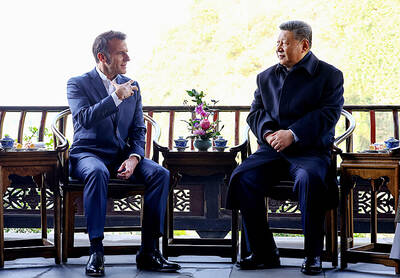
RELAXED: After talks on Ukraine and trade, the French president met with students while his wife visited pandas, after the pair parted ways with their Chinese counterparts French President Emmanuel Macron concluded his fourth state visit to China yesterday in Chengdu, striking a more relaxed note after tough discussions on Ukraine and trade with Chinese President Xi Jinping (習近平) a day earlier. Far from the imposing Great Hall of the People in Beijing where the two leaders held talks, Xi and China’s first lady, Peng Liyuan (彭麗媛), showed Macron and his wife Brigitte around the centuries-old Dujiangyan Dam, a World Heritage Site set against the mountainous landscape of Sichuan Province. Macron was told through an interpreter about the ancient irrigation system, which dates back to the third century


 RSS
RSS