


Indonesian rescuers yesterday mounted a desperate search for those missing after flash floods and landslides sparked by torrential rains killed at least 43 people across the Jakarta region while health authorities raced to prevent disease outbreaks.
Around a dozen people were still unaccounted for after record rains that started on New Year’s Eve pounded the capital and left swathes of the megalopolis, home to 30 million, under water and with thousands homeless.
Around 192,000 residents have been evacuated to temporary shelters, authorities said, with many unable to return to waterlogged homes in neighborhoods turned into wastelands of debris and overturned cars.
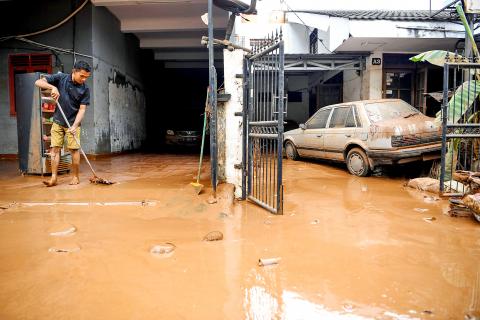
Photo: Antara Foto/Hafidz Mubarak/ via REUTERS
“We’re encouraging people whose houses are still inundated to go to a safer place,” National Disaster Mitigation Agency spokesperson Agus Wibowo said.
The agency said 43 people had been confirmed dead in Greater Jakarta and neighboring Lebak regency in the south of Java island.
Waters had receded in many areas and power, which had been shut off across many districts, was being restored.
In hard-hit Bekasi, on the outskirts of the city, swampy streets were littered with debris and crushed cars were lying on top of each other — with waterline marks reaching as high as the second floors of buildings.
The government said yesterday it would start cloud seeding to the west of the capital — inducing rain using chemicals sprayed from planes — to prevent approaching rainfall from pounding the region.
Using inflatable boats to evacuate residents trapped in their homes, including children and seniors, rescuers said they were targeting the hardest-hit areas of the city.
Shelters filled up with many refugees, including infants, resting on thin mats as food and drinking water ran low.
“It’s impossible for me to go back to my home,” 72-year-old Lumongga Siregar said.
“We have no clean water right now ... and we’re hoping for more food because there isn’t much,” she added.
Mother Dewi Puspitasari worried about her one-year-old daughter’s health.
“The blanket and mat I’ve got here aren’t thick enough for her and we’re scared she will get sick,” she said.
Indonesia’s health ministry said it deployed about 11,000 health workers and soldiers to distribute medicine, disinfectant hygiene kits and food in a bid to stave off outbreaks of hepatitis A, mosquito-borne dengue fever and other illnesses, including infections linked to contact with dead animals.
In Lebak, residents started the slow process of cleaning up their deluged homes.
“Everything’s gone,” said shop owner Aminah, who goes by one name.
“I couldn’t bring anything ... I left it all because I got scared at how high the water was getting,” Aminah said.
Around Jakarta, a family — including a four and nine-year-old — died of suspected gas poisoning from a portable power generator, while an eight-year-old boy killed in a landslide and an 82-year-old pensioner were also among the victims. Others died from drowning or hypothermia, while one 16-year-old boy was electrocuted by a power line.
Most services have been restored although some commuter train lines were still suspended yesterday.
Jakarta is regularly hit by floods during the rainy season, which started in late November.
However, this week’s disaster marked Jakarta’s worst flooding since 2013 when dozens were killed after the city was inundated by monsoon rains.
“This year’s flooding was phenomenally bad because of the extremely high rainfall,” Jakarta-based urban planning expert Yayat Supriatna said.
Jakarta’s myriad infrastructure problems, including poor drainage and rampant overdevelopment, worsened the situation, he added.
“Yes, the weather conditions were terrible, but this was exacerbated by awful urban planning,” Supriatna said.
Indonesian President Joko Widodo has announced a plan to move the country’s capital to Borneo island to take pressure off Jakarta.

A plan by Switzerland’s right-wing People’s Party to cap the population at 10 million has the backing of almost half the country, according to a poll before an expected vote next year. The party, which has long campaigned against immigration, argues that too-fast population growth is overwhelming housing, transport and public services. The level of support comes despite the government urging voters to reject it, warning that strict curbs would damage the economy and prosperity, as Swiss companies depend on foreign workers. The poll by newspaper group Tamedia/20 Minuten and released yesterday showed that 48 percent of the population plan to vote

PARLIAMENT CHAOS: Police forcibly removed Brazilian Deputy Glauber Braga after he called the legislation part of a ‘coup offensive’ and occupied the speaker’s chair Brazil’s lower house of Congress early yesterday approved a bill that could slash former Brazilian president Jair Bolsonaro’s prison sentence for plotting a coup, after efforts by a lawmaker to disrupt the proceedings sparked chaos in parliament. Bolsonaro has been serving a 27-year term since last month after his conviction for a scheme to stop Brazilian President Luiz Inacio Lula da Silva from taking office after the 2022 election. Lawmakers had been discussing a bill that would significantly reduce sentences for several crimes, including attempting a coup d’etat — opening up the prospect that Bolsonaro, 70, could have his sentence cut to

A powerful magnitude 7.6 earthquake shook Japan’s northeast region late on Monday, prompting tsunami warnings and orders for residents to evacuate. A tsunami as high as three metres (10 feet) could hit Japan’s northeastern coast after an earthquake with an estimated magnitude of 7.6 occurred offshore at 11:15 p.m. (1415 GMT), the Japan Meteorological Agency (JMA) said. Tsunami warnings were issued for the prefectures of Hokkaido, Aomori and Iwate, and a tsunami of 40cm had been observed at Aomori’s Mutsu Ogawara and Hokkaido’s Urakawa ports before midnight, JMA said. The epicentre of the quake was 80 km (50 miles) off the coast of

RELAXED: After talks on Ukraine and trade, the French president met with students while his wife visited pandas, after the pair parted ways with their Chinese counterparts French President Emmanuel Macron concluded his fourth state visit to China yesterday in Chengdu, striking a more relaxed note after tough discussions on Ukraine and trade with Chinese President Xi Jinping (習近平) a day earlier. Far from the imposing Great Hall of the People in Beijing where the two leaders held talks, Xi and China’s first lady, Peng Liyuan (彭麗媛), showed Macron and his wife Brigitte around the centuries-old Dujiangyan Dam, a World Heritage Site set against the mountainous landscape of Sichuan Province. Macron was told through an interpreter about the ancient irrigation system, which dates back to the third century


 RSS
RSS