


Conservatives led by Austrian People’s Party Chairman Sebastian Kurz on Wednesday agreed to form an unprecedented coalition government with the Greens, capping almost three months of negotiations.
“We have succeeded to unite the best of both worlds... It is possible to protect the climate and borders,” said Kurz, whose party gained the most votes in snap elections in September last year.
The polls were triggered after a corruption scandal engulfed Kurz’s far-right ally after just 18 months in a coalition government, during which the 33-year-old had carefully cultivated his image as a hardliner on immigration.
Greens leader Werner Kogler said the two disparate parties had managed to “build bridges” to form a government for “the future of Austria.”
It is to mark the first time the Green party has been in power. The ecologists made key gains in the elections, with the environment replacing immigration as the top concern of voters.
Kogler said that the Alpine nation — which has been among just a handful of EU nations that have seen their greenhouse-gas emissions continue to increase between 1990 and 2017 — would aim to become a front-runner in terms of fighting climate change in Europe.
The two leaders said that they would reform the tax system to lower the burden on Austrians — a key People’s Party promise — but at the same time introduce higher ecological taxes in line with the Greens’ campaign.
Kogler said transparency, including freedom of information, as well as fighting poverty among children, the elderly and women would also be a priority.
Analysts said that the new government would face challenges after Kurz’s previous rule with the far-right Freedom Party saw a raft of anti-immigration measures passed, sharply dividing Austrians.
Describing a deal as a “huge stretch,” analyst Thomas Hofer said that Kurz could lose voters he gained from the Freedom Party, when the People’s Party got 37.5 percent of the vote.
The Greens secured 13.9 percent of the vote, their best-ever result, due to the environment replacing immigration as top concern in the nation of 8.8 million people.
Hofer said that other European nations, such as Germany, could also see Conservative-Green coalitions. Sweden, Finland, Lithuania and Luxemburg already have Greens in government.
“Kurz is setting a certain trend maybe ahead of time and this is certainly something also on the international stage that he would be able to sell,” Hofer said.
Hofer described Kogler, who is expected to be vice chancellor, as a “pragmatist,” who had stabilized his party.
A congress of the party’s almost 280 delegates must endorse the coalition agreement, but are expected to do so.
“It’s a historical chance for them,” Hofer said.
As junior coalition partner, the Greens are expected to get four ministries, including an enlarged environment ministry that would also comprise infrastructure, traffic, energy and technology, a party representative familiar with the negotiations said.

A plan by Switzerland’s right-wing People’s Party to cap the population at 10 million has the backing of almost half the country, according to a poll before an expected vote next year. The party, which has long campaigned against immigration, argues that too-fast population growth is overwhelming housing, transport and public services. The level of support comes despite the government urging voters to reject it, warning that strict curbs would damage the economy and prosperity, as Swiss companies depend on foreign workers. The poll by newspaper group Tamedia/20 Minuten and released yesterday showed that 48 percent of the population plan to vote

PARLIAMENT CHAOS: Police forcibly removed Brazilian Deputy Glauber Braga after he called the legislation part of a ‘coup offensive’ and occupied the speaker’s chair Brazil’s lower house of Congress early yesterday approved a bill that could slash former Brazilian president Jair Bolsonaro’s prison sentence for plotting a coup, after efforts by a lawmaker to disrupt the proceedings sparked chaos in parliament. Bolsonaro has been serving a 27-year term since last month after his conviction for a scheme to stop Brazilian President Luiz Inacio Lula da Silva from taking office after the 2022 election. Lawmakers had been discussing a bill that would significantly reduce sentences for several crimes, including attempting a coup d’etat — opening up the prospect that Bolsonaro, 70, could have his sentence cut to

A powerful magnitude 7.6 earthquake shook Japan’s northeast region late on Monday, prompting tsunami warnings and orders for residents to evacuate. A tsunami as high as three metres (10 feet) could hit Japan’s northeastern coast after an earthquake with an estimated magnitude of 7.6 occurred offshore at 11:15 p.m. (1415 GMT), the Japan Meteorological Agency (JMA) said. Tsunami warnings were issued for the prefectures of Hokkaido, Aomori and Iwate, and a tsunami of 40cm had been observed at Aomori’s Mutsu Ogawara and Hokkaido’s Urakawa ports before midnight, JMA said. The epicentre of the quake was 80 km (50 miles) off the coast of
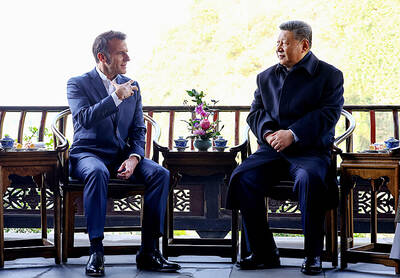
RELAXED: After talks on Ukraine and trade, the French president met with students while his wife visited pandas, after the pair parted ways with their Chinese counterparts French President Emmanuel Macron concluded his fourth state visit to China yesterday in Chengdu, striking a more relaxed note after tough discussions on Ukraine and trade with Chinese President Xi Jinping (習近平) a day earlier. Far from the imposing Great Hall of the People in Beijing where the two leaders held talks, Xi and China’s first lady, Peng Liyuan (彭麗媛), showed Macron and his wife Brigitte around the centuries-old Dujiangyan Dam, a World Heritage Site set against the mountainous landscape of Sichuan Province. Macron was told through an interpreter about the ancient irrigation system, which dates back to the third century


 RSS
RSS