


Rodeo season has got off to a rocky start in New Zealand, with protest numbers swelling outside events around the country.
About three dozen protesters yesterday chanted outside the Wanaka rodeo in the South Island — “there’s no excuse for animal abuse” — calling for an end to the sport, which they say is cruel and demeaning to the animals.
About 100 protesters also turned out at Warkworth rodeo near Auckland calling for a council ban.
The animal protection society SAFE said four animals died in rodeos in New Zealand last year, and the government needed to follow the lead of the UK in outlawing all events.
Earlier this year SAFE claimed its first victory after the Northland Mid Northern Rodeo Club canceled its rodeo due to financial pressures.
“Every year at the Wanaka rodeo, normally docile animals are bullied, abused or killed by so-called ‘cowboys,’” SAFE spokesman Will Appelbe said.
“The reality is that all animals used in rodeo are treated appallingly,” he said. “Horses, bulls and calves are all bullied and tormented purely so a few people can play ‘cowboy’ for the day.”
Of particular concern to SAFE was the use of “flank straps” on bulls and horses in rodeos, with the animals being “riled up” before the event and then fitted with the straps, which were pulled tight, causing them to buck in an attempt to remove the pressure, Appelbe said.
SAFE and other animal rights groups say rodeos place undue stress on the animals, as well as causing a litany of injuries including torn ligaments, broken bones, bruising and internal damage, particularly in the rope and tie and steer wrestling events, which use calves.
“Most people don’t realize they [bulls] are prey animals, so being ridden by a ‘cowboy’ makes them feel as if a predator has jumped on their back,” Appelbe said.
New Zealand’s rodeo is a small circuit, with just 35 events a year and 500 competitors, but it draws large crowds in the holiday season.
In the last few years major businesses such as Foodstuffs, Meridian Energy and House of Travel have withdrawn their sponsorship from rodeo events over animal welfare concerns, causing many clubs to struggle financially.
New Zealand Rodeo Cowboys Association president Lyall Cocks said vets are on duty at every event, monitoring animals welfare and removing any animals from competition that display signs of stress.
Animals are checked before and after they enter the arena, Cocks said.
Rodeos are a “lifeline” for isolated rural communities, Cocks said, adding that the events test real-life stockman skills with on-farm application.
So far the Labour Party coalition government has refused to cave to protesters demands, but animal rights groups say their protests would only get bigger, placing more pressure on the government in an election year.
For cowboy Chad Ormsby, the protesters are no more than an uncomfortable distraction, and he, like many in the rodeo community, criticize the activists for failing to understand their culture.
“I see our animals like children, they need training, education and respect — then they learn their job and what is expected of them,” Ormsby said.
“It is silly to think about hurting the animals or doing harm by them because in this world, we need them, we need to look after them,” he added.
Queenstown Vegan Society spokesperson Kat Gollop, who was protesting outside the Wanaka rodeo, said children should be taught to respect animals, but that would not happen when they were being “exploited in the name of entertainment.”
“Children attending rodeo are being desensitized to the distress, fear, and injury of animals,” Gallop said.
“In their pre-election campaign, the Labour Party promised to get rid of some of the cruelest aspects of rodeo events. They’ve failed to uphold those promises. We are now calling on the government to ban rodeos in New Zealand for good,” Gollop said.

A plan by Switzerland’s right-wing People’s Party to cap the population at 10 million has the backing of almost half the country, according to a poll before an expected vote next year. The party, which has long campaigned against immigration, argues that too-fast population growth is overwhelming housing, transport and public services. The level of support comes despite the government urging voters to reject it, warning that strict curbs would damage the economy and prosperity, as Swiss companies depend on foreign workers. The poll by newspaper group Tamedia/20 Minuten and released yesterday showed that 48 percent of the population plan to vote

PARLIAMENT CHAOS: Police forcibly removed Brazilian Deputy Glauber Braga after he called the legislation part of a ‘coup offensive’ and occupied the speaker’s chair Brazil’s lower house of Congress early yesterday approved a bill that could slash former Brazilian president Jair Bolsonaro’s prison sentence for plotting a coup, after efforts by a lawmaker to disrupt the proceedings sparked chaos in parliament. Bolsonaro has been serving a 27-year term since last month after his conviction for a scheme to stop Brazilian President Luiz Inacio Lula da Silva from taking office after the 2022 election. Lawmakers had been discussing a bill that would significantly reduce sentences for several crimes, including attempting a coup d’etat — opening up the prospect that Bolsonaro, 70, could have his sentence cut to

A powerful magnitude 7.6 earthquake shook Japan’s northeast region late on Monday, prompting tsunami warnings and orders for residents to evacuate. A tsunami as high as three metres (10 feet) could hit Japan’s northeastern coast after an earthquake with an estimated magnitude of 7.6 occurred offshore at 11:15 p.m. (1415 GMT), the Japan Meteorological Agency (JMA) said. Tsunami warnings were issued for the prefectures of Hokkaido, Aomori and Iwate, and a tsunami of 40cm had been observed at Aomori’s Mutsu Ogawara and Hokkaido’s Urakawa ports before midnight, JMA said. The epicentre of the quake was 80 km (50 miles) off the coast of
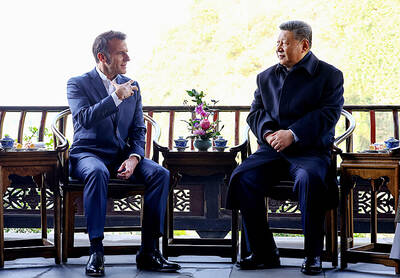
RELAXED: After talks on Ukraine and trade, the French president met with students while his wife visited pandas, after the pair parted ways with their Chinese counterparts French President Emmanuel Macron concluded his fourth state visit to China yesterday in Chengdu, striking a more relaxed note after tough discussions on Ukraine and trade with Chinese President Xi Jinping (習近平) a day earlier. Far from the imposing Great Hall of the People in Beijing where the two leaders held talks, Xi and China’s first lady, Peng Liyuan (彭麗媛), showed Macron and his wife Brigitte around the centuries-old Dujiangyan Dam, a World Heritage Site set against the mountainous landscape of Sichuan Province. Macron was told through an interpreter about the ancient irrigation system, which dates back to the third century


 RSS
RSS