


A partial new US-China trade agreement would be signed in the middle of this month, US President Donald Trump said on Tuesday, announcing that he would also then travel to China for continued talks.
Trump’s tweet, sent moments before Wall Street opened for the year’s final trading day, set a calendar date for an event that had hung in uncertainty in the past few weeks as details remained scant.
Washington and Beijing earlier this month announced a “phase pne” trade deal, de-escalating their nearly two-year trade dispute as Trump reduced or canceled some tariffs while Beijing promised to adopt trade reforms and buy more US farm exports.
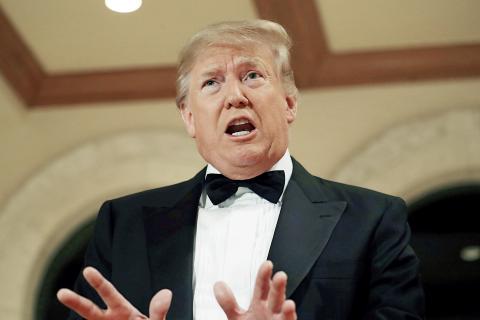
Photo: AP
The text has yet to be made public pending what US officials say is a largely technical review.
“I will be signing our very large and comprehensive Phase One Trade Deal with China on January 15,” Trump tweeted. “The ceremony will take place at the White House. High level representatives of China will be present.”
US and Chinese officials have said the agreement includes protections for intellectual property, food and farm goods, financial services and foreign exchange, and a provision for dispute resolution.
Under the new deal, China has committed to a minimum of US$200 billion in increased purchases over the next two years from US manufacturers, farmers, energy producers and service providers, US Trade Representative Robert Lighthizer said.
Trump said he would travel to Beijing to continue negotiations “at a later date” — showing willingness to pursue talks that have acrimoniously broken down more than once and left both sides to salvage a partial deal.
While the detente put a stop to further deterioration in the trade dispute, it leaves many of the barriers erected so far in place.
Trump canceled plans to impose tariffs on US$160 billion in Chinese merchandise on Dec. 13 — including hot consumer items such as mobile phones — but punishing US tariffs remain for about US$250 billion in Chinese-made goods, including machinery and many electronic items.
The two economic powers have been locked in a bruising trade dispute since the first half of 2018 that has roiled the global economy and helped send the manufacturing sector into decline.
Observers say in that time, the trade dispute might have ushered in a long-term decoupling of trade relations between the world’s two largest economies.
Americans cut merchandise purchases from China substantially last year, while their appetite for Mexican goods has grown.
The yawning US goods deficit with China fell 14.7 percent in the 10 months through October last year, but rose 29 percent with Mexico, official US figures showed.
What the two sides can accomplish in a potentially thornier “phase two” of negotiations — which could touch on Beijing’s sweeping market interventions and industrial subsidies — remains unclear.
US Office of Trade and Manufacturing Policy Director Peter Navarro on Tuesday told CNBC that the phase one agreement was only one plank in the Trump trade agenda, which encompasses other newly negotiated agreements in North America and Asia.
“Next year ... we’re going to try to get something going with Great Britain, Vietnam, Europe and anybody else who wants to fairly trade with the United States,” he said.

A plan by Switzerland’s right-wing People’s Party to cap the population at 10 million has the backing of almost half the country, according to a poll before an expected vote next year. The party, which has long campaigned against immigration, argues that too-fast population growth is overwhelming housing, transport and public services. The level of support comes despite the government urging voters to reject it, warning that strict curbs would damage the economy and prosperity, as Swiss companies depend on foreign workers. The poll by newspaper group Tamedia/20 Minuten and released yesterday showed that 48 percent of the population plan to vote

PARLIAMENT CHAOS: Police forcibly removed Brazilian Deputy Glauber Braga after he called the legislation part of a ‘coup offensive’ and occupied the speaker’s chair Brazil’s lower house of Congress early yesterday approved a bill that could slash former Brazilian president Jair Bolsonaro’s prison sentence for plotting a coup, after efforts by a lawmaker to disrupt the proceedings sparked chaos in parliament. Bolsonaro has been serving a 27-year term since last month after his conviction for a scheme to stop Brazilian President Luiz Inacio Lula da Silva from taking office after the 2022 election. Lawmakers had been discussing a bill that would significantly reduce sentences for several crimes, including attempting a coup d’etat — opening up the prospect that Bolsonaro, 70, could have his sentence cut to

A powerful magnitude 7.6 earthquake shook Japan’s northeast region late on Monday, prompting tsunami warnings and orders for residents to evacuate. A tsunami as high as three metres (10 feet) could hit Japan’s northeastern coast after an earthquake with an estimated magnitude of 7.6 occurred offshore at 11:15 p.m. (1415 GMT), the Japan Meteorological Agency (JMA) said. Tsunami warnings were issued for the prefectures of Hokkaido, Aomori and Iwate, and a tsunami of 40cm had been observed at Aomori’s Mutsu Ogawara and Hokkaido’s Urakawa ports before midnight, JMA said. The epicentre of the quake was 80 km (50 miles) off the coast of
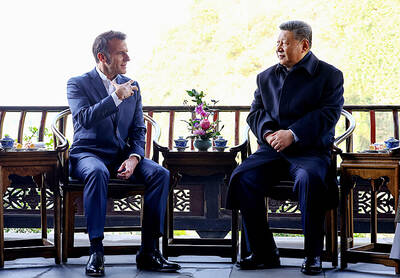
RELAXED: After talks on Ukraine and trade, the French president met with students while his wife visited pandas, after the pair parted ways with their Chinese counterparts French President Emmanuel Macron concluded his fourth state visit to China yesterday in Chengdu, striking a more relaxed note after tough discussions on Ukraine and trade with Chinese President Xi Jinping (習近平) a day earlier. Far from the imposing Great Hall of the People in Beijing where the two leaders held talks, Xi and China’s first lady, Peng Liyuan (彭麗媛), showed Macron and his wife Brigitte around the centuries-old Dujiangyan Dam, a World Heritage Site set against the mountainous landscape of Sichuan Province. Macron was told through an interpreter about the ancient irrigation system, which dates back to the third century


 RSS
RSS