


North Korean leader Kim Jong-un yesterday declared an end to moratoriums on nuclear and intercontinental ballistic missile tests, while threatening a demonstration of a “new strategic weapon.”
The announcement, reported by state media, amounted to Kim putting a missile “to [US President] Donald Trump’s head,” analysts said, warning that the escalation by Pyongyang would probably backfire.
Washington was swift to respond, with US Secretary of State Mike Pompeo urging Kim to “take a different course,” adding that the US wanted “peace not confrontation” with North Korea.

Photo: AP
Trump played down the development.
Pyongyang has previously fired missiles capable of reaching the US mainland and has carried out six nuclear tests, the last of them 16 times more powerful than the Hiroshima bomb, according to the highest estimates.
A self-imposed ban on such tests — Kim declared they were no longer needed — has been a centerpiece of nuclear diplomacy between Pyongyang and Washington over the past two years, which has seen three meetings between Kim and Trump, but little tangible progress.
Any test is likely to infuriate Trump, who has repeatedly referred to Kim’s “promise” to him not to carry them out and has downplayed launches of shorter-range weapons.
Negotiations between the two sides have been largely deadlocked since the breakup of a Hanoi summit in February last year and North Korea set the US an end-of-year deadline for it to offer fresh concessions on sanctions relief, or it would adopt a “new way.”
“There is no ground for us to get unilaterally bound to the commitment any longer,” Korean Central News Agency (KCNA) cited Kim as telling top officials.
“The world will witness a new strategic weapon to be possessed by the DPRK [Democratic People’s Republic of Korea] in the near future,” he added.
The full meeting of the central committee of the Workers’ Party was an indication of a major policy shift.
Kim acknowledged the impact of international sanctions imposed on Pyongyang over its weapons programs, but made it clear that North Korea was willing to pay the price to preserve its nuclear capability.
“The US is raising demands contrary to the fundamental interests of our state and is adopting a brigandish attitude,” KCNA cited him as saying.
Washington had “conducted tens of big and small joint military drills which its president personally promised to stop,” and sent high-tech military equipment to South Korea, he said.
Pyongyang for months has been demanding the easing of international sanctions imposed over its nuclear and ballistic missile programs, while Washington has insisted it takes more tangible steps toward giving them up.
“North Korea has, in effect, put an ICBM [intercontinental ballistic missile] to Donald Trump’s head in order to gain the two concessions it wants most: sanctions relief and some sort of security guarantee,” Washington-based Center for the National Interest director of defense studies Harry Kazianis said. “Kim Jong-un is playing a dangerous game of geopolitical chicken.”
The strategy is risky, he said, as Washington is likely to respond with “more sanctions, an increased military presence in East Asia, and more fire and fury style threats coming from Donald Trump’s Twitter account.”
Speaking to Fox News and CBS after Kim’s announcement, Pompeo said that a resumption of nuclear and missile tests would be “deeply disappointing.”
“We hope that Chairman Kim will take a different course ... that he’ll choose peace and prosperity over conflict and war,” Pompeo said. “We want peace, not confrontation.”
The South Korean Ministry of Unification said that a strategic weapon test “would not help denuclearization negotiations.”
Trump was emollient, saying that he thought Kim was “a man of his word,” and that at their Singapore summit “we did sign a contract, talking about denuclearization.”

A plan by Switzerland’s right-wing People’s Party to cap the population at 10 million has the backing of almost half the country, according to a poll before an expected vote next year. The party, which has long campaigned against immigration, argues that too-fast population growth is overwhelming housing, transport and public services. The level of support comes despite the government urging voters to reject it, warning that strict curbs would damage the economy and prosperity, as Swiss companies depend on foreign workers. The poll by newspaper group Tamedia/20 Minuten and released yesterday showed that 48 percent of the population plan to vote
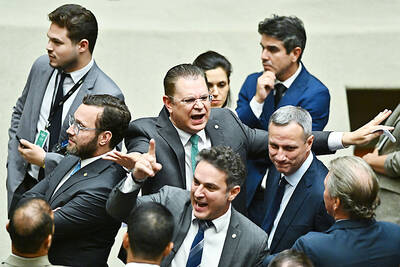
PARLIAMENT CHAOS: Police forcibly removed Brazilian Deputy Glauber Braga after he called the legislation part of a ‘coup offensive’ and occupied the speaker’s chair Brazil’s lower house of Congress early yesterday approved a bill that could slash former Brazilian president Jair Bolsonaro’s prison sentence for plotting a coup, after efforts by a lawmaker to disrupt the proceedings sparked chaos in parliament. Bolsonaro has been serving a 27-year term since last month after his conviction for a scheme to stop Brazilian President Luiz Inacio Lula da Silva from taking office after the 2022 election. Lawmakers had been discussing a bill that would significantly reduce sentences for several crimes, including attempting a coup d’etat — opening up the prospect that Bolsonaro, 70, could have his sentence cut to
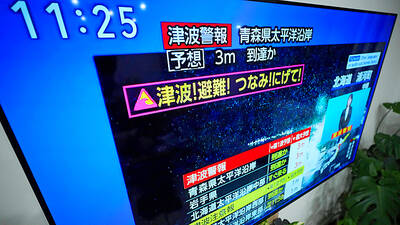
A powerful magnitude 7.6 earthquake shook Japan’s northeast region late on Monday, prompting tsunami warnings and orders for residents to evacuate. A tsunami as high as three metres (10 feet) could hit Japan’s northeastern coast after an earthquake with an estimated magnitude of 7.6 occurred offshore at 11:15 p.m. (1415 GMT), the Japan Meteorological Agency (JMA) said. Tsunami warnings were issued for the prefectures of Hokkaido, Aomori and Iwate, and a tsunami of 40cm had been observed at Aomori’s Mutsu Ogawara and Hokkaido’s Urakawa ports before midnight, JMA said. The epicentre of the quake was 80 km (50 miles) off the coast of
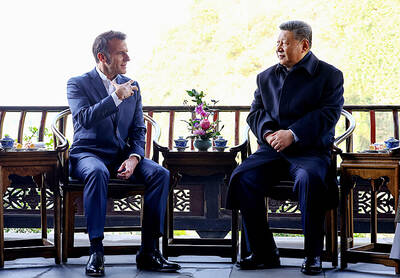
RELAXED: After talks on Ukraine and trade, the French president met with students while his wife visited pandas, after the pair parted ways with their Chinese counterparts French President Emmanuel Macron concluded his fourth state visit to China yesterday in Chengdu, striking a more relaxed note after tough discussions on Ukraine and trade with Chinese President Xi Jinping (習近平) a day earlier. Far from the imposing Great Hall of the People in Beijing where the two leaders held talks, Xi and China’s first lady, Peng Liyuan (彭麗媛), showed Macron and his wife Brigitte around the centuries-old Dujiangyan Dam, a World Heritage Site set against the mountainous landscape of Sichuan Province. Macron was told through an interpreter about the ancient irrigation system, which dates back to the third century


 RSS
RSS