


India’s tourism industry has been hit by a wave of violent anti-government protests against a new citizenship law that have rocked several cities this month, with at least seven countries issuing travel warnings.
At least 25 people have been killed in clashes between police and protesters, and demonstrations against the law continue.
Officials estimate about 200,000 domestic and international tourists canceled or postponed their trip to the Taj Mahal in the past two weeks, one of the world’s most popular tourist attractions.

Photo: Reuters
“There has been a 60 percent decline in visitor footfalls in December this year,” said Dinesh Kumar, a police inspector overseeing a special tourist police station near the Taj Mahal who has access to visitor data.
He said the decline was compared with December last year.
“Indian and foreign tourists have been calling our control rooms to check security. We assure them protection, but many still decide to stay away,” Kumar said.
The 17th-century marble monument is in Uttar Pradesh, the northern state that has witnessed the highest number of deaths and intense bursts of violence in two weeks of unrest.
A group of European tourists traveling in a group across India said they now planned to cut short their 20-day trip.
“We are all retired folks, for us travel has to be slow and relaxing. The newspaper headlines have led to a sense of concern and we will leave sooner than we had planned,” said Dave Millikin, a retired banker living on the outskirts of London, who spoke to reporters from the capital, New Delhi.
The Taj Mahal, located in the town of Agra, attracts more than 6.5 million tourists every year, generating nearly US$14 million annually from entrance fees. A foreign tourist pays 1,100 rupees (US$15.40) to enter the grounds, although nationals from neighboring countries get a discount.
Managers in luxury hotels and guest houses around the Taj Mahal said that last-minute cancelations during the festive season have further dampened business sentiment at a time when the country’s economic growth has slowed to 4.5 percent, its slowest pace in more than six years.
In a bid to clamp down on violence and unrest, authorities have suspended mobile Internet services in Agra.
“Blocking the Internet has affected travel and tourism in Agra by about 50-60 percent,” said Sandeep Arora, president of the Agra Tourism Development Foundation, which groups more than 250 tour operators, hotels and guides.
Taiwan, the US, the UK, Russia, Israel, Singapore and Canada have issued travel advisories asking their citizens to either refrain from visiting or to exercise caution when visiting regions embroiled in India’s protests.
Jayanta Malla Baruah, the head of the Assam Tourism Development Corp, said that the state, home to the world’s largest concentration of one-horned rhinoceroses, is visited on average by 500,000 tourists during December. “But this time, due to the ongoing protests and travel advisories by various countries, the number is down by 90 percent, if not more,” Baruah said.

A plan by Switzerland’s right-wing People’s Party to cap the population at 10 million has the backing of almost half the country, according to a poll before an expected vote next year. The party, which has long campaigned against immigration, argues that too-fast population growth is overwhelming housing, transport and public services. The level of support comes despite the government urging voters to reject it, warning that strict curbs would damage the economy and prosperity, as Swiss companies depend on foreign workers. The poll by newspaper group Tamedia/20 Minuten and released yesterday showed that 48 percent of the population plan to vote

PARLIAMENT CHAOS: Police forcibly removed Brazilian Deputy Glauber Braga after he called the legislation part of a ‘coup offensive’ and occupied the speaker’s chair Brazil’s lower house of Congress early yesterday approved a bill that could slash former Brazilian president Jair Bolsonaro’s prison sentence for plotting a coup, after efforts by a lawmaker to disrupt the proceedings sparked chaos in parliament. Bolsonaro has been serving a 27-year term since last month after his conviction for a scheme to stop Brazilian President Luiz Inacio Lula da Silva from taking office after the 2022 election. Lawmakers had been discussing a bill that would significantly reduce sentences for several crimes, including attempting a coup d’etat — opening up the prospect that Bolsonaro, 70, could have his sentence cut to

A powerful magnitude 7.6 earthquake shook Japan’s northeast region late on Monday, prompting tsunami warnings and orders for residents to evacuate. A tsunami as high as three metres (10 feet) could hit Japan’s northeastern coast after an earthquake with an estimated magnitude of 7.6 occurred offshore at 11:15 p.m. (1415 GMT), the Japan Meteorological Agency (JMA) said. Tsunami warnings were issued for the prefectures of Hokkaido, Aomori and Iwate, and a tsunami of 40cm had been observed at Aomori’s Mutsu Ogawara and Hokkaido’s Urakawa ports before midnight, JMA said. The epicentre of the quake was 80 km (50 miles) off the coast of
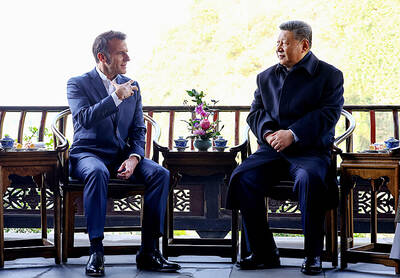
RELAXED: After talks on Ukraine and trade, the French president met with students while his wife visited pandas, after the pair parted ways with their Chinese counterparts French President Emmanuel Macron concluded his fourth state visit to China yesterday in Chengdu, striking a more relaxed note after tough discussions on Ukraine and trade with Chinese President Xi Jinping (習近平) a day earlier. Far from the imposing Great Hall of the People in Beijing where the two leaders held talks, Xi and China’s first lady, Peng Liyuan (彭麗媛), showed Macron and his wife Brigitte around the centuries-old Dujiangyan Dam, a World Heritage Site set against the mountainous landscape of Sichuan Province. Macron was told through an interpreter about the ancient irrigation system, which dates back to the third century


 RSS
RSS