


Chilean President Sebastian Pinera, whose government has been rocked by riots over inequality, ignited a fresh wave of anger after claiming that “many” videos on social media of police abuse of demonstrators were “fake news,” and that unrest was being fomented by foreign governments.
Pinera told CNN Chile in an interview that there had been a “gigantic” disinformation campaign, with videos circulating on Facebook, Instagram and Twitter that had been “filmed outside of Chile or misrepresented.”
“There has doubtless been some participation by foreign governments and institutions,” he said.
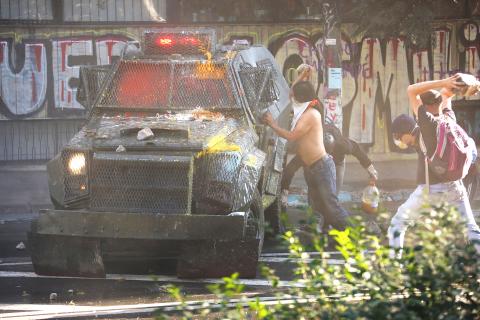
Photo: EPA-EFE
Pinera’s comments were first screened by CNN on Dec. 15, but only gained widespread renown on Thursday, when they became the subject of intense debate.
On Friday, after Santiago residents were called to a “K-pop rally” in the city’s central Plaza Italia, thousands of people gathered to bang pots and pans and chant anti-government slogans, with a massive deployment of police who moved in to disperse them with water cannon and tear gas.
Pinera has been blamed by the political opposition, human rights organizations and activist groups for failing to act more quickly on widespread claims of rights abuses by security forces policing the protests since they began over inequality on Oct. 18.
With more than 26 people killed during the unrest and thousands more injured and arrested, Pinera’s approval ratings have tumbled to as low as 10 percent.
The claims of foreign interference are not new: The US Department of State said that it had seen indications of Russian “influence” on the unrest, “skewing it through the use and abuse of social media, trolling.”
However, Pinera’s claims were met with fury from his political opponents and members of his own governing coalition, Chile Vamos.
Manuel Jose Ossandon, a senator for the center-right National Renewal party, told newspaper La Tercera: “Enough. Chile is living a decisive moment. These declarations don’t help, they divide.”
Sergio Micco, the head of the Chilean National Human Rights Institute, which has reviewed online content as part of an investigation into police handling of the protests, told a local radio station that while the group had seen misleading material, the “immense majority” was authentic.
Chilean Attorney General Jorge Abbott said: “At the moment, the images we have analyzed don’t fall in that category [of coming from abroad].”
On Thursday night, the president said on Twitter that he had not expressed himself “clearly enough,” adding that human rights abuses “should always be condemned.”
Last week, the government gave prosecutors a report it said had been sent to its intelligence agency by an undisclosed source that analyzed 5 million social media accounts tweeting at the peak of the unrest.
The report highlighted that one in five tweets about the unrest was generated outside of Chile, and among the most active accounts were fans of South Korea’s K-pop culture.
Friday’s call for a “K-pop rally” in Santiago included the ambitious promise of a closing concert by South Korean mega band BTS.
In the evening, as protesters gathered, the nearby Alameda Art Center, whose lobby has been used as a triage center by volunteer medics during the protests, was set alight and almost totally destroyed, Santiago firefighters said.
There were widespread claims on social media that the fire was started by a police tear gas canister, although firefighters said that they could not confirm the cause of the blaze and police did not respond to a request for comment.
Firefighters were also called to San Sebastian University in the nearby Bellavista neighborhood, which was significantly vandalized and set alight during the protest.

A plan by Switzerland’s right-wing People’s Party to cap the population at 10 million has the backing of almost half the country, according to a poll before an expected vote next year. The party, which has long campaigned against immigration, argues that too-fast population growth is overwhelming housing, transport and public services. The level of support comes despite the government urging voters to reject it, warning that strict curbs would damage the economy and prosperity, as Swiss companies depend on foreign workers. The poll by newspaper group Tamedia/20 Minuten and released yesterday showed that 48 percent of the population plan to vote
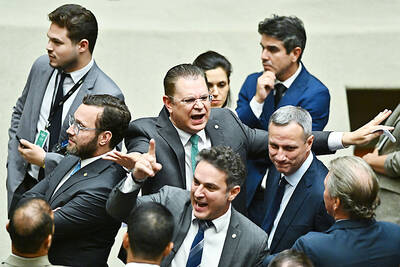
PARLIAMENT CHAOS: Police forcibly removed Brazilian Deputy Glauber Braga after he called the legislation part of a ‘coup offensive’ and occupied the speaker’s chair Brazil’s lower house of Congress early yesterday approved a bill that could slash former Brazilian president Jair Bolsonaro’s prison sentence for plotting a coup, after efforts by a lawmaker to disrupt the proceedings sparked chaos in parliament. Bolsonaro has been serving a 27-year term since last month after his conviction for a scheme to stop Brazilian President Luiz Inacio Lula da Silva from taking office after the 2022 election. Lawmakers had been discussing a bill that would significantly reduce sentences for several crimes, including attempting a coup d’etat — opening up the prospect that Bolsonaro, 70, could have his sentence cut to

A powerful magnitude 7.6 earthquake shook Japan’s northeast region late on Monday, prompting tsunami warnings and orders for residents to evacuate. A tsunami as high as three metres (10 feet) could hit Japan’s northeastern coast after an earthquake with an estimated magnitude of 7.6 occurred offshore at 11:15 p.m. (1415 GMT), the Japan Meteorological Agency (JMA) said. Tsunami warnings were issued for the prefectures of Hokkaido, Aomori and Iwate, and a tsunami of 40cm had been observed at Aomori’s Mutsu Ogawara and Hokkaido’s Urakawa ports before midnight, JMA said. The epicentre of the quake was 80 km (50 miles) off the coast of
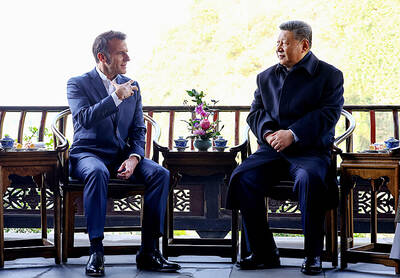
RELAXED: After talks on Ukraine and trade, the French president met with students while his wife visited pandas, after the pair parted ways with their Chinese counterparts French President Emmanuel Macron concluded his fourth state visit to China yesterday in Chengdu, striking a more relaxed note after tough discussions on Ukraine and trade with Chinese President Xi Jinping (習近平) a day earlier. Far from the imposing Great Hall of the People in Beijing where the two leaders held talks, Xi and China’s first lady, Peng Liyuan (彭麗媛), showed Macron and his wife Brigitte around the centuries-old Dujiangyan Dam, a World Heritage Site set against the mountainous landscape of Sichuan Province. Macron was told through an interpreter about the ancient irrigation system, which dates back to the third century


 RSS
RSS