


The UN General Assembly on Friday approved a resolution strongly condemning human rights abuses against Myanmar’s Rohingya Muslims and other minorities, including arbitrary arrests, torture, rape and deaths in detention.
The 193-member world body voted 134-9 with 28 abstentions in favor of the resolution, which also calls on the Burmese government to take urgent measures to combat incitement of hatred against the Rohingya and other minorities in Rakhine, Kachin and Shan states.
General Assembly resolutions are not legally binding, but they do reflect world opinion.
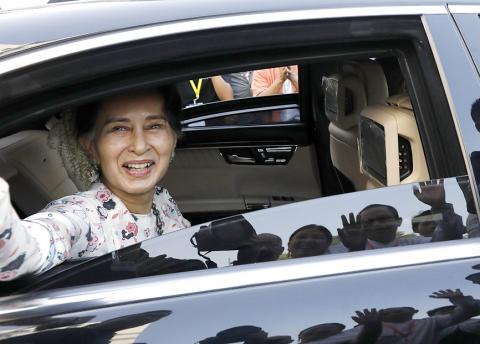
Photo: EPA-EFE
Buddhist-majority Myanmar has long considered the Rohingya to be “Bengalis” from Bangladesh, even though their families have lived in the country for generations.
Nearly all have been denied citizenship since 1982, effectively rendering them stateless, and they are also denied freedom of movement and other basic rights.
The long-simmering Rohingya crisis exploded on Aug. 25, 2017, when the Burmese military launched what it called a clearance campaign in Rakhine in response to an attack by a Rohingya insurgent group.
The campaign led to the mass Rohingya exodus to Bangladesh and to accusations that security forces committed mass rapes and killings, and burned thousands of homes.
Burmese Ambassador to the UN Hau Do Suan called the resolution “another classic example of double standards — selective and discriminatory application of human rights norms — to exert unwanted political pressure on Myanmar.”
The resolution did not attempt to find a solution to the complex situation in Rakhine state and refused to recognize government efforts to address the challenges, he said.
The resolution “will sow seeds of distrust and will create further polarization of different communities in the region,” he added.
The resolution expresses alarm at the movement of Rohingya Muslims to neighboring Bangladesh over the past four decades — numbering 1.1 million, including the 744,000 who arrived since August 2017 — “in the aftermath of atrocities committed by the security and armed forces of Myanmar.”
The assembly expressed alarm at an independent international fact-finding mission’s uncovering “of gross human rights violations and abuses suffered by Rohingya Muslims and other minorities” by the security forces, which the mission said “undoubtedly amount to the gravest crimes under international law.”
The resolution called for an immediate cessation of fighting and hostilities.
It expressed “deep distress at reports that unarmed individuals in Rakhine state have been and continue to be subjected to the excessive use of force and violations of international human rights law, international humanitarian law by the military, and security and armed forces.”
It also called for Burmese forces to protect all people and for urgent steps to ensure justice for all rights violations.

A plan by Switzerland’s right-wing People’s Party to cap the population at 10 million has the backing of almost half the country, according to a poll before an expected vote next year. The party, which has long campaigned against immigration, argues that too-fast population growth is overwhelming housing, transport and public services. The level of support comes despite the government urging voters to reject it, warning that strict curbs would damage the economy and prosperity, as Swiss companies depend on foreign workers. The poll by newspaper group Tamedia/20 Minuten and released yesterday showed that 48 percent of the population plan to vote

PARLIAMENT CHAOS: Police forcibly removed Brazilian Deputy Glauber Braga after he called the legislation part of a ‘coup offensive’ and occupied the speaker’s chair Brazil’s lower house of Congress early yesterday approved a bill that could slash former Brazilian president Jair Bolsonaro’s prison sentence for plotting a coup, after efforts by a lawmaker to disrupt the proceedings sparked chaos in parliament. Bolsonaro has been serving a 27-year term since last month after his conviction for a scheme to stop Brazilian President Luiz Inacio Lula da Silva from taking office after the 2022 election. Lawmakers had been discussing a bill that would significantly reduce sentences for several crimes, including attempting a coup d’etat — opening up the prospect that Bolsonaro, 70, could have his sentence cut to

A powerful magnitude 7.6 earthquake shook Japan’s northeast region late on Monday, prompting tsunami warnings and orders for residents to evacuate. A tsunami as high as three metres (10 feet) could hit Japan’s northeastern coast after an earthquake with an estimated magnitude of 7.6 occurred offshore at 11:15 p.m. (1415 GMT), the Japan Meteorological Agency (JMA) said. Tsunami warnings were issued for the prefectures of Hokkaido, Aomori and Iwate, and a tsunami of 40cm had been observed at Aomori’s Mutsu Ogawara and Hokkaido’s Urakawa ports before midnight, JMA said. The epicentre of the quake was 80 km (50 miles) off the coast of

RELAXED: After talks on Ukraine and trade, the French president met with students while his wife visited pandas, after the pair parted ways with their Chinese counterparts French President Emmanuel Macron concluded his fourth state visit to China yesterday in Chengdu, striking a more relaxed note after tough discussions on Ukraine and trade with Chinese President Xi Jinping (習近平) a day earlier. Far from the imposing Great Hall of the People in Beijing where the two leaders held talks, Xi and China’s first lady, Peng Liyuan (彭麗媛), showed Macron and his wife Brigitte around the centuries-old Dujiangyan Dam, a World Heritage Site set against the mountainous landscape of Sichuan Province. Macron was told through an interpreter about the ancient irrigation system, which dates back to the third century


 RSS
RSS