


Embattled Israeli Prime Minister Benjamin Netanyahu yesterday declared a “huge” victory after winning a leadership primary that ensures he is to lead his right-wing Likud party into March elections.
Israel’s longest-serving prime minister, who faces a corruption indictment and a third general election in 12 months, was expected to beat rival Gideon Saar, but the convincing margin of victory strengthened his position in the party that he has dominated for 20 years.
With all votes counted, Likud early yesterday announced that Netanyahu had secured 72.5 percent, with Saar winning 27.5 percent.
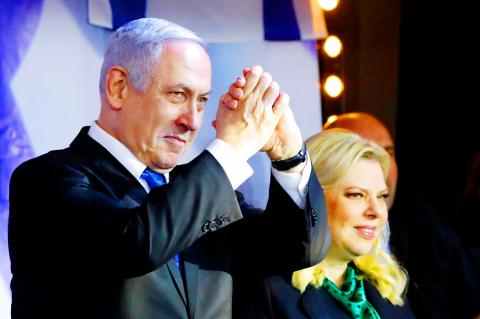
Photo: AFP
“A huge win. Thank you to Likud members for their trust, support and love,” Netanyahu tweeted. “With God’s and your help, I will lead Likud to a big victory in the upcoming elections and we will continue to lead the state of Israel to unprecedented achievements.”
About 57,000 Likud members — a little less than 50 percent of those eligible — on Thursday cast their ballots across the country.
Saar, a former minister of the interior perceived to be to the right of Netanyahu, campaigned on the basis that the prime minister was no longer able to win elections after deadlocked polls in April and September.
“I am content with my decision to have stood. Those who are unwilling to take a risk for what they believe in will never succeed,” Saar tweeted. “My colleagues and I will stand behind [Netanyahu] in campaigning for the Likud’s success.”
He announced his leadership challenge last month after the Israeli attorney general indicted the prime minister for fraud, bribery and breach of trust.
Netanyahu, 70, denies the allegations, accusing the police, prosecutors and the media of a witch hunt.
Stephan Miller, a pollster who has worked on multiple Israeli campaigns, said that Netanyahu had campaigned harder than ever before to defeat Saar.
Netanyahu held multiple campaign events a day in different parts of the country, while on Thursday his Facebook page broadcast live video of him phoning supporters.
“His job was on the line and he fought to keep it successfully,” Miller said.
Netanyahu’s downfall has been predicted multiple times since he was elected for a second term in 2009, but he has defied expectations and beaten off multiple potential rivals.
He is likely to remain prime minister at least until new elections on March 2.
Likud and the centrist Blue and White party were near neck-and-neck after polls in March and September, with neither able to form a coalition under the country’s proportional system.
Early polls indicate that the third round could again be a stalemate.
In the short term, attention will turn to Netanyahu’s legal woes.
Netanyahu is accused of corruption in three separate cases, ranging from receiving illegal gifts of thousands of dollars to offering to change a regulatory framework in exchange for positive media coverage.
The Israeli Supreme Court on Tuesday is expected to hold a hearing on whether a prime minister that has been indicted can form a government.
The result could embolden Netanyahu in his campaign against the charges, Hebrew University political science professor Gayil Talshir said.
“He is going to argue that the people chose him, and not the mechanisms and the judiciary,” Talshir said. “The big game for Netanyahu is immunity and for that he needs 61 votes [in the 120-seat Israeli parliament].”

A plan by Switzerland’s right-wing People’s Party to cap the population at 10 million has the backing of almost half the country, according to a poll before an expected vote next year. The party, which has long campaigned against immigration, argues that too-fast population growth is overwhelming housing, transport and public services. The level of support comes despite the government urging voters to reject it, warning that strict curbs would damage the economy and prosperity, as Swiss companies depend on foreign workers. The poll by newspaper group Tamedia/20 Minuten and released yesterday showed that 48 percent of the population plan to vote

PARLIAMENT CHAOS: Police forcibly removed Brazilian Deputy Glauber Braga after he called the legislation part of a ‘coup offensive’ and occupied the speaker’s chair Brazil’s lower house of Congress early yesterday approved a bill that could slash former Brazilian president Jair Bolsonaro’s prison sentence for plotting a coup, after efforts by a lawmaker to disrupt the proceedings sparked chaos in parliament. Bolsonaro has been serving a 27-year term since last month after his conviction for a scheme to stop Brazilian President Luiz Inacio Lula da Silva from taking office after the 2022 election. Lawmakers had been discussing a bill that would significantly reduce sentences for several crimes, including attempting a coup d’etat — opening up the prospect that Bolsonaro, 70, could have his sentence cut to

A powerful magnitude 7.6 earthquake shook Japan’s northeast region late on Monday, prompting tsunami warnings and orders for residents to evacuate. A tsunami as high as three metres (10 feet) could hit Japan’s northeastern coast after an earthquake with an estimated magnitude of 7.6 occurred offshore at 11:15 p.m. (1415 GMT), the Japan Meteorological Agency (JMA) said. Tsunami warnings were issued for the prefectures of Hokkaido, Aomori and Iwate, and a tsunami of 40cm had been observed at Aomori’s Mutsu Ogawara and Hokkaido’s Urakawa ports before midnight, JMA said. The epicentre of the quake was 80 km (50 miles) off the coast of
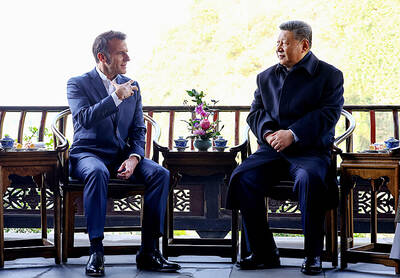
RELAXED: After talks on Ukraine and trade, the French president met with students while his wife visited pandas, after the pair parted ways with their Chinese counterparts French President Emmanuel Macron concluded his fourth state visit to China yesterday in Chengdu, striking a more relaxed note after tough discussions on Ukraine and trade with Chinese President Xi Jinping (習近平) a day earlier. Far from the imposing Great Hall of the People in Beijing where the two leaders held talks, Xi and China’s first lady, Peng Liyuan (彭麗媛), showed Macron and his wife Brigitte around the centuries-old Dujiangyan Dam, a World Heritage Site set against the mountainous landscape of Sichuan Province. Macron was told through an interpreter about the ancient irrigation system, which dates back to the third century


 RSS
RSS