


A colorful cast of political novices who won Hong Kong’s local elections are attending cram courses and trading tips on how to take the fight to the territory’s pro-Beijing establishment in their own neighborhoods.
Last month’s landslide victory for the pro-democracy camp was a clarion call for change after six months of huge and increasingly violent protests against the government of Beijing-backed Hong Kong Chief Executive Carrie Lam (林鄭月娥).
The territory’s district councils are the only elections in which Hong Kongers can vote for every seat — and they did so in record numbers this year.

Photo: AFP
Pro-democracy candidates won 392 of 452 races, seizing all but one of the territory’s 18 districts during a poll that was widely seen as a barometer of seething public anger toward Beijing’s rule.
Yet many of those elected openly admit they are political newcomers who would never would have dreamed of running had Beijing and Lam not spent months digging in against the protests.
“I thought I would lose. To be honest, I don’t have enough experience,” said Chan Tsz-wai (陳梓維), a 26-year-old convenience store worker who wrote his manifesto by hand.
He managed to unseat a rising star of the Democratic Alliance for Betterment — Hong Kong’s largest and wealthiest pro-Beijing party — in Yau Tsim Mong, a district that has seen some of the fiercest battles between protesters and riot police.
“We are all fumbling our way across the river,” added Richard Chan (陳振哲), a 47-year-old funeral home director, who won in his district of Tai Po.
He recently attended a series of cram courses for new councilors, detailing duties such as balancing the books, running public meetings and how to hire assistants.
Hong Kong’s district councils deal with bread-and-butter issues such as bus timetables and garbage collections.
However, pro-democracy candidates are strategizing on how to maximize their influence where they can.
Chan Tsz-wai plans to focus on pursuing police and local authorities over Aug. 31, a night when police were filmed beating demonstrators inside the Prince Edward subway station.
“I hope we can investigate this on a district level,” he said. “I understand that the power of district council is very weak, but I will do my best.”
Richard Chan is getting a team together to scrutinize a large housing project with one of the territory’s biggest property developers.
Sky-high housing costs fuel Hong Kong’s political crisis, with public anger palpable over the pro-Beijing establishment’s cozy links with tycoons.
“What most needs to be changed is the cronyism,” he said.
Jocelyn Chau (仇栩欣), a former client manager in a bank, was launched from obscurity to eventual political office when she live-streamed her arrest earlier in the year.
The 23-year-old won a seat in North Point, an area that has a long history of support for the pro-Beijing establishment.
She plans to focus on services for young people, a demographic that she said was often ignored by the pro-Beijing parties and have formed the backbone of this year’s protests.
“I will continue to look after the needs of the elderly, while allocating more resources to cater the young people and families in my communities,” she said.
Beijing forbids Hong Kongers from directly electing their leader — a stance which lies at the heart of the territory’s political unrest.
The position is instead chosen by a 1,200-strong committee stacked with pro-Beijing political and business figures who reliably return a party loyalist.
However, after last month’s landslide district council victories, the pro-democracy camp would have control of about 117 votes on the committee — not enough to swing a vote, but possibly enough to influence the debate over what kind of leader Hong Kong needs.
The next leader is to be chosen in 2022. Lam — who won 777 votes to take office — boasts record-low approval ratings.
“The [local] election results told us people wanted change,” Richard Chan said.
Some councilors have said they must reach across the ideological divide that permeates Hong Kong.
Cary Lo Chun-yu (盧俊宇) became a hero to the protest movement in the local elections when he toppled one of the most controversial pro-Beijing figures, outspoken Hong Kong Legislator Junius Ho (何君堯).
Ho was stabbed on the campaign trail by a man who pretended to be a fan, and his face is routinely plastered on the ground for people to walk on.
However, Lo said bridges needed to be built, adding that Ho received 100 more votes than the last election and only lost because of the high turnout of pro-democracy supporters.
“We can’t neglect that there are different people supporting Ho,” he said.

A plan by Switzerland’s right-wing People’s Party to cap the population at 10 million has the backing of almost half the country, according to a poll before an expected vote next year. The party, which has long campaigned against immigration, argues that too-fast population growth is overwhelming housing, transport and public services. The level of support comes despite the government urging voters to reject it, warning that strict curbs would damage the economy and prosperity, as Swiss companies depend on foreign workers. The poll by newspaper group Tamedia/20 Minuten and released yesterday showed that 48 percent of the population plan to vote

PARLIAMENT CHAOS: Police forcibly removed Brazilian Deputy Glauber Braga after he called the legislation part of a ‘coup offensive’ and occupied the speaker’s chair Brazil’s lower house of Congress early yesterday approved a bill that could slash former Brazilian president Jair Bolsonaro’s prison sentence for plotting a coup, after efforts by a lawmaker to disrupt the proceedings sparked chaos in parliament. Bolsonaro has been serving a 27-year term since last month after his conviction for a scheme to stop Brazilian President Luiz Inacio Lula da Silva from taking office after the 2022 election. Lawmakers had been discussing a bill that would significantly reduce sentences for several crimes, including attempting a coup d’etat — opening up the prospect that Bolsonaro, 70, could have his sentence cut to

A powerful magnitude 7.6 earthquake shook Japan’s northeast region late on Monday, prompting tsunami warnings and orders for residents to evacuate. A tsunami as high as three metres (10 feet) could hit Japan’s northeastern coast after an earthquake with an estimated magnitude of 7.6 occurred offshore at 11:15 p.m. (1415 GMT), the Japan Meteorological Agency (JMA) said. Tsunami warnings were issued for the prefectures of Hokkaido, Aomori and Iwate, and a tsunami of 40cm had been observed at Aomori’s Mutsu Ogawara and Hokkaido’s Urakawa ports before midnight, JMA said. The epicentre of the quake was 80 km (50 miles) off the coast of
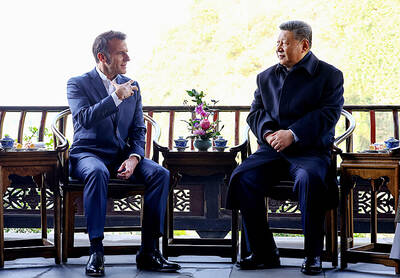
RELAXED: After talks on Ukraine and trade, the French president met with students while his wife visited pandas, after the pair parted ways with their Chinese counterparts French President Emmanuel Macron concluded his fourth state visit to China yesterday in Chengdu, striking a more relaxed note after tough discussions on Ukraine and trade with Chinese President Xi Jinping (習近平) a day earlier. Far from the imposing Great Hall of the People in Beijing where the two leaders held talks, Xi and China’s first lady, Peng Liyuan (彭麗媛), showed Macron and his wife Brigitte around the centuries-old Dujiangyan Dam, a World Heritage Site set against the mountainous landscape of Sichuan Province. Macron was told through an interpreter about the ancient irrigation system, which dates back to the third century


 RSS
RSS