


New Zealand authorities yesterday said that their country would be a safer place after owners handed in more than 50,000 guns during a buyback program following a ban on assault weapons, but critics have said that the process is flawed and that many owners have illegally stashed their firearms.
The government banned the most lethal types of semi-automatic weapons less than a month after a lone gunman in March killed 51 worshipers at two Christchurch mosques. The police then launched a six-month program to buy the newly banned weapons from owners.
The buyback ended at midnight on Friday, with gun collection events staying open late as police reported a surge in last-minute returns.
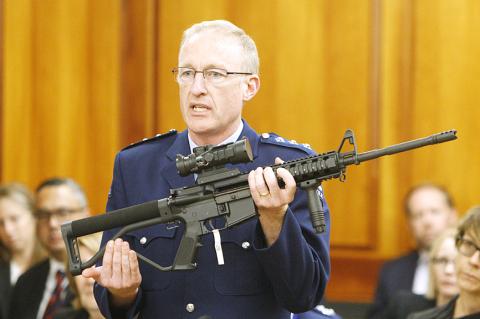
Photo: AP
Provisional figures indicate that 33,000 people handed in 51,000 guns, and that another 5,000 guns were turned in as part of a parallel amnesty program, in which owners could hand over any type of firearm without any questions being asked, but without getting compensated.
Owners also modified another 2,700 guns to make them legally compliant, while police said that they seized an additional 1,800 guns from gangs since March.
Police said that they are in the process of collecting another 1,600 guns from gun dealers.
Criminals would find it more difficult to get their hands on assault weapons, because they tend to steal them from lawful owners, but those weapons would now be out of circulation, New Zealand Minister of Police Stuart Nash told reporters yesterday.
Police Deputy Commissioner Mike Clement thanked gun owners for doing the right thing.
He acknowledged in a statement that it had been “a difficult process for some people.”
Both Nash and Clement said that the country is now safer than it was before the March attacks.
However, Nicole McKee, spokeswoman for the advocacy group Council of Licensed Firearms Owners, said that owners have kept about two-thirds of the banned weapons, because they have lost faith in the government and have not been offered adequate compensation.
“They never overcame being blamed by authorities for being somehow responsible for a heinous act of terrorism — something they would never do,” McKee said.
The ban on assault weapons was strongly backed by lawmakers in an historic 119-1 vote after the mosque attacks. Lawmakers are now considering additional restrictions, including creating a register to track all guns.
Police figures indicate that the government paid out just more than NZ$100 million (US$66.04 million) to compensate owners during the buyback.

A plan by Switzerland’s right-wing People’s Party to cap the population at 10 million has the backing of almost half the country, according to a poll before an expected vote next year. The party, which has long campaigned against immigration, argues that too-fast population growth is overwhelming housing, transport and public services. The level of support comes despite the government urging voters to reject it, warning that strict curbs would damage the economy and prosperity, as Swiss companies depend on foreign workers. The poll by newspaper group Tamedia/20 Minuten and released yesterday showed that 48 percent of the population plan to vote

PARLIAMENT CHAOS: Police forcibly removed Brazilian Deputy Glauber Braga after he called the legislation part of a ‘coup offensive’ and occupied the speaker’s chair Brazil’s lower house of Congress early yesterday approved a bill that could slash former Brazilian president Jair Bolsonaro’s prison sentence for plotting a coup, after efforts by a lawmaker to disrupt the proceedings sparked chaos in parliament. Bolsonaro has been serving a 27-year term since last month after his conviction for a scheme to stop Brazilian President Luiz Inacio Lula da Silva from taking office after the 2022 election. Lawmakers had been discussing a bill that would significantly reduce sentences for several crimes, including attempting a coup d’etat — opening up the prospect that Bolsonaro, 70, could have his sentence cut to

A powerful magnitude 7.6 earthquake shook Japan’s northeast region late on Monday, prompting tsunami warnings and orders for residents to evacuate. A tsunami as high as three metres (10 feet) could hit Japan’s northeastern coast after an earthquake with an estimated magnitude of 7.6 occurred offshore at 11:15 p.m. (1415 GMT), the Japan Meteorological Agency (JMA) said. Tsunami warnings were issued for the prefectures of Hokkaido, Aomori and Iwate, and a tsunami of 40cm had been observed at Aomori’s Mutsu Ogawara and Hokkaido’s Urakawa ports before midnight, JMA said. The epicentre of the quake was 80 km (50 miles) off the coast of
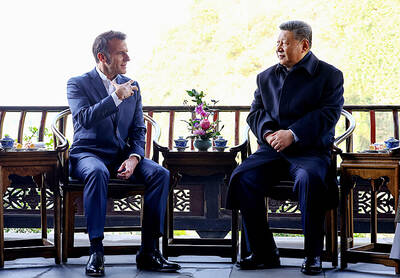
RELAXED: After talks on Ukraine and trade, the French president met with students while his wife visited pandas, after the pair parted ways with their Chinese counterparts French President Emmanuel Macron concluded his fourth state visit to China yesterday in Chengdu, striking a more relaxed note after tough discussions on Ukraine and trade with Chinese President Xi Jinping (習近平) a day earlier. Far from the imposing Great Hall of the People in Beijing where the two leaders held talks, Xi and China’s first lady, Peng Liyuan (彭麗媛), showed Macron and his wife Brigitte around the centuries-old Dujiangyan Dam, a World Heritage Site set against the mountainous landscape of Sichuan Province. Macron was told through an interpreter about the ancient irrigation system, which dates back to the third century


 RSS
RSS