


Bolivia’s attorney general on Wednesday ordered the arrest of exiled former Bolivian president Evo Morales after the interim government accused him of sedition and terrorism.
Public prosecutors in La Paz signed a warrant for police to detain the 60-year-old — who is in Argentina — and take him to the attorney general’s office.
Morales last month fled Bolivia after civil unrest broke out following his re-election in an Oct. 20 poll widely dismissed as rigged.

Photo: AP
The former trade union leader denounced the arrest order as “illegal, unfair and unconstitutional.”
“I’m not worried. As long as I’m alive I’ll continue with greater strength in the political and ideological struggle for a free and sovereign Bolivia,” Morales said on Twitter.
Morales governed the South American country for almost 14 years before resigning last month and leaving Bolivia.
He initially received asylum in Mexico and then traveled to Argentina last week.
The allegations against him stem from an audio recording released by Bolivian Minister of Government Arturo Murillo.
In the recording, Morales allegedly tells one of his supporters to block trucks and interrupt the food supply to several cities.
Morales was in Mexico at the time, the complaint alleges.
Murillo last month began legal action against Morales, after weeks of roadblocks caused food and fuel shortages in La Paz following his resignation.
The former president countered by accusing the interim government of manufacturing the recording to damage him politically.
The controversial October poll was annulled following an Organization of American States audit that found clear evidence of vote-rigging.
Right-wing then-Bolovian Senate president Jeanine Anez took over as interim president and has vowed to call new elections early next year, although no date has been set.
The interim government has barred Morales from standing in the ballot.
Bolivia’s constitution limits a president to two consecutive terms, but Morales stood for a potential fourth term in October.
Ahead of the past two elections, the Bolivian Plurinational Constitutional Tribunal — filled with Morales loyalists — made controversial decisions authorizing him to run again.
His detractors accused him of corruption and authoritarianism.
Speaking from Buenos Aires on Tuesday, Morales pledged to back another candidate from his Movement for Socialism party.
“I’m convinced that we’ll win the next elections. I won’t be a candidate, but I have a right to be in politics,” Morales told reporters.
“My obligation now that I’m not a candidate, now that I’m not president, is to accompany candidates so that they can win the elections,” added Morales, who was Bolivia’s first-ever indigenous president.
He previously insisted that he had been the victim of a coup, and has launched near-daily Twitter attacks against Anez and her allies.

A plan by Switzerland’s right-wing People’s Party to cap the population at 10 million has the backing of almost half the country, according to a poll before an expected vote next year. The party, which has long campaigned against immigration, argues that too-fast population growth is overwhelming housing, transport and public services. The level of support comes despite the government urging voters to reject it, warning that strict curbs would damage the economy and prosperity, as Swiss companies depend on foreign workers. The poll by newspaper group Tamedia/20 Minuten and released yesterday showed that 48 percent of the population plan to vote

PARLIAMENT CHAOS: Police forcibly removed Brazilian Deputy Glauber Braga after he called the legislation part of a ‘coup offensive’ and occupied the speaker’s chair Brazil’s lower house of Congress early yesterday approved a bill that could slash former Brazilian president Jair Bolsonaro’s prison sentence for plotting a coup, after efforts by a lawmaker to disrupt the proceedings sparked chaos in parliament. Bolsonaro has been serving a 27-year term since last month after his conviction for a scheme to stop Brazilian President Luiz Inacio Lula da Silva from taking office after the 2022 election. Lawmakers had been discussing a bill that would significantly reduce sentences for several crimes, including attempting a coup d’etat — opening up the prospect that Bolsonaro, 70, could have his sentence cut to

A powerful magnitude 7.6 earthquake shook Japan’s northeast region late on Monday, prompting tsunami warnings and orders for residents to evacuate. A tsunami as high as three metres (10 feet) could hit Japan’s northeastern coast after an earthquake with an estimated magnitude of 7.6 occurred offshore at 11:15 p.m. (1415 GMT), the Japan Meteorological Agency (JMA) said. Tsunami warnings were issued for the prefectures of Hokkaido, Aomori and Iwate, and a tsunami of 40cm had been observed at Aomori’s Mutsu Ogawara and Hokkaido’s Urakawa ports before midnight, JMA said. The epicentre of the quake was 80 km (50 miles) off the coast of
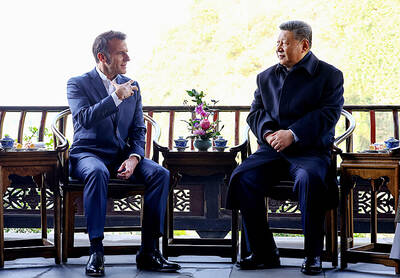
RELAXED: After talks on Ukraine and trade, the French president met with students while his wife visited pandas, after the pair parted ways with their Chinese counterparts French President Emmanuel Macron concluded his fourth state visit to China yesterday in Chengdu, striking a more relaxed note after tough discussions on Ukraine and trade with Chinese President Xi Jinping (習近平) a day earlier. Far from the imposing Great Hall of the People in Beijing where the two leaders held talks, Xi and China’s first lady, Peng Liyuan (彭麗媛), showed Macron and his wife Brigitte around the centuries-old Dujiangyan Dam, a World Heritage Site set against the mountainous landscape of Sichuan Province. Macron was told through an interpreter about the ancient irrigation system, which dates back to the third century


 RSS
RSS