


Chinese President Xi Jinping (習近平) yesterday landed in Macau as the territory prepares to mark 20 years since the former Portuguese colony was returned to China, a celebration that stands in stark contrast with months of unrest in neighboring Hong Kong.
Security has been ramped up ahead of Xi’s three-day visit, which culminates on tomorrow’s anniversary.
China’s authoritarian leadership is eager to showcase Macau as a successful example of its “one country, two systems” model, with party leaders heaping praise on a pliant territory of 700,000 that has grown rich on gambling and deference to authoritarian rule.
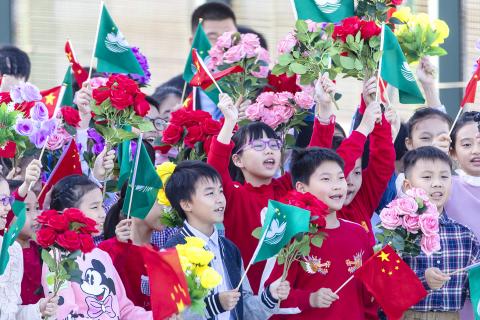
Photo: Bloomberg
Since the 1999 handover by Lisbon, Macau has witnessed little of the dissent that has exploded in Hong Kong during six months of often violent pro-democracy protests as large chunks of the population seethes under Beijing’s rule.
Limited details have been released regarding Xi’s schedule.
Today, he is to meet local leaders, and attend a dinner and a cultural performance. Tomorrow, Xi is to preside over the inauguration of incoming Macanese chief executive Ho Iat Seng (賀一誠).
Ho won a one-horse race this summer to become chief executive — a position that is chosen by a 400-member committee stacked with Beijing loyalists.
Security has been tightened ahead of Xi’s visit to a territory that long ago passed mainland-style anti-sedition laws.
Police set up checkpoints and extra screenings for passenger arrivals, while authorities said that some major roads would see closures.
The territory’s first light rail line announced that it would shut down for the duration, just a week after Macau Light Rapid Transit was first opened to the public, while Macau International Airport said that some flights would be rescheduled.
Security checks were also increased in Hong Kong’s ferry terminals and on the Hong Kong–Zhuhai–Macau Bridge linking the two territories.
Authorities in Macau routinely deny the few requests that are made to hold rallies and the territory’s more authoritarian streak has been on display in the run-up to the anniversary, as multiple journalists with Hong Kong passports working for local and international media have been denied entry, while a group of pro-democracy lawmakers were denied permission to board a ferry yesterday.
“It’s totally one country, one system,” a 34-year-old local who regularly travels to Hong Kong said, adding that protesting in Macau is “pointless and dangerous.”
“The reason it looks like it’s working well is because Macau people don’t protest,” he added.
However, he said that there was local anger about the wealth of the territory’s elites, the limited transport infrastructure and severe overcrowding, even though the population have become wealthier.
Macau’s skyline and economy have changed beyond recognition since four centuries of Portuguese rule ended in 1999, with glittering casinos the backbone of the territory’s dramatic rise.
As the only place in China where gambling is allowed, Macau’s GDP has soared from US$6.4 billion in 1999 to more than US$55 billion.
Per capita GDP is the third-highest in the world behind Luxembourg and Switzerland, according to the IMF, while its casinos rake in each week the same as Las Vegas makes in a month.
However, while Macau has grown rich and been politically stable in the 20 years of Chinese rule, it has many vulnerabilities.
Much of the territory’s wealth is concentrated in the hands of a small elite and all of its economic chips are in the gambling basket, which still accounts for 80 percent of government revenue.

A plan by Switzerland’s right-wing People’s Party to cap the population at 10 million has the backing of almost half the country, according to a poll before an expected vote next year. The party, which has long campaigned against immigration, argues that too-fast population growth is overwhelming housing, transport and public services. The level of support comes despite the government urging voters to reject it, warning that strict curbs would damage the economy and prosperity, as Swiss companies depend on foreign workers. The poll by newspaper group Tamedia/20 Minuten and released yesterday showed that 48 percent of the population plan to vote
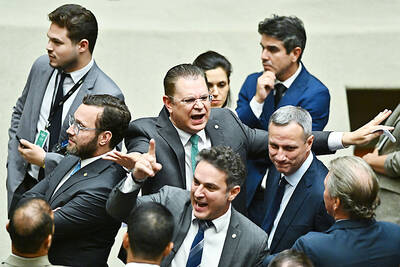
PARLIAMENT CHAOS: Police forcibly removed Brazilian Deputy Glauber Braga after he called the legislation part of a ‘coup offensive’ and occupied the speaker’s chair Brazil’s lower house of Congress early yesterday approved a bill that could slash former Brazilian president Jair Bolsonaro’s prison sentence for plotting a coup, after efforts by a lawmaker to disrupt the proceedings sparked chaos in parliament. Bolsonaro has been serving a 27-year term since last month after his conviction for a scheme to stop Brazilian President Luiz Inacio Lula da Silva from taking office after the 2022 election. Lawmakers had been discussing a bill that would significantly reduce sentences for several crimes, including attempting a coup d’etat — opening up the prospect that Bolsonaro, 70, could have his sentence cut to

A powerful magnitude 7.6 earthquake shook Japan’s northeast region late on Monday, prompting tsunami warnings and orders for residents to evacuate. A tsunami as high as three metres (10 feet) could hit Japan’s northeastern coast after an earthquake with an estimated magnitude of 7.6 occurred offshore at 11:15 p.m. (1415 GMT), the Japan Meteorological Agency (JMA) said. Tsunami warnings were issued for the prefectures of Hokkaido, Aomori and Iwate, and a tsunami of 40cm had been observed at Aomori’s Mutsu Ogawara and Hokkaido’s Urakawa ports before midnight, JMA said. The epicentre of the quake was 80 km (50 miles) off the coast of
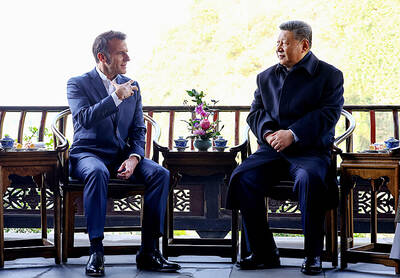
RELAXED: After talks on Ukraine and trade, the French president met with students while his wife visited pandas, after the pair parted ways with their Chinese counterparts French President Emmanuel Macron concluded his fourth state visit to China yesterday in Chengdu, striking a more relaxed note after tough discussions on Ukraine and trade with Chinese President Xi Jinping (習近平) a day earlier. Far from the imposing Great Hall of the People in Beijing where the two leaders held talks, Xi and China’s first lady, Peng Liyuan (彭麗媛), showed Macron and his wife Brigitte around the centuries-old Dujiangyan Dam, a World Heritage Site set against the mountainous landscape of Sichuan Province. Macron was told through an interpreter about the ancient irrigation system, which dates back to the third century


 RSS
RSS