


Rohingya refugees accused Burmese pro-democracy icon Aung San Suu Kyi of lying to the International Court of Justice in her testimony on Wednesday in which she denied that her country’s armed forces were guilty of genocide against the Muslim minority group.
Aung San Suu Kyi, who is now Myanmar’s leader, told the court that the exodus of hundreds of thousands of Rohingya Muslims to neighboring Bangladesh was the unfortunate result of a battle with insurgents.
She denied that the army had killed civilians, raped women and torched houses in 2017. Critics describe the actions by the army as a deliberate campaign of ethnic cleansing and genocide that forced more than 700,000 Rohingya to flee.
“The world will judge their claim of no genocide with evidence,” said a Rohingya leader, Mohammed Mohibullah, who is chairman of the Arakan Rohingya Society for Peace and Human Rights.
“A thief never admits he is a thief, but justice can be delivered through evidence. The world has obtained evidence from us,” he said at the Kutupalong refugee camp in Bangladesh’s Cox’s Bazar district.
“Even if [Aung San] Suu Kyi lies, she won’t be spared. She will certainly face justice. The world should take steps against her,” he said.
Nur Kamal, another refugee at Kutupalong, also rejected Aung San Suu Kyi’s testimony.
“The military cordoned off people and killed them by opening fire, setting them ablaze — isn’t this genocide? Will this be justified if [Aung San] Suu Kyi says so?” he said.
“The world will not accept that. The whole world has seen the level of torture of us. It is still going on,” he added.
A legal team from Gambia, acting on behalf of the 57-country Organization of Islamic Cooperation, asked the International Court of Justice in The Hague to take “all measures within its power to prevent all acts that amount to or contribute to the crime of genocide” in Myanmar.
Gambia alleged that genocide was committed and is ongoing.
Aung San Suu Kyi accused Gambia of providing a misleading and incomplete account of what happened in Myanmar’s Rakhine state in August 2017.
Her appearance at the court was striking in that she was defending the same military that kept her under house arrest for about 15 years.
She was awarded the 1991 Nobel Peace Prize in absentia for championing democracy and rights under Myanmar’s then-ruling junta.
Buddhist-majority Myanmar has consistently denied violating human rights and says that military operations in Rakhine state, where most Rohingya lived, were justified in response to attacks on security posts by Rohingya insurgents.
A UN-established investigation earlier recommended the prosecution of Myanmar’s top military commanders on charges of genocide, war crimes and crimes against humanity for the crackdown on the Rohingya.
Earlier this year, the UN Independent International Fact-Finding Mission on Myanmar said rapes of Rohingya by Burmese security forces were systemic and demonstrated the intent to commit genocide.
It said in a report that the discrimination that Myanmar practiced against the Rohingya in peacetime aggravated the sexual violence toward them during times of conflict.
Bangladesh and Myanmar have signed an agreement to start the repatriation of Rohingya refugees from Bangladesh, but two attempts failed when no one came forward to return voluntarily, citing continuing security concerns in Myanmar.

A plan by Switzerland’s right-wing People’s Party to cap the population at 10 million has the backing of almost half the country, according to a poll before an expected vote next year. The party, which has long campaigned against immigration, argues that too-fast population growth is overwhelming housing, transport and public services. The level of support comes despite the government urging voters to reject it, warning that strict curbs would damage the economy and prosperity, as Swiss companies depend on foreign workers. The poll by newspaper group Tamedia/20 Minuten and released yesterday showed that 48 percent of the population plan to vote

PARLIAMENT CHAOS: Police forcibly removed Brazilian Deputy Glauber Braga after he called the legislation part of a ‘coup offensive’ and occupied the speaker’s chair Brazil’s lower house of Congress early yesterday approved a bill that could slash former Brazilian president Jair Bolsonaro’s prison sentence for plotting a coup, after efforts by a lawmaker to disrupt the proceedings sparked chaos in parliament. Bolsonaro has been serving a 27-year term since last month after his conviction for a scheme to stop Brazilian President Luiz Inacio Lula da Silva from taking office after the 2022 election. Lawmakers had been discussing a bill that would significantly reduce sentences for several crimes, including attempting a coup d’etat — opening up the prospect that Bolsonaro, 70, could have his sentence cut to

A powerful magnitude 7.6 earthquake shook Japan’s northeast region late on Monday, prompting tsunami warnings and orders for residents to evacuate. A tsunami as high as three metres (10 feet) could hit Japan’s northeastern coast after an earthquake with an estimated magnitude of 7.6 occurred offshore at 11:15 p.m. (1415 GMT), the Japan Meteorological Agency (JMA) said. Tsunami warnings were issued for the prefectures of Hokkaido, Aomori and Iwate, and a tsunami of 40cm had been observed at Aomori’s Mutsu Ogawara and Hokkaido’s Urakawa ports before midnight, JMA said. The epicentre of the quake was 80 km (50 miles) off the coast of
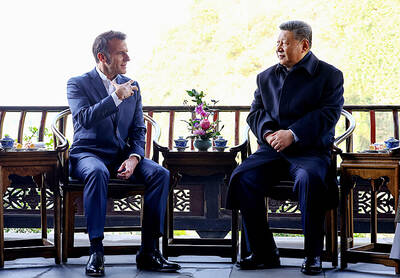
RELAXED: After talks on Ukraine and trade, the French president met with students while his wife visited pandas, after the pair parted ways with their Chinese counterparts French President Emmanuel Macron concluded his fourth state visit to China yesterday in Chengdu, striking a more relaxed note after tough discussions on Ukraine and trade with Chinese President Xi Jinping (習近平) a day earlier. Far from the imposing Great Hall of the People in Beijing where the two leaders held talks, Xi and China’s first lady, Peng Liyuan (彭麗媛), showed Macron and his wife Brigitte around the centuries-old Dujiangyan Dam, a World Heritage Site set against the mountainous landscape of Sichuan Province. Macron was told through an interpreter about the ancient irrigation system, which dates back to the third century


 RSS
RSS