


Record commodity prices and low global interest rates have encouraged African nations to borrow like they did in the 1990s, but some are now struggling to pay up as their revenue slows along with economic growth.
Government debt as a percentage of GDP in sub-Saharan Africa has doubled in the past decade, heading back toward the level it reached in 2000.
IMF managing director Kristalina Georgieva last month said that this was a cause for concern.
Of the 54 countries on the continent, 20 are near or at distressed levels, according to the IMF, which means they face difficulties honoring their obligations.
African governments have raised about US$26 billion in international markets this year, from close to US$30 billion last year, as they took advantage of investors’ thirst for returns in a world awash with negative yields.
Volatile currencies across the continent increase the risks of borrowing in hard currency and the rising cost of serving debt could crowd out other expenditure in a region that is home to more than half of the world’s poor people.
“The conditions are ripe for a much higher level of debt distress,” Sonja Gibbs, head of sustainable finance at the Institute of International Finance, said by telephone. “Whatever triggers the next crisis, when it happens, you are likely to see a high degree of contagion risk because investors have been moving into higher yielding assets.”
Still, the continent is far from a debt crisis, its biggest multilateral lender said.
“Some individual countries are getting to higher levels in terms of debt-to-GDP ratios, that’s the concern,” African Development Bank president Akinwumi Adesina said in an interview.
The debt-to-GDP ratio of Africa is still “well within acceptable limits,” he said.
More reliance on commercial bonds has raised servicing costs, diverting funds that could be spent on new roads or schools. Nigeria, the continent’s top oil producer, spends about the same amount every year on repaying debt as it does on infrastructure.
Countries such as South Africa, the continent’s most industrialized economy, are raising debt levels and this year had its biggest eurobond issuance yet to help plug a widening budget deficit as economic growth slows, and public-sector wages and bailouts for state companies sap resources.
External debt paymentsnow eat up on average about 13 percent of the revenue of African governments from 4.7 percent in 2010, data compiled by the UK-based Jubilee Debt Campaign showed.
Overspending and crashing commodity prices in the 1990s led to a debt crisis that prompted multilateral lenders and rich nations to write off the obligations of dozens of African countries in 2005. This time around a debt pardon might not be that easy.

A plan by Switzerland’s right-wing People’s Party to cap the population at 10 million has the backing of almost half the country, according to a poll before an expected vote next year. The party, which has long campaigned against immigration, argues that too-fast population growth is overwhelming housing, transport and public services. The level of support comes despite the government urging voters to reject it, warning that strict curbs would damage the economy and prosperity, as Swiss companies depend on foreign workers. The poll by newspaper group Tamedia/20 Minuten and released yesterday showed that 48 percent of the population plan to vote

PARLIAMENT CHAOS: Police forcibly removed Brazilian Deputy Glauber Braga after he called the legislation part of a ‘coup offensive’ and occupied the speaker’s chair Brazil’s lower house of Congress early yesterday approved a bill that could slash former Brazilian president Jair Bolsonaro’s prison sentence for plotting a coup, after efforts by a lawmaker to disrupt the proceedings sparked chaos in parliament. Bolsonaro has been serving a 27-year term since last month after his conviction for a scheme to stop Brazilian President Luiz Inacio Lula da Silva from taking office after the 2022 election. Lawmakers had been discussing a bill that would significantly reduce sentences for several crimes, including attempting a coup d’etat — opening up the prospect that Bolsonaro, 70, could have his sentence cut to

A powerful magnitude 7.6 earthquake shook Japan’s northeast region late on Monday, prompting tsunami warnings and orders for residents to evacuate. A tsunami as high as three metres (10 feet) could hit Japan’s northeastern coast after an earthquake with an estimated magnitude of 7.6 occurred offshore at 11:15 p.m. (1415 GMT), the Japan Meteorological Agency (JMA) said. Tsunami warnings were issued for the prefectures of Hokkaido, Aomori and Iwate, and a tsunami of 40cm had been observed at Aomori’s Mutsu Ogawara and Hokkaido’s Urakawa ports before midnight, JMA said. The epicentre of the quake was 80 km (50 miles) off the coast of
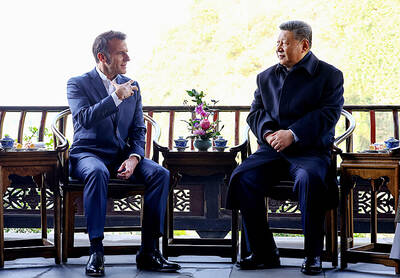
RELAXED: After talks on Ukraine and trade, the French president met with students while his wife visited pandas, after the pair parted ways with their Chinese counterparts French President Emmanuel Macron concluded his fourth state visit to China yesterday in Chengdu, striking a more relaxed note after tough discussions on Ukraine and trade with Chinese President Xi Jinping (習近平) a day earlier. Far from the imposing Great Hall of the People in Beijing where the two leaders held talks, Xi and China’s first lady, Peng Liyuan (彭麗媛), showed Macron and his wife Brigitte around the centuries-old Dujiangyan Dam, a World Heritage Site set against the mountainous landscape of Sichuan Province. Macron was told through an interpreter about the ancient irrigation system, which dates back to the third century


 RSS
RSS